
Delhi sees more protests as ‘cockroach’ group’s leaders released
-
Published
A court in Indian capital Delhi has released the top leaders of the Gen Z-led Cockroach Janta Party (CJP) as the city sees more protests for a second day with thousands of security personnel deployed and roads barricaded.
Abhijeet Dipke – who began the movement in May after India’s Chief Justice likened some jobless young people to “cockroaches” – and other leaders were arrested on arrival in Delhi on Saturday to lead protests seeking electoral reforms.
In his first comments after his release, Dipke said “the CJP will neither back down nor be intimidated”.
On Saturday, media reports said, 7,000 demonstrators were detained and released late at night.
The CJP – which is not registered as a political party in India – is seeking electoral reforms just months before crucial state elections.
It has also demanded the resignation of Chief Election Commissioner (CEC) Gyanesh Kumar over allegations of manipulating voters’ lists – which the Election Commission has denied.
On Sunday morning, the CJP lawyer Ratna Singh said she had been informed by the police that Dipke and two other senior CJP leaders – Saurav Das and Ashutosh Ranka – would be produced before the magistrate by the police seeking their remand “to maintain public peace”.
She subsequently posted on X that the three had been set free by the court “on the condition that they will not engage in breach of peace for one year” – she later deleted the post about the condition and it’s not clear what that means and whether the CJP leaders can take part in protests.
After his release, Dipke posted on X, external, saying: “Modi, as PM, is an embarrassment to India.”
In another post, external, he said he was going to his village to attend his grandmother’s funeral who died around the time of his arrest yesterday.
“Heading back to my village to be with my family during this moment of grief,” he posted, adding that Das and Ranka would address a press conference in Delhi.
“The CJP will neither back down nor be intimidated,” he added.
Saturday saw dramatic scenes as police officials boarded the flight to detain Dipke, Das and Ranka as their plane landed.
To play this video you need to enable JavaScript in your browser.
This video can not be played
Police had refused permission for Saturday’s protest to take place at Jantar Mantar, a landmark in the Indian capital, and the city was in a virtual lockdown with unprecedented curbs in place to thwart the protesters from reaching the venue.
At least 45 metro stations were closed and Delhi’s main railway stations were shut with major train services cancelled. Many protesters attempting to travel from outside were de-boarded en route. Internet was also curtailed in central Delhi for the entire day.
For a second day in a row on Sunday, much of central Delhi has roads barricaded and offices, shops and restaurants shut and internet services curtailed.
In Connaught Place, one of Delhi’s busiest shopping and entertainment hubs, there are rows upon rows of bright yellow police barricades, guarded by thousands of police and paramilitary personnel.
While some shops were open, people working here said they were worried about how the day would unfold.
Protesters have returned to the area for a second consecutive day, but, for now, they are vastly outnumbered by security personnel and the BBC has witnessed many detentions.
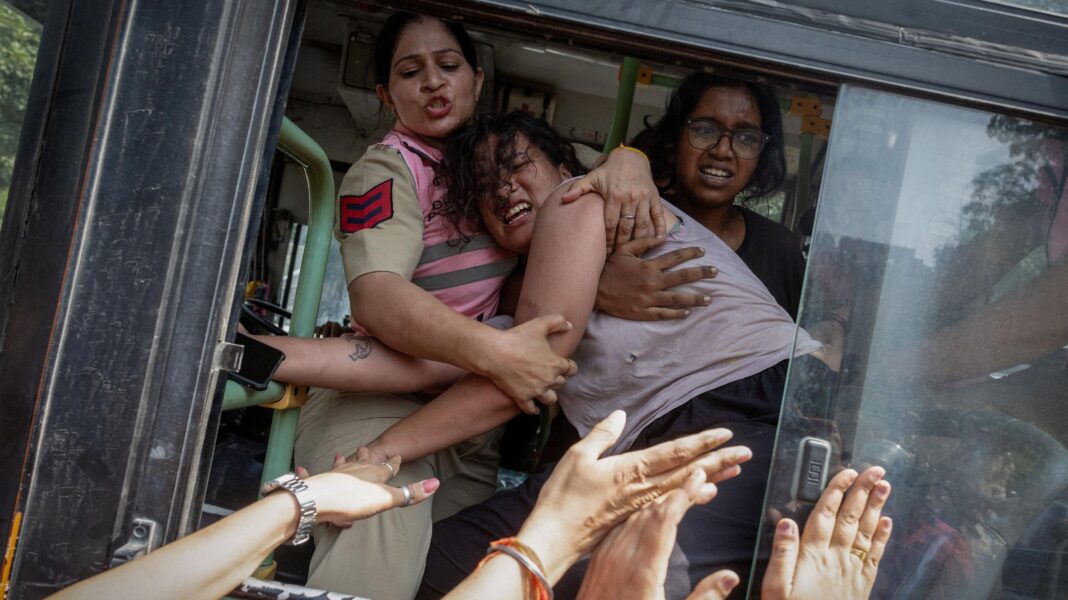
Some were put into buses before being driven away. Some could be seen peering through the windows, others trying to push their way out while shouting “Gyanesh must go!” At one point, an entire bus reverberated with similar chants.
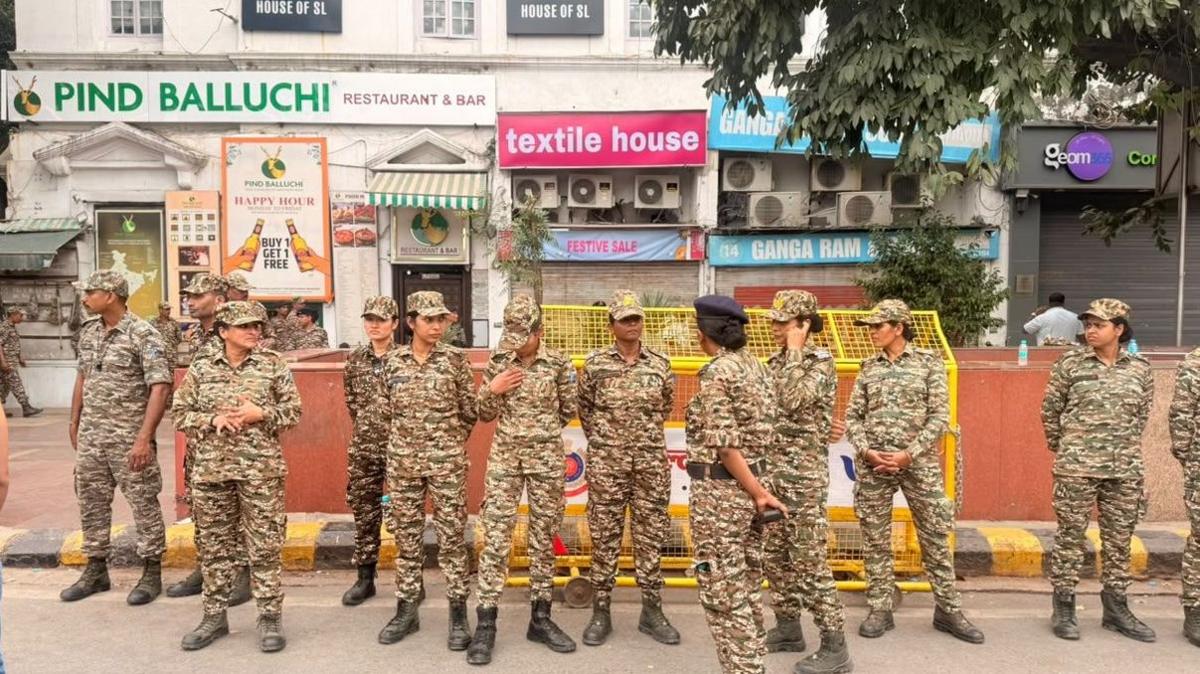
The CJP had called for a protest on Saturday at Jantar Mantar – the road that the demonstrators had occupied for weeks earlier this summer seeking education reforms.
But it remained barricaded at both ends, guarded by thousands of police and paramilitary personnel.
After the police detained the CJP leaders and other activists, lawyers and students leaders, the CJP called for more protests on Sunday.
On Sunday, the Indian Supreme Court held a special hearing to deal with complaints of shutdowns and detentions.
The court ordered the government to restore internet and ensure that metro and rail services functioned normally, unless there was disturbance to public order. The court also said that free movement of people should be permitted and there should be no illegal detention.
To play this video you need to enable JavaScript in your browser.
This video can not be played
Why are people protesting?
The row centres over a mammoth exercise to update electoral rolls nationwide – the commission has said it’s a routine exercise to weed out dead, duplicate or ineligible voters.
At least 130 million voter names have been purged from the rolls so far and in many states, the exercise has been shrouded in controversy, with tens of thousands of people alleging they have been wrongly removed.
The CJP – and opposition parties – accuse Kumar of favouring Prime Minister Narendra Modi’s Bharatiya Janata Party (BJP) in the way the electoral rolls are being updated.
The Election Commission and the BJP have denied this.
The CJP first emerged as a major protest movement during weeks of demonstrations over the summer demanding education reforms and the resignation of Education Minister Dharmendra Pradhan.
The group stemmed from a joke made by Dipke in response to a remark by Chief Justice Surya Kant, who had likened jobless youngsters to “cockroaches”. He later said the comments were misinterpreted.
Dipke, who previously worked with the opposition Aam Aadmi Party (AAP), had just completed a master’s degree at Boston University when he posted a question on X in May: “What if all cockroaches come together?”
The post went viral, and the CJP was born. Momentum built around the movement which tapped into anger over unemployment, exam paper leaks and government accountability.
Their five-week-long protest ended in celebration for the protesters in July after the resignation of India’s education minister.
-
-
Published2 days ago
-
-
-
Published1 day ago
-
-
-
Published2 October
-