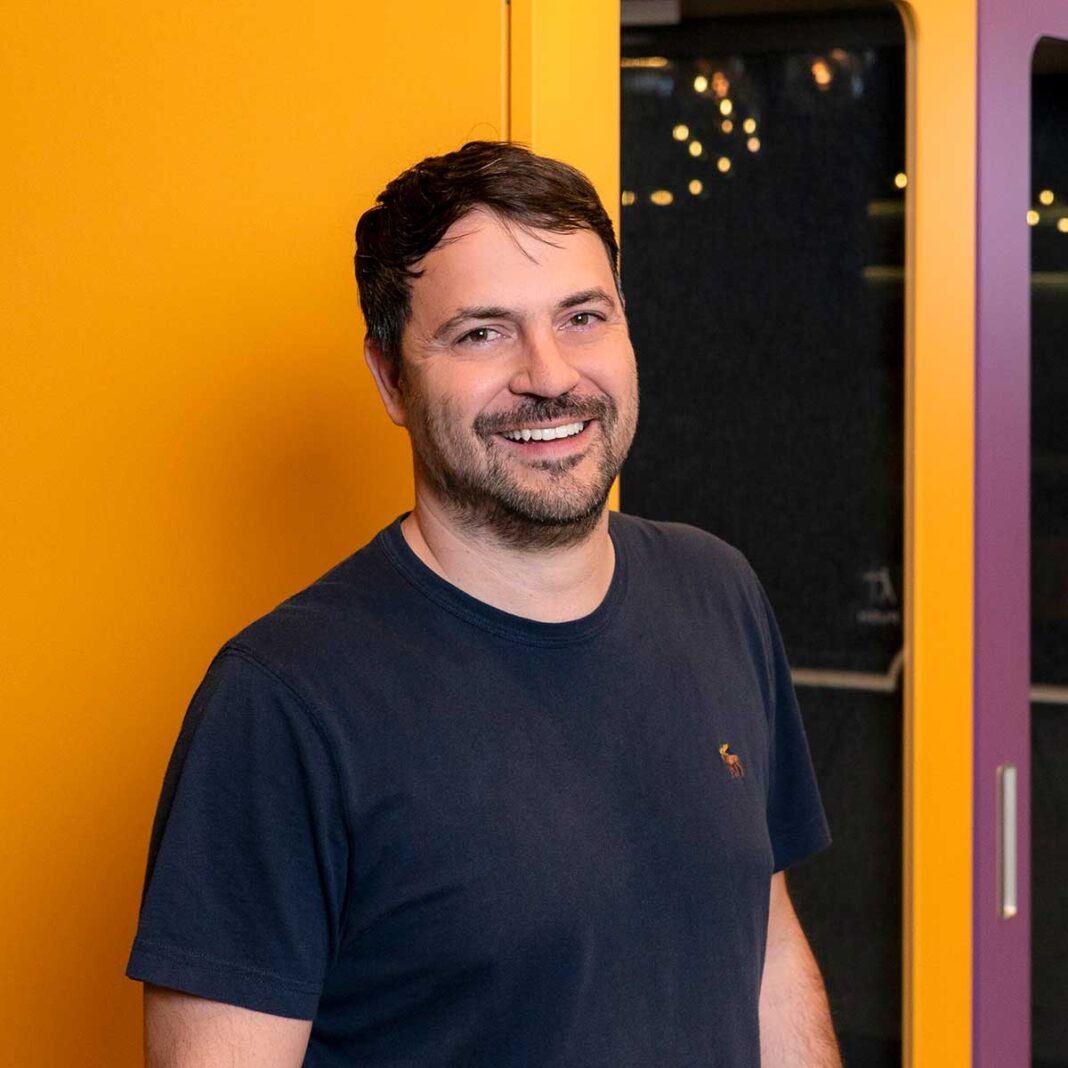

Todor Madzharov is the London-based co-founder of MEAVO, which designs and manufactures acoustic phone booths and meeting pods for open-plan offices and sells them directly to the companies that use them.
Founded with Thomas Anselmino in 2018, the bootstrapped business now lists appointment-only showrooms in more than 20 cities across the UK, mainland Europe, the US and Dubai, and its range runs from the £3,399 Soho phone booth to the premium Haven Line of booths and meeting pods. MEAVO holds a Gold rating from EcoVadis, which the company says places it among the top 5 per cent of companies assessed.
He tells Business Matters why the best growth lever was a warehouse rather than a campaign, and why he now recommends remote working for a physical product business.
What do you currently do at MEAVO?
I co-founded MEAVO with Thomas Anselmino in 2018. We design and manufacture acoustic phone booths and meeting pods: self-contained quiet rooms that go into open-plan offices.
My background is in marketing, and in the early years that is mostly what I did: lead generation, working out where our customers were and how to reach them. As we grew that changed, and today I am responsible for the product itself and for the less glamorous question behind it. That question is making sure that when a company orders booths, we can actually build them, ship them and install them on the date we promised. For a physical product sold across Europe and North America by a remote team of around 30, that is a significant part of the job.
A lot of my time goes on the software and systems the team runs on. Manufacturing, supply chain, sales and fulfilment each generate their own data; unless those systems talk to each other, you end up with a booth sitting in a warehouse that sales thinks is on a lorry.
Building the internal tooling that keeps everyone looking at the same picture is where I have ended up spending my energy. That is a long way from PPC campaigns, and probably a more useful place for a co-founder to be as the company grows.
What was the inspiration behind your business?
We were customers before we were founders. Thomas and I needed a phone booth for the office we were working out of, so we went to buy one, and the experience was bad enough to start a company over.
The lead times were months, and the prices were far higher than the product seemed to justify. You could not buy one directly either: everything went through resellers, each adding a margin and a delay, none of them able to tell you much about the product itself. It was a category where the customer had almost no relationship with the people who actually made the thing.
We had both spent our careers on the other side of that problem: finding out what a market wants, building for it, and getting it to people efficiently. So the idea was simple: make a good, affordable, down-to-earth booth, and sell it directly to the companies that need one, with no one in between. Nothing about it was revolutionary, but it just had not been done.
The first prototype was actually assembled in Thomas’s living room in early 2017, over several hours, in a sea of packaging, and it was a bad booth. Still, it was standing, and we had made it. From that point on, there was no talking us out of it.
Who do you admire?
Yvon Chouinard, who built Patagonia. Not necessarily for their outdoor gear, but more for proving that you can run a business where the environmental commitment is not a marketing department’s project. It is a proper guideline and guardrail on how the whole company operates, while still making money.
When we say each of our booths gives new life to more than 800 recycled plastic bottles, or point to our EcoVadis Gold rating, we are trying to work the same way: sustainability as something you can audit, not merely something that we announce. He got there decades before it was even fashionable, and he regularly achieved things the industry said could not be done.
I am fortunate that Thomas and I see eye to eye on this. Building a sustainable business has been our commitment from day one, and for both of us it is simply the only way we know how to build one. It was never a strategy we adopted.
If anything, it has turned out to be part of why we have succeeded. The customers and architects we work with increasingly have to prove their own sustainability credentials, and a supplier who takes it seriously from the start is a much easier partner to justify.
Looking back, is there anything you would have done differently?
I would have committed to a manufacturing partner sooner. In the early days we prototyped with factories across several countries, chasing a slightly better price here or a slightly better finish there. It felt like diligence. In hindsight, it was mostly a delay: a year of comparing options when we should really have just picked one good partner and started learning from real customers.
The same goes for holding stock close to the customer. For a long time we shipped from the factory on every order, because holding inventory ties up cash and it is uncomfortable. When we finally started keeping booths in local warehouses, lead times collapsed from months to weeks, and that single change did more for our growth than any marketing campaign I have run.
If your differentiator is speed, you pay for it somewhere on the balance sheet. I would have accepted that earlier.
On the other hand, the one thing I would not change is starting small and bootstrapped. It forced us to get the economics right before we got big, and that is the reason we are still here.
What defines your way of doing business?
Proof over claims. The acoustic pod market has a lot of products that look identical in a photograph and perform completely differently in a room, so we made a decision early to let independent testing do the arguing for us.
Our booths are tested to ISO 23351-1:2020, the acoustic standard written specifically for enclosures like ours, certified by TÜV SÜD, fire-tested to DIN EN 1021, and built with FSC wood. We hold ISO 9001, 14001, 27001 and 45001 across the business. That is a lot of paperwork, and every piece of it exists so that a facilities manager or an architect does not have to take our word for anything.
The second thing is that we sell the outcome, not the object. Nobody wants to buy a colourful box; they want their team to stop losing hours a day to noise, or their fit-out to land on the date they promised the board. When we stopped talking about panels and hinges and started talking about that, the conversations got shorter and the customers happier.
Finally, we try to be direct. Our whole tone as a company is short sentences and no corporate language, and that applies internally as much as in a sales email. A fully remote team only works if people write things down plainly and mean what they write.
What advice would you give to someone starting out?
Work out whether your customer searches for you or has to be sold to. It sounds like a marketing question, but it determines almost everything: where your budget goes, what your website has to do, how big a sales team you need. Our customer, for instance, searches, usually the week after a noise complaint. Once we understood that, it was easier to make the right decisions about marketing budgets and sales processes, and that helped us grow more quickly.
Second, decide early what you are prepared to pay for. Every real differentiator has a cost. Fast delivery means inventory. Great installation means a field team. Sustainability means more expensive materials. Founders who have not decided which of those they will fund end up mediocre at all of them.
And if you are building a physical product, question the assumption that everyone has to sit in the same building. We are 30 people, remote, selling and installing furniture across two continents. It works because remote work forces us to document everything, and documentation is what makes a supply chain reliable. I would have laughed at that advice in 2017, but I give it now without hesitation.