
Breaking down Man Utd’s tactics after Fernandes’ criticism
To play this video you need to enable JavaScript in your browser.
This video can not be played
-
Published
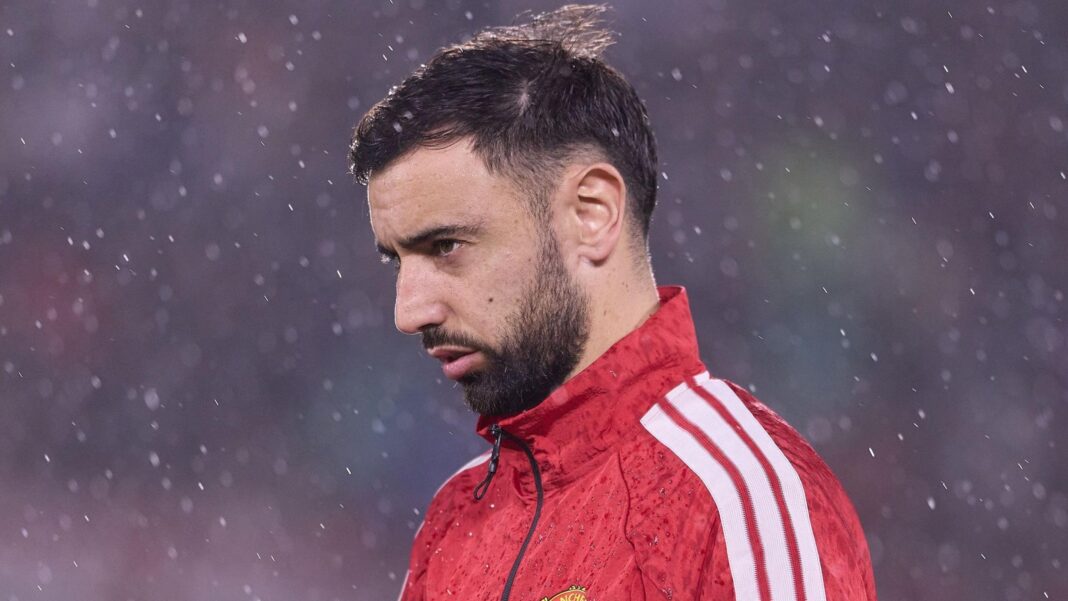
Manchester United captain Bruno Fernandes appeared to question their tactical approach after Wednesday’s 4-1 Champions League defeat by Como.
“We started off on the wrong foot,” the Portuguese said. “They scored very early, [we had] not much pressure on the ball.
“It’s a decision from the staff to not press man-to-man and sometimes leave some space behind, to try and get the ball in the first moment [by] waiting for them, [giving] them the ball.
“Sometimes when you give too much of the ball to these teams, they get confidence. They have so many bodies behind the ball, they make you run a lot, people get frustrated.”
His quotes are tactically dense so warrant breaking down, but what did Fernandes mean, and does he have a point?
 Image source, Getty Images
Was Fernandes’ analysis accurate?
Since Michael Carrick became United manager in January, they have largely defended in a zonal 4-2-4 or 4-4-2 shape that springs into a press in moments.
When Fernandes said United “leave some space behind, to try and get the ball in the first moment” he was referring to them not immediately pressing across the pitch in a man-to-man fashion.
Holding their 4-2-4 shape a little bit deeper, United allow opposition defenders time and space on the ball, looking to set traps before pouncing.
The overarching idea is with four players narrow and high, United’s attackers are well positioned to score from turnovers should they win the ball back.

At times during Carrick’s stint as caretaker head coach last season, it worked well – as we saw when Bryan Mbeumo scored in United’s 3-2 win at Arsenal in January two weeks after Carrick took over


1 of 3
Slide 1 of 3, Screen grabs showing United’s press against Arsenal last season, United didn’t press Arsenal in a man-to-man fashion but still found joy
But the same approach has been less effective this season.
On the same night defender Lisandro Martinez questioned United’s recruitment – after their 2-0 defeat by Atletico Madrid – he also spoke about the ever-changing tactical landscape.
“You can’t stay with what you did last season.” he said. “Teams know you, how you play, know every detail, and if you don’t change, next season is a big problem.”
Last season, the introduction of the 4-2-4 shape as a defensive tactic caught a number of teams off guard, making it more effective.
Pep Guardiola and Pep Lijnders used the same shape at Manchester City – a tweak that underpinned their Carabao Cup final win over an ill-prepared Arsenal.
Having replaced Guardiola, Enzo Maresca redeployed it for the Community Shield in August, but this time Arsenal boss Mikel Arteta had the solutions and the Gunners won.
Within a few games, Maresca had abandoned the 4-24 and moved to a more man-to-man style of defending.


1 of 2
Slide 1 of 2, Screen grabs showing Arsenal’s build-up play against City’s 4-2-4 shape, Arsenal were able to create clever overloads around City’s 4-2-4 in the wide areas

Perhaps that is the sort of change Fernandes is hoping for – recognising the reduced effectiveness of United’s defensive approach, with signs of weakness visible as early as pre-season.
AC Milan – now managed by former United boss Ruben Amorim – repeatedly found joy playing around the 4-2-4, with a back five that outnumbered the Red Devils’ front four.
United’s two central attackers would look to block passes into Milan’s midfield two before pressing the central defenders.
The wide position of one of the central defenders would force a United winger to step out, and Milan’s wing-back – dropping deep and wide – gave them an easy way out.
United’s full-back would then have to cover a large distance to close down the wing-back but by the time pressure was applied, the ball was gone.

The same problems were seen in United’s defeat by Atletico Madrid.
Atletico took the risk of employing the same tactic with a back four rather than a back five, which left them an extra attacker high up the pitch.
As United’s front two looked to stop passes into the central midfielders, the wide position of the centre-backs drew out United’s wingers.
That, in turn, meant left-back Alejandro Grimaldo found himself in space out wide.
This required Diogo Dalot, or if he was pinned back by winger Alex Baena, Youri Tielemans to cover large distances in an attempt to apply some pressure to Grimaldo.
So while Fernandes may have been referring to himself when he said “they make you run a lot, people get frustrated”, it could easily have applied to these team-mates.

Why is Carrick taking this approach?
When Fernandes’ quotes were put to Carrick after the game, he pushed back.
“We actually half-pressed, man-to-man in the second half and then ended up conceding a goal from that,” he said.
“It’s a little bit on whatever system you play, whatever tactics you play, but if you don’t run and you don’t run forward and you don’t run back, you aren’t going to win.”
While the less aggressive 4-2-4 has its weaknesses, it often leaves an extra player in the backline, giving United a numerical advantage in defence.
It also aims to funnel attacks down the flanks, where they are – in theory – less dangerous than chances conceded through the middle.
United’s backline have also – under both Carrick and Amorim – struggled to track and duel with their opponents in one-against-one situations when they have committed to a full press.
When using a man-to-man press, losing an individual battle, or lacking the intensity to arrive at your opposing player quickly, makes the system fall apart as we saw for Como’s second goal.


1 of 4
Slide 1 of 4, Screen grabs showing United’s man-oriented defence before Como’s second goal., In the second half, United took a more man-oriented defensive approach


1 of 2
Slide 1 of 2, Screen grabs showing United’s man-oriented defence before Atletico Madrid’s opening goal, Against Atletico, although United didn’t start the game pressing in a man-to-man fashion, Lisandro Martinez pressed his attacker in a man-to-man way in the build-up to Atletico Madrid’s opening goal
In the Premier League, United have also had spells during which they have attempted to press in a more man-to-man fashion, but these have also been imperfectly executed.
In fact, against Spurs, it was Fernandes who misread moments and positioned himself incorrectly.
What can United do?
Despite Amorim’s flaws, one of his strengths was in improving United’s physical base and intensity. There is a question as to whether Carrick’s United, with one game a week last season, were beneficiaries of that.
This season they look unable to sustain the intensity to execute a man-to-man press with the effectiveness of, say, Fabian Hurzeler’s Brighton – a physically fit squad aligned on how and when to press.
For United, more concerningly, there appears to be a disconnect – at least in how Fernandes sees the game and the messaging from the coaching staff.
This misalignment makes it hard to execute any defensive approach, with good defending built on intensity and co-ordination between players.
“Sometimes you have to be more brave under pressure,” said Fernandes. “Take the risk of pressing high and making them uncomfortable.”
But bravery is subjective and one might argue that Carrick defending with four forwards – ready to attack quickly – is an incredibly brave, if not naive, decision.
Going for a ‘half man-to-man’ approach – looking to lock opponents into one area of the pitch – while allowing some players to defend more zonally feels like a fair trade-off from Carrick.
But how United defend in the 4-2-4 feels outdated already, and is being exposed.
So while both Fernandes and Carrick seem to have a point, if United are to win regularly, any solution this season is likely to lie somewhere in between their views.
-
-
Published2 hours ago
-
-
-
Published17 hours ago

-