
Affiliate marketing is still one of the simplest ways to make money online.
You recommend products you genuinely rate. When someone buys through your link, you get a commission. You don’t have to make the product, hold stock, handle shipping, or deal with refunds.
In this guide, I’ll show you how to think about affiliate marketing in 2026, what still works, what has changed, and how to start without building the kind of site Google or readers can easily ignore.
What is affiliate marketing?
Affiliate marketing is when you promote another company’s product or service. If someone buys through your link, you earn a commission.
For example, Serious Eats earns a commission when you click through to any of these links and make a purchase.
So if you clicked through and bought their top pick, the $69 Yosukata carbon steel wok, on Amazon, Serious Eats would earn about $3.10 at Amazon’s standard 4.5% rate for kitchen products.
It doesn’t sound like much. But multiply that by thousands of readers a month, across hundreds of recommendations, and it adds up.
Not every program pays like Amazon either. Software companies often pay much more per sale. For example, Shopify pays up to $150 for every new paying merchant you refer.
How does affiliate marketing work?
There are usually three or four parties involved:
- The merchant: the company selling the product (e.g., Amazon, Shopify, HubSpot).
- The affiliate: you, the person recommending the product.
- The customer: the person who clicks your link and buys.
- The affiliate network (sometimes): a middleman like Awin, Impact, CJ, or Rakuten that handles tracking and payments for lots of merchants at once. Some merchants, like Amazon, run their programs in-house.
When you join an affiliate program, you get a unique link containing a tracking ID. This tells the merchant that a visitor came from you.
When someone clicks your link, the merchant stores a small file called a cookie on their device. The cookie has an expiry date (the “cookie duration”), so you still get credit if they don’t buy right away.
For example, here’s how it works if you’re an Amazon affiliate:
- Someone reads your post on the best winter jackets.
- They click your Amazon link for one of your recommendations.
- They get distracted and close the tab.
- They come back to Amazon later that day and buy the jacket.
Because the purchase happened within Amazon’s cookie window, you earn a commission.
Amazon’s cookie only lasts 24 hours, though. However, if the customer adds the item to their cart during this window, the window extends. You’ll still earn a referral commission as long as the order is placed before the cart expires, usually up to 90 days.
Other affiliate programs could be more straightforward and generous, giving you a cookie window up to 30, 90, or even 180 days.
Affiliate programs usually pay in one of these ways:
- Percentage of the sale: e.g., Amazon pays 1–10% depending on the category.
- Flat fee per sale: e.g., Bluehost pays $65 per qualified hosting sale.
- Recurring commission: e.g., HubSpot pays 30% of a customer’s subscription for up to a year.
- Pay per lead or sign-up: you get paid when someone signs up for a trial or fills in a form, even if they don’t buy straight away.
In affiliate marketing, two conversions need to happen for you to get paid.
First, the reader has to click your link. You control that. Second, they have to buy on the merchant’s site. You don’t control that. The merchant owns the product, the price, the checkout, and the program terms. That’s why choosing the right merchants matters so much (more on that later).
How much money do affiliate marketers make?
It varies hugely. But here are some benchmarks.
But look closer, and the picture changes:
- Affiliates with less than one year of experience earn an average of just $636 per month.
- Affiliates with 1–2 years of experience earn an average of $4,196 per month.
- Affiliates with 3+ years of experience earn roughly 9x more than beginners.
Keep in mind these are averages. A handful of very successful affiliates pull the numbers up, so the typical affiliate earns less than this.
For example, take Random Olive, a craft and hobby blog that publishes its income every month. In August 2026, it earned $2,568 in affiliate commissions, mostly from TikTok Shop ($1,274) and Amazon ($1,218).
In September 2026, that dropped to $1,915. That’s a nice side income, and it shows two things: affiliate income often comes from several programs at once, and it can swing quite a bit from month to month.
So don’t expect to be successful right away. If you’re just starting out, your first checks might look more like this for a while:
Further reading
Affiliate earnings calculator
Use this calculator to see how much you could potentially earn on your affiliate site.
Is affiliate marketing still worth starting?
But “worth it” depends on how you plan to do it.
The market is still growing
According to the PMA 2025 US Performance Marketing Study, US affiliate marketing spend grew from $9.1 billion in 2021 to $13.62 billion in 2024. In fact, that spending generated an estimated $113 billion in ecommerce sales. Merchants are still putting real money into affiliate programs.
That said, industry growth does not automatically mean a beginner can throw up a review site and make money. Some of that spend goes to cashback sites, loyalty programs, tech partners, large publishers, and creators.
So a growing market is good news, just not a personal income forecast.
Big publishers are still growing affiliate referral revenue
Large media companies are still investing in affiliate content, and many are growing it:
- Wirecutter (The New York Times): Affiliate referral revenue grew by $3.9 million year over year in the first six months of 2026, according to the company’s Q2 2026 10-Q filing.
- People Inc. (formerly Dotdash Meredith): Performance marketing revenue grew 13% year over year in Q2 2026, “driven by 11% affiliate commerce growth,” according to its Q2 2026 earnings release.
- Condé Nast: Commerce revenue grew 13% in 2025, according to CEO Roger Lynch’s annual memo.
Not every big publisher is growing, though. Future plc (which owns sites like Tom’s Guide and TechRadar) saw its affiliate revenue fall 24% in its most recent half-year, which it blamed on lower search audiences. Ziff Davis’s tech and shopping division is shrinking too.
Notice the pattern. The publishers that are growing have strong brands that people visit directly. The ones that are struggling rely more heavily on Google traffic. We’ll come back to this.
Independent affiliate websites are doing well too
You’ve probably heard stories of affiliate sites decimated by Google’s Helpful Content Update. Those stories are real. But plenty of independent publishers have recovered, and some are bigger than ever.
For example:
- HouseFresh, the air purifier review site, lost about 95% of its Google traffic after the 2023 update. By October 2025, it was back to pre-update levels, helped in part by building a YouTube channel.
- That Fit Friend went from around 100,000 monthly search visits to almost nothing in mid-2024, then recovered to well above where it started.
- Treeline Review, an independent outdoor gear site, now gets an estimated 60%+ more search traffic than it did before the update.
Then there’s iRunFar, which has survived every Google update. Its estimated search traffic has roughly tripled since early 2023. Watch the interview with its founder on our YouTube channel:
The big risk: depending too much on search
Look at the chart above again. Even sites that did everything right saw their traffic collapse almost overnight before recovering. Not every site recovers.
There’s a reason for this. Google seems increasingly unwilling to reward websites that exist only to capture search traffic and pass it on to a merchant. If your site adds nothing beyond what the merchant’s own product page says, Google has little reason to send people to you rather than straight to the merchant.
Do you have an existing or intended audience for your business or site that would find the content useful if they came directly to you?
There’s another reason to be cautious too. Google is answering more questions directly in search results. For example, our study found that the presence of an AI Overview now correlates with a 58% lower average clickthrough rate for the top-ranking page.
So the goal in 2026 is not to be a clever arbitrage of Google’s traffic. It’s to become a destination: a brand people seek out by name, subscribe to, watch, and come back to. Search can still be a big part of how people find you. It just shouldn’t be the only reason you exist.
How to get started with affiliate marketing
A lot of affiliate guides start with the platform: should you start a blog, a YouTube channel, or a TikTok account?
That matters, but it shouldn’t be your first decision. Your first decision is what you’re going to talk about.
Here are the seven steps to follow:
1. Pick your niche
Your niche is the main topic your site or channel covers.
A good niche scores well on these four criteria:
- Competition. Choose your battles wisely. As a solo creator, you’re not going to outrank Wirecutter or Good Housekeeping on “best vacuum cleaner.” Pick a space where you have a realistic chance.
- Commercial value. Look for lots of searches like “best ,” “ vs ,” and “ review.” These people are comparing options because they’re about to buy.
- Breadth. There needs to be enough to talk about. A site about pulled pork sandwiches would run out of topics within a month. A site about food is too broad to tackle. Smoking meats is about right: plenty to cover, with room to expand later.
- Personal interest. Affiliate marketing is a long game. If you don’t genuinely care about the topic, you’ll struggle to keep going when results are slow.
Watch this video to learn more:
Start with what you’re interested in
You saw earlier that affiliate marketers with >3 years of experience make the most money.
But in order to last at least three years, you need to work on something that you care about. Otherwise, you’ll give up at the slightest obstacle.
Of the four criteria, personal interest is the easiest place to begin.
For example, I probably couldn’t build a useful gardening site because I know nothing about gardening. But I could build one about breakdancing, which I’ve done for more than 10 years. (Which was what I did years ago.)
If you’re not sure where to start, ask yourself:
- What am I good at?
- What do I like doing (enough to make content about it for years)?
- What do other people ask me for advice on?
Check the landscape
Next, plug each idea into Keywords Explorer. You’re not looking for a keyword to rank for yet. You’re trying to understand the overall landscape and see how well it matches against the four criteria.
For example, let’s imagine that one of my favorite weekend hobbies is hiking. So, that’s personal interest taken care of. So, I’ll enter the keyword “hiking”:
Lots of search volume, a sign of an established niche. If we click through to the Matching terms report, we see tons of keywords, which is a great sign of breadth.
Now, let’s add a filter for “best” keywords to see if there’s any commercial intent in the niche. Another great sign as we see tons of keywords (28,000+) and a high search volume (~580K).
But a KD of 61 for the overall topic seems to be on the challenging side. Do we have a potential opening into this niche? We can find out by setting a KD filter (of say 20) to find keywords with low difficulty.
There are still >3,700 keywords to target. Pretty good!
Make sure you can earn commissions from it
Specifically for affiliate marketing, you’ll want to make one extra check. Commercial searches alone aren’t enough. People also need to be buying things you can earn a commission on.
For example, let’s say you’re targeting the niche “best restaurants in New England”. It’s a great niche that fulfills all four criteria. However, there’s one major problem: most restaurants don’t have affiliate programs.
So if you’re building an affiliate site, make sure the products you’re going to recommend have affiliate programs before you commit.
2. Find affiliate programs to join
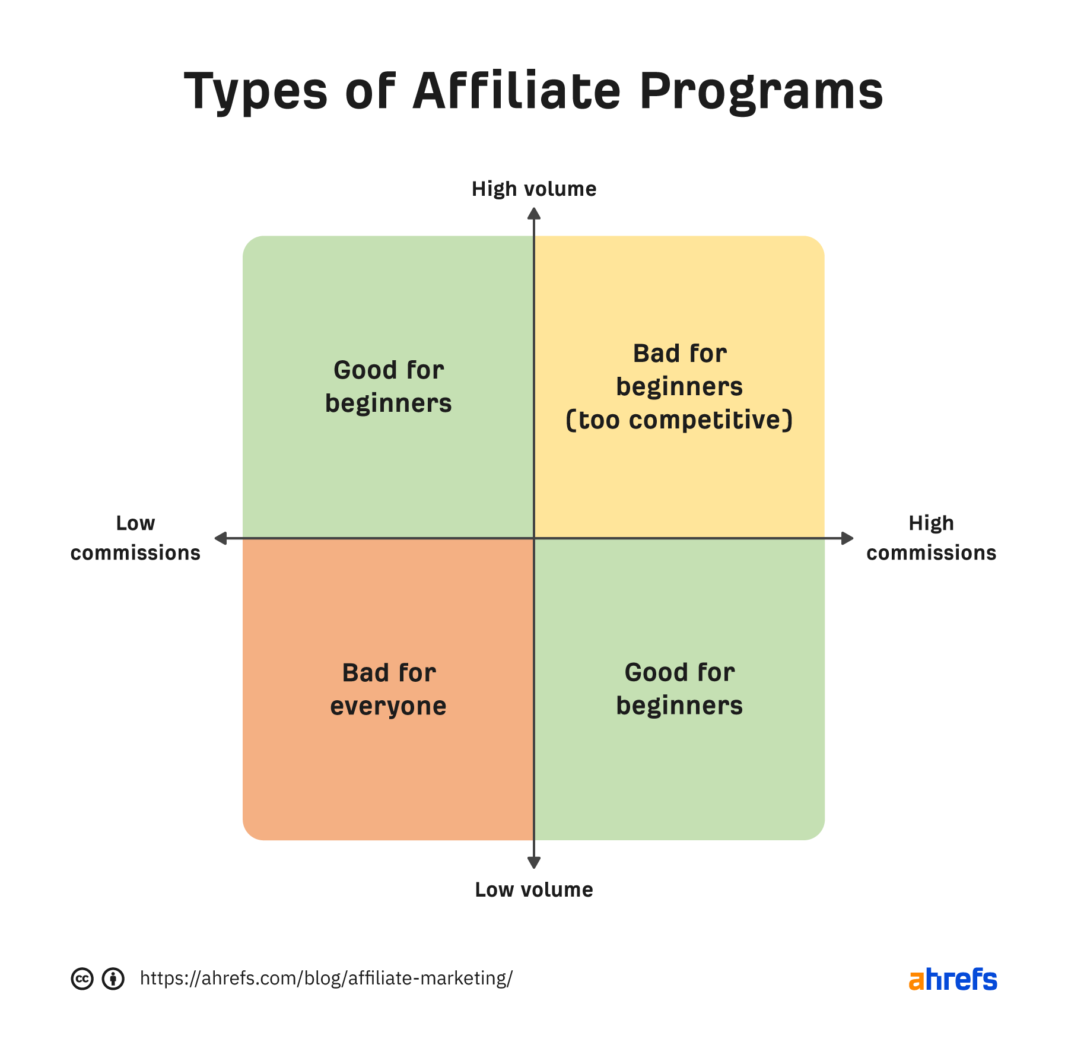
Broadly speaking, there are three types of affiliate programs:
- High-paying, low-volume. Niche products with fewer buyers but big payouts. These are usually software or B2B products. For example, HubSpot sells only to businesses, but its affiliate program pays 30% recurring commission for up to a year.
- Low-paying, high-volume. Products with mass appeal, but low commission rates. For example, Amazon Associates pays only 1–10%, depending on the category. But almost everyone shops on Amazon, so it converts well.
- High-paying, high-volume. Expensive products with mass appeal, like credit cards, insurance, VPNs, or web hosting. These programs pay well, which is exactly why they’re the most competitive. You’ll be up against affiliates with deep pockets and years of experience.
Which one should you join? It depends on who you’re helping.
If you’re targeting consumers, start with low-paying, high-volume programs like Amazon or big retailers. They’re easy to join and convert well. If you’re targeting businesses, go for high-paying, low-volume programs like software. I’d avoid high-paying, high-volume programs like credit cards as a beginner, unless you have real expertise in that space.
You’ll also come across affiliate networks. These are marketplaces where thousands of merchants list their programs, so you can join many through a single account. The big ones are Awin, Impact, CJ, and Rakuten Advertising. For software, PartnerStack is popular.
If you don’t want to apply to individual programs at all, tools like Skimlinks automatically turn your product links into affiliate links across thousands of merchants, in exchange for a cut of your commissions (Skimlinks keeps 25%).
How to find affiliate programs
The easiest way is to search Google for “[brand name] affiliate program.” Most companies with a program have a dedicated page for it.
Another way is to see which programs other affiliates in your niche promote. Just enter a competing affiliate site into Ahrefs’ Site Explorer and go to the Linked domains report. This shows which websites it links to most. Many of these will be merchants it’s an affiliate for.
For example, when I look at the report for Pat Flynn’s SmartPassiveIncome site, I see that he has linked to Kit a total of 364 times.
So many links to a tool is a sign that Pat Flynn either owns the tool or is an affiliate. In this case, he’s an affiliate.
If there’s a product you’d like to promote but it doesn’t have a public affiliate program, reach out to the company and ask. Many brands are happy to set up a deal with a creator who has a relevant audience.
How to choose a good program
A high commission does not make a product worth recommending. If the offer doesn’t fit your audience, doesn’t convert, or isn’t something you’d feel good recommending, it’s still a bad offer.
Start with the commission structure, because this is where beginners usually get stuck:
- Percentage vs. flat fee. Percentage commissions work in your favor when people buy expensive items or fill up their carts. Flat fees are more predictable, and are usually better for low-priced products or subscriptions with cheap entry plans. A good rule of thumb: work out what you’d actually earn per sale on a typical order, not the headline rate. 10% of a $20 product is $2. A $65 flat fee is $65.
- One-time vs. recurring. Recurring commissions are great for subscription products, because one referral keeps paying you every month. But they only pay off if customers stick around. If you’re promoting a tool people try for a month and cancel, a bigger one-time payout is usually the better deal. Many programs also cap recurring payments at 12 months, so check how long they last.
- Cookie duration. The longer the cookie, the more time people have to decide and still credit you. This matters most for expensive, considered purchases, like software, mattresses, or cameras. For cheap impulse buys, a short cookie like Amazon’s 24 hours matters less.
Then, before you commit, run through this checklist:
- Does the product fit your audience? If you’re targeting solopreneurs but you keep pushing expensive enterprise tools, the commission rate won’t save you.
- Can you explain it honestly? You should know who it’s for, who should skip it, what the trade-offs are, and how it compares with sensible alternatives. If you can’t, it’s probably not a good product for you to lead with.
- Does the merchant convert? You only control the click. A confusing product page, weak pricing, a clunky checkout, or no shipping to your readers’ country can kill your sales. Look for public income reports (search for “income report [program name]”) to see if other affiliates are earning from it. Or sign up and ask the affiliate manager for average conversion rates and earnings per click.
- Do your sales actually get credited? Check the attribution rules. Most programs credit the last affiliate link clicked, so a coupon site or browser extension can sometimes “steal” your sale at checkout. That’s what PayPal’s Honey extension was accused of in 2024, which led to lawsuits and a Chrome Web Store policy change.
- Are refunds and reversals high? A dashboard full of commissions looks nice until half of them get reversed. If a product has lots of cancellations, the headline numbers will mislead you.
- Is the merchant reliable? Look for clear terms, on-time payments, decent support, and a history of keeping the program running.
And always ask yourself one uncomfortable question: What happens if this merchant cuts commissions next month?
It happens more than you’d think. In 2026, Amazon quietly cut commission rates by as much as 50% for many of the large publishers on negotiated rates. If one affiliate program makes up most of your income, that’s a risk you should be aware of. Spread your recommendations across several merchants where you can.
3. Pick a channel that fits how people choose
For most beginners, there are two common ways to do affiliate marketing today:
- Publish useful product content people can find through search
- Show products in use on YouTube or social media
You can also combine them. Many of the most successful affiliate publishers do both.
Publish useful product content people can find through search
This works best when buyers actively research before purchasing. Examples of such keywords are “best trail running shoes for wide feet,” “best air purifier for pet hair,” or “notion alternatives for agencies.”
These are the kinds of searches you found in Step 1, and they’re where detailed comparisons, testing, and explanations can still help.
The goal is not to publish as many buyers’ guides as possible, but to make your most important ones the best in the niche. For example, iRunFar publishes only a handful of buyers’ guides. But it makes sure these guides are consistently updated and the best in the business.
Show products in use on YouTube or social media
This works best when the product benefits from being seen in action, like skincare, audio gear, food, and fashion. Video is especially useful when trust depends on seeing how someone actually uses the product, what they like, and what annoys them.
For example, Fallow reviews pans by cooking on them in their restaurant kitchens:
4. Create great content using your unfair advantage
In the past, many affiliate marketers chose products purely for their commissions and published review after review. Often, they knew little about the niche and had never used the products they recommended.
As more people copied this playbook, search results filled up with unhelpful reviews. Google clamped down, but it didn’t say affiliate content had no place in search. Its guidance shows what it wants instead: original reviews based on real experience, testing, and useful comparisons.
In other words, you now need to build a brand and create genuinely helpful content. That means giving readers a reason to trust you over everyone else covering the same products: an unfair advantage.
You picked a niche you know and care about, which is a good start. Here are five ways to turn that into an advantage:
Develop a unique testing methodology
Lots of affiliate sites claim they “tested” the products they recommend. Far fewer explain how. A clear, repeatable testing methodology, especially one nobody else in your niche uses, makes your recommendations much harder to copy and much easier to trust.
A good example is HouseFresh’s air purifier testing methodology. They explain the specific work they do: which tests they run, the conditions, what they measure, and how they compare products. A reader can inspect the process instead of just accepting a vague claim that the products were “reviewed.”
The point is not simply to say you tested something. The point is to show the deep and hard work that went into testing it. As if you were an inspector and trying to see if a product passed the ISO9000 requirements.
Show products in action
Plenty of reviews are written at a desk. The running shoe gets a few laps around the block, the tent gets pitched in the backyard, and the pan gets one omelette.
But products aren’t designed for those conditions. A running shoe is made to carry you through mile 20 of a marathon. A tent is made to stay up in the wind and rain. A pan is made to survive a busy dinner service. That’s where the real differences between products show up, so that’s where you should test them.
A good example is DC Rainmaker’s Garmin Forerunner 970 in-depth review. Over nearly a month, he used the watch for 50 km runs, trail runs, interval sessions, a half-marathon-length run in summer heat, mountain bike rides, open-water swims, and a four-hour hike. He even wore other watches on his other wrist to compare their accuracy.
You can do this in any niche:
- Wear the running shoes in an actual race, not just on a treadmill
- Take the tent camping in bad weather, not just to the backyard
- Cook a full meal for a crowd, not just a single test dish
- Use the software for a real client project, not just the free trial demo
Then tell readers exactly where and how you used the product. “I ran the Berlin Marathon in these” is far more convincing than “I tested these shoes extensively.”
Collect data nobody else has
Testing tells readers how one product performs. Data tells them how it compares with everything else on the market.
For example, RTINGS doesn’t just review monitors one by one. It has measured more than 400 of them the same way, so you can sort and filter every model by things like brightness or input lag in a single results table.
You don’t need a lab to do this. Depending on your niche, you could track:
- Prices over time, so readers know when a deal is actually a deal
- Shipping times and customer service experiences across retailers
- Ingredients or materials across every product in a category
- Specs compiled into one sortable comparison table
- Reader-submitted results, like how many miles people get from a shoe
The more products and the longer you track, the harder it is for anyone else to catch up.
Get access other people can’t
Most affiliates are working from the same information: the product page, the press release, and everyone else’s reviews. If you can get information they can’t, your content is different by default.
For example, TopJaw got its start by interviewing famous chefs on where they eat in London. Anyone can write a list of the best restaurants in London. Very few people can get Marcus Wareing to tell them his favorites.
TopJaw with celebrity chef Marcus Wareing
The Strategist frequently builds recommendations by interviewing people with relevant experience: chefs, dermatologists, designers, cleaners, and other specialists.
You don’t need celebrity contacts to do this. In most niches, you could:
- Ask professionals who use the product every day what they’d buy, like a physio on running shoes or an electrician on power tools
- Interview people with specific needs, like parents of twins on strollers or people with back pain on office chairs
- Get your hands on products that are hard to find, region-locked, or not yet widely available
- Join beta programs and early-access lists to cover updates before everyone else
Access is hard to scale, which is exactly why it’s valuable. Every interview is something your competitors (and AI) can’t copy from somewhere else.
Build something people actually use
Sometimes the best affiliate content isn’t an article at all. It’s a tool people come back to every time they need to make a decision.
A great example is PCPartPicker’s system builder. It helps people plan a PC build, checks that the parts are compatible, and lists prices from different retailers next to each part. So the moment someone is ready to buy, the links are right there.
In other niches, a tool could be:
- A calculator, like how much paint you need for a room
- A quiz, like which tent suits your kind of camping trip
- A compatibility checker, like which lenses fit your camera
- A planner, like a packing list builder for a multi-day hike
People bookmark useful tools, share them, and link to them, which makes them one of the best ways to earn repeat visits and backlinks. And because they do something rather than just say something, they’re much harder for AI to replace.
You don’t need to be a developer to build one anymore. You can create simple tools like these with Letaido. For example, the affiliate earnings calculator you saw earlier in the post? I made that entirely via Letaido, using plain English instructions.
Make every recommendation worth trusting
Your advantage gives readers a reason to listen to you. But each recommendation still has to earn their trust on its own. Pages that just reuse the merchant’s product descriptions don’t, and Google’s thin affiliation policy specifically calls them out.
Whatever channel you choose, a good recommendation answers these questions for your audience:
- Who is this for? There’s no product that’s “best” for everyone. A KitchenAid stand mixer might be too much for a beginner but could be indispensable for a serious home baker. The more specific you are, the more believable the recommendation usually becomes.
- Why are you recommending it? Show the exact reason. This is where your unfair advantage comes in. Maybe you cut up an expensive luxury handbag, like Tanner Leatherstein does, and found that the material quality and construction don’t match the price. You need to justify the reason, otherwise your recommendation is just an opinion.
- What matters most in this category? People don’t buy products because they are “good.” They buy products because they are good at the thing they care about. For example, someone might want headphones that last the whole week without charging, rather than the best audio quality. Help readers focus on the criteria that actually matter.
- What did you learn that the product page won’t tell them? Manufacturers already explain the official features. Your job is to explain what the buyer learns only after using, comparing, or researching the product properly. Maybe the latest hyped AI software is only a demo, not a real product yet. Or perhaps the running shoe everyone covets doesn’t last more than 100 hours. That’s the kind of detail that helps people buy better.
- What are the real alternatives? A recommendation is stronger when people understand what else they should compare it to. That doesn’t mean listing every product in the category. It means covering the alternatives a sensible buyer would actually consider. For example, if your reader gets a blender, do they still need a food processor?
- What trade-off comes with this choice? Every product wins somewhere and loses somewhere. What can you do with a wok that you can’t do with a stainless steel pan? If you pretend everything is amazing, people stop trusting you.
- Is the content up to date? Products change. Prices change. New versions come out. Outdated affiliate content is one of the easiest ways to lose trust.
Use AI to speed up real work, not fake it
With AI, the landscape has changed.
Not only can affiliate marketers make more content, AI can even create content that fakes the signals that used to “prove” someone actually tested the product.
For example, look at this 2020 review on iRunFar on the Salomon Cross shoes:
In the past, saying this was enough proof to readers that you tested it. Of course, it can be faked by humans too, but with AI, this faking can hit scale. Any affiliate marketer can generate hundreds of articles pretending to have tested everything first-hand.
Don’t do this.
Secondly, AI isn’t only available to publishers. Regular people use AI too and know that AI can fake these signals. That’s why the younger generation is turning towards more authentic signals, like TikTok and YouTube, to make purchase decisions.
It’s also why you see more affiliate publishers making video content: it’s one of the best ways to prove they’re authentic.
Finally, if you’re trying to build a long-lasting affiliate business, this kind of faking will damage your brand and trust in the long run.
If you didn’t test the product, don’t imply that you did.
By the way, I’m not disparaging AI. I love AI. AI can be extremely helpful for affiliate sites. For example, you can set up an automation on Letaido to notify you of price changes or new feature releases so you can quickly update your buyers’ guide.
Use AI to help you work faster on things that are already real. Don’t use it to manufacture fake authority.
5. Add your affiliate links
You’ve created a great piece of content. But that doesn’t mean people will click your affiliate links. How and where you add them matters.
Place them where readers decide
If all your affiliate links are at the bottom of the page where people rarely scroll, clicks will be few and far between. On the other hand, make every other word a link in your introduction, and your content will look spammy.
The best place for a link is right where a reader is likely to make up their mind: next to your top pick, at the end of a review section, or in a comparison table.
Use callouts for your top picks
Callouts like buttons, boxes, and comparison tables grab readers’ attention and make your content easier to skim.
For example, Wirecutter uses eye-catching boxes with product links whenever it shares a top pick.
Disclose your affiliate links
In the US, the FTC requires you to clearly disclose when you earn money from a recommendation. Many other countries have similar rules.
Put the disclosure where people will actually see it before they click, like near the top of the post. A link to a disclosure page in your footer isn’t enough on its own.
On YouTube, say it in the video and include it in your description. On social media, use the platform’s built-in paid partnership or affiliate label.
Handle the technical details
There are two technical details worth getting right from the start:
- Tag your links as sponsored. Google asks you to mark affiliate links with rel=”sponsored” (or rel=”nofollow”). Most WordPress affiliate plugins can do this for you automatically.
- Use a link management plugin. Tools like ThirstyAffiliates or Pretty Links let you manage all your affiliate links in one place. This sounds like a small thing until a program changes. When ShareASale shut down in 2025, affiliates who managed their links centrally could swap them to Awin in minutes. Everyone else had to hunt through hundreds of posts.
6. Drive traffic to your affiliate site
You’ve created great content and added your links. Now you need people to see it.
As we’ve covered, you shouldn’t depend on any one channel. Here are the main ways to drive traffic to your affiliate content:
SEO
SEO is the practice of optimizing your pages to rank high in search engines like Google. As long as you rank high for your target keywords, you’ll get consistent traffic without paying for every visitor.
On a basic level, SEO is about:
- Understanding what your target customers are searching for
- Creating content around those topics
- Making sure Google understands clearly what your page is about
- Acquiring or earning links to push your pages higher in the search engines
- Ensuring Google can find, crawl, and index your content
AI assistants
More and more people now ask ChatGPT, Perplexity, or Google’s AI Mode what to buy instead of searching Google and clicking through ten reviews.
That sounds like bad news for affiliates. If ChatGPT recommends a product directly, your link isn’t in that answer.
But AI assistants have to get their recommendations from somewhere, and often that’s affiliate sites. They pull from reviews, comparisons, and test results, then cite the pages they used. Some people click through to those sources to check the details before they buy.
The process of appearing in AI search is called answer engine optimization (AEO).
Fundamentally, much of AEO is still SEO, with some slight differences.
YouTube and social media
Even if your main platform is a website, video helps you reach people where they already spend time, and it’s harder for AI to replace. Remember, part of HouseFresh’s recovery came from starting a YouTube channel.
You can repurpose your reviews into YouTube videos, short-form clips for TikTok, Instagram Reels, and YouTube Shorts, or pins on Pinterest (which works especially well for home, fashion, and food). Then link back to your full reviews.
You’ve seen above how affiliate websites lost almost all their search traffic overnight from an algorithm update. The same can happen to your YouTube channel or social media accounts when algorithms change or you run afoul of some policy.
That’s why you should build an email list. It lets you own the relationship with your readers and reach them whenever you like. You can tell subscribers about new reviews, deals, and updates, which brings them back to your content and your affiliate links.
To get people to sign up, offer them something valuable, like a buyer’s checklist, a deals newsletter, or early access to your reviews.
An email list can’t be the start of your affiliate marketing, though. You need readers first. Use the channels above to find them, then turn them into subscribers.
Paid traffic
You can also pay for traffic using pay-per-click (PPC) ads on Google, Meta, or other platforms. The advantage is that you get traffic the moment you start paying.
But there are two big downsides. First, ads eat into your profits, and it’s normal to lose money while you figure out what works. Second, once you stop paying, your traffic stops.
Generally, paid traffic only makes sense if you’re promoting a high-paying program and can make the numbers work. If you’re new to paid ads or working with low commissions like Amazon’s, I’d skip it. Some programs also restrict bidding on their brand name, so check the terms first.
Further reading
7. Track what earns and double down
Once clicks and sales start coming in, look at which pages, products, and programs actually make you money.
The most useful metric is earnings per click (EPC): your total commissions divided by the number of clicks on your affiliate links. It lets you compare programs fairly. A program with a lower commission rate but a higher EPC is earning you more.
- Update your best-earning content regularly so it stays accurate and keeps ranking.
- Test where you place links and callouts on your highest-traffic pages.
- Swap out products or programs that get clicks but don’t convert.
- Make more content around the topics and products that are working.
Use affiliate marketing to launch a bigger business
Affiliate marketing teaches you what people actually want to buy, before you have to create a product of your own. That makes it a great starting point for a bigger business.
This is especially true if you’ve been building your own community via an email list, subreddit, or an old-school forum.
You may have started with an affiliate site, but eventually you could build a:
- Digital product
- Paid newsletter
- Membership
- Consulting or service business
- Physical product
- Sponsorship business
- Ecommerce store
For example, That Fit Friend began by helping people choose shoes and training gear. Now it even makes and sells its own shoes.
That makes sense. If you spend years helping people choose among existing products, you eventually learn what buyers want and what the market is missing.
Watch our interview with Jake Boly, the founder of That Fit Friend, here:
You don’t need to rush into this. But it’s useful to know that affiliate marketing can be a starting point, not the final form of the business.
Final thoughts
Affiliate marketing is still worth starting in 2026.
But the old playbook (churning out reviews of products you’ve never used, ranking them on Google, and knocking back cocktails at a beach club in Bali) no longer works.
You have to put in the effort and treat it like a real business. You have to want to build an actual publication, TikTok account, or YouTube channel that helps people make better buying decisions. Build a brand that lasts.
That’s a much better business than just chasing clicks forever.
FAQ
Is affiliate marketing legit?
Yes. Affiliate marketing is a legal, well-established business model. Companies like The New York Times and Condé Nast earn millions from it. Just make sure you comply with the laws in your country, disclose your affiliate relationships, and only recommend products you believe in.
Can I do affiliate marketing without a website?
Yes. As long as you can get people to click your links, you can do affiliate marketing on YouTube, TikTok, Instagram, Pinterest, a podcast, or a newsletter.
Many creators do it without a website. That said, a website is one of the few channels you fully own, so it’s worth having one eventually.
What is cookie duration in affiliate marketing?
Cookie duration is how long after someone clicks your link a purchase still counts as yours. For example, if a program has a 30-day cookie and someone buys 20 days after clicking your link, you get the commission. If they buy on day 31, you don’t. Cookie durations range from 24 hours (Amazon) to 180 days or more.
What is EPC in affiliate marketing?
EPC stands for earnings per click. It’s the average amount you earn each time someone clicks one of your affiliate links:
EPC = total commissions earned ÷ number of affiliate link clicks
What is high-ticket affiliate marketing?
High-ticket affiliate marketing means promoting products or services with large payouts, usually $100 or more per sale. Think software, web hosting, financial products, or luxury goods. The payouts are bigger, but competition is usually fiercer and buyers take longer to decide. Learn more in our guide to high-ticket affiliate marketing.
How do I start affiliate marketing on Amazon?
All the steps above apply to Amazon. Sign up for Amazon Associates, and you’ll have 180 days to make three qualifying sales before your account is approved.