
Chris Mason: The Budget is imminent as tricky things pile up for Burnham
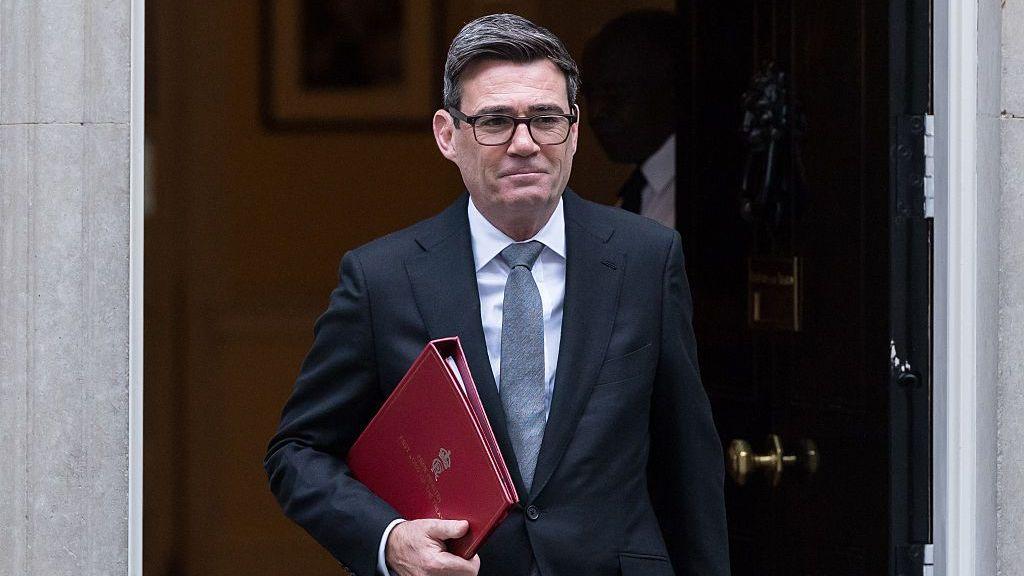 Image source, Getty Images
-
Published
This feels like the week where the rubber hits the road for the prime minister’s new government.
It is now 100 days since Andy Burnham arrived in Downing Street from Buckingham Palace and began to assemble his cabinet.
Three months later, Labour MPs are more chipper, the party’s poll ratings have notched up and the tone and style of government feels very different from when Sir Keir Starmer was in charge.
Coming next, though, there are a whole series of crunchy decisions and trade offs – economic and political – some of which are inevitable and some of which Burnham has decided to lean into.
First up, the Budget
You would be forgiven for only just clocking there is a Budget this week.
There are three reasons for this year’s feeling like a comparatively low key affair: it is happening a month earlier than a year ago, squeezing the space available for briefings, leaks and speculation. It is considerably smaller in big picture terms – in other words the scale of tax rises – so limiting the noisy talk in advance about who might get clobbered. And the new chancellor John Healey and his team have sought to make a virtue out of not saying very much beforehand.
But woe betide suggesting to anyone involved in assembling this Budget that it is a steady-as-she-goes, nothing-to-see-here thing.
Every Budget is a big deal, goes the argument run past me by some. They don’t all have to be visible from space in the way some recent ones have been – think Kwasi Kwarteng in one direction followed by Jeremy Hunt in the other four years ago, or Rachel Reeves in the last two years.
Cost of living support for some, help for entrepreneurs, more financial clout for mayors in England and an economy now recuperating will be themes for Healey on Wednesday.
You will be the judge of this Budget’s scale – its value, or the lack of it to you – before long.
Next, Brexit – and our relationship with the EU
In recent years, many but not all politicians have approached the issue of Brexit like you or I might approach an electric fence. Avoid getting too close and, if needs must, climb over it gingerly.
Burnham has no such reservations: he has repeatedly said in the last few weeks, let’s talk about Brexit. He reckons the current deal between the UK and European Union isn’t good enough.
Over the weekend he went further, suggesting he wanted an “honest discussion” about freedom of movement. Countries in the EU’s single market have to sign up to freedom of movement, which lets people live and work in all the countries that are part of it. Given how big a deal immigration was for many in the EU referendum in 2016, even reopening the question of freedom of movement feels like a big deal.
On Monday morning, the prime minister appeared to add more detail, suggesting freedom of movement would only return in the UK having been sanctioned in a referendum.
Later, though, his team wouldn’t repeat that, instead emphasising that Burnham wants to start a broad based conversation – without at this point committing to any possible outcome.
Some of his MPs felt this was a self-inflicted tangle he could have done without. Others see merit in Burnham’s penchant for narrating his thoughts and possible direction publicly, thereby using his position to seek to dominate the political debate.
While the Labour Party’s centre of gravity tilts towards a collective instinct that a closer relationship with the EU would be preferable to the status quo, there are differences of emphasis and indeed outright disagreements about how much closer and when would be wise.
-
Healey’s Budget needs to sustain the stronger economy through gathering clouds
-
Published1 day ago
-
-
Rosebank: Life on the oil field at the centre of a political storm
-
Published1 day ago
-
-
No 10 appears to backtrack on PM’s freedom of movement referendum suggestion
-
Published8 hours ago
-
Some Labour MPs representing seats in the north of England and Midlands, which backed Brexit, are privately nervous about anything coming across as too enthusiastic an embrace of Brussels. A nod to that scepticism appeared to come publicly from Home Secretary Shabana Mahmood who noted that a call for an honest discussion is “not the same as settled policy”.
She added: “The prime minister has also observed that there were very significant issues with freedom of movement when we were within the EU. An honest debate means actually being honest about all of the aspects of that debate and not cherry-picking.”
Next month, there will be a UK-EU Summit in Brussels, which was due to happen in the summer but was postponed when Sir Keir Starmer resigned.
We can expect both sides to talk up tweaks to the current deal and the government to also, in time, set out options for what the long term relationship might look like.
On the detail, there are divisions from the cabinet and down. The key thing will be what the party decides to include or not in its next general election manifesto.
The question of North Sea oil
Last week, Energy Secretary Miatta Fahnbulleh approved drilling in the Jackdaw field in the North Sea, about 150 miles east of Aberdeen.
This is principally a gas field and Fahnbulleh grounded her justification in providing the UK with greater energy security, at a time of war in Ukraine and in the Middle East.
The gas, she said, could be tapped into and serve British homes and businesses pretty much straight away, with the tax revenue put into an “energy wealth fund”, with the aim being to invest in renewable and low carbon energy projects.
But what about the Rosebank field, 80 miles north west of the Shetland islands, with its focus on oil?
Labour figures in and outside government acknowledge this is a much, much harder sell to plenty in their own party and beyond. Some, who want to see the project go ahead, fear that the energy secretary is not likely to be convinced that it should.
It is in that context that we should see allies of the chancellor pointedly making it known that he is in favour of it.
His public language was quite telling on the day Jackdaw was approved, when he was talking about the Energy Wealth Fund: “It means the extra tax revenues that come from North Sea oil and gas can be directed into developing more clean energy projects for the future.”
Note his reference to oil. Fahnbulleh said that Rosebank was “a different proposition” to Jackdaw.
Can those who worry, in particular, about the emissions from a new oil field, be won over by an argument grounded in this being a geopolitically pragmatic and environmentally credible part of transition to cleaner fuels?
Some Labour MPs hope so, but they know it’s a tall order to persuade some, including some in government – which could, if it was approved, raise the question of ministerial resignations. Let’s see.
There is more: benefits, immigration, defence
Expected before long, the former Labour cabinet minister Alan Milburn’s review into young people and work – and with it a set of suggestions to try to cut the number of young people not in work, education or training and, in time, to try to cut the benefits bill too.
Plenty of Labour MPs acknowledge these are nettles that need grabbing, but how many may flinch when presented with the sharper edges of what might be proposed?
Meanwhile, we await where the government eventually ends up on how long migrants should have to wait to claim permanent residence in the UK.
And then, beyond what is set out in the Budget, how ministers will find the money to spend 3% of national income on defence by the end of the decade – and with what trade offs to make that happen.
There will be plenty to observe in the second 100 days of Burnham’s government and beyond.
-
What is the Budget and what could be in it?
-
Published23 hours ago
-
-
Four ways Labour could raise money in the Budget without hiking income tax
-
Published1 day ago
-
-
Chris Mason: Jackdaw approved but tricky energy trade-offs remain
-
Published5 days ago
-

Sign up for our Politics Essential newsletter to keep up with the inner workings of Westminster and beyond.