
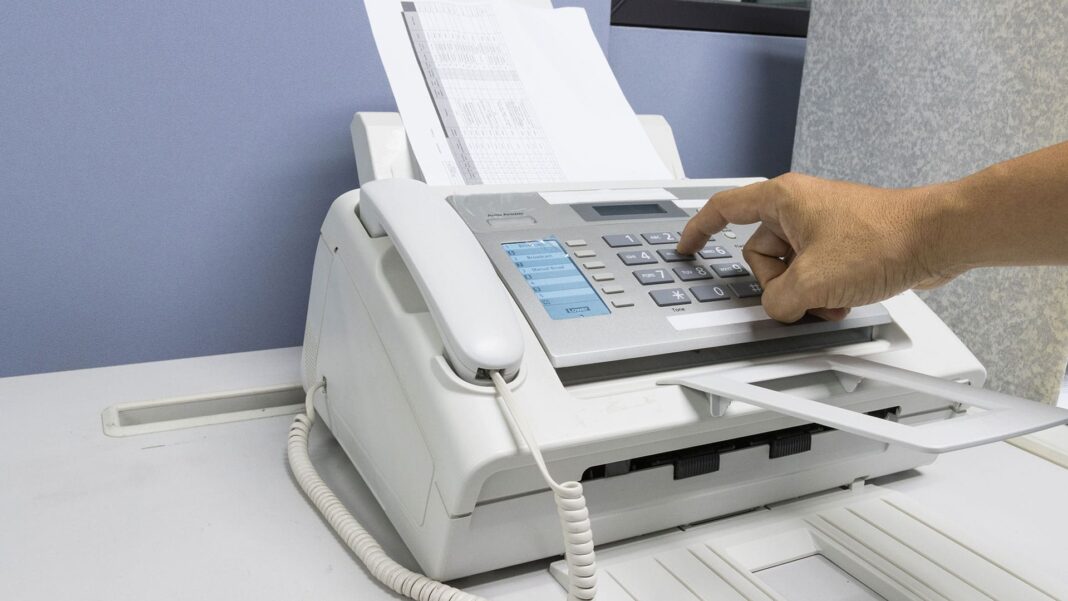

The fax line is rarely on the org chart. It sits in accounts payable, or in the one department whose counterparty will not accept email. It survives because the person at the other end has a legal reason to want it.
Healthcare in the United States is the obvious case. So is anything touching chain of custody, where a transmission report counts as proof of delivery. An email read receipt does not.
What makes this a business problem is the cost of doing it badly. A physical machine means a dedicated line, a person near it, and no record beyond a curl of thermal paper. The usual fix is a web portal, which replaces the paper with a login and a human who must remember to use it. Neither puts the event in your systems. So nobody can answer “did that go” without walking to a desk.
Treating it as an API changes the question. A fax becomes a job with an identifier, a status and a cost you can see.
Here is what that looks like in practice, using current published pricing from Fax for Agents as the example. Sending costs $0.039 per page in the United States and Canada. Receiving costs $0.019 per page. A dedicated number is $2 per month, prepaid from a wallet instead of invoiced in arrears.
Those numbers are small enough that the interesting figure is not the per page cost. It is the staff time you stop spending on confirmations.
The part worth specifying carefully is the callback. When a transmission finishes, something has to tell your system. An unsigned HTTP request to a public endpoint is a hole in your process, not a record of it. Signed webhooks with HMAC-SHA256 and an event identifier are the difference between a log you can show an auditor and a log you merely have.
Two practical details decide whether a finance team can use this without a developer beside them.
The first is what you can send. Uploads cover PDF, PNG, JPG and TIFF, and text, Markdown and HTML are rendered to PDF on the way out. That handles the signed scan and the generated statement without anyone converting anything by hand.
The second is retries. A dropped connection after you post a document is the moment a naive integration sends the same page twice. A service that hands back a stable job identifier lets you ask what happened instead of guessing.
There is a newer wrinkle for anyone letting software act on their behalf. Document workflows are increasingly triggered by assistants, so the send a clerk used to perform now gets requested by a tool. Fax for Agents documents setup for Claude Code, Claude Desktop, Cursor, Codex and n8n for that reason. It also means the approval step has to be explicit. If an automated process can send a patient record to a number it chose itself, you have a governance question and not an efficiency gain. The sensible pattern is a human approval on anything leaving the business, logged under the same event identifier as the send.
None of this makes faxing modern. It makes it accountable, which is the only thing a business needs from a channel it cannot retire.
The test is simple. Pick the last fax your company sent and ask three people what it contained, when it arrived and what it cost. If the answers do not match, the problem was never the fax machine.