This post was originally published on this site.
 Getty Images
Most Strasbourg fans thought they had it good from the deal which tied them together with Chelsea.
After all, the BlueCo investment has given the French side a team who are competitive in Ligue 1 and finished top of the Uefa Conference League table last month.
There has been a £157m revamp of their Stade de la Meinau home, improving facilities and increasing capacity.
Then there is their activity in the transfer market.
Before Todd Boehly and Clearlake Capital-owned BlueCo took control in 2023 the club’s total transfer fees paid out per season were £6.1m, £3.9m and £9.5m.
In the following three seasons Strasbourg have spent £52.6m, £53.6m and £96.5m. They were the biggest-spending club in France last summer, outgunning even Paris St-Germain (£89.2m).
Success on the pitch was underpinned by the attacking and exciting football under Liam Rosenior. Until now.
Last week the Englishman left to take charge of Chelsea. Those who were happy to accept success over a loss of autonomy in a multi-club ownership (MCO) structure now know the trade-off.
There is evidence that opinion appears to be changing as fans find out what it means to be the perceived subservient partner.
Strasbourg-based L’Equipe journalist Cyril Olives-Berthet says BlueCo have “shot themselves in the foot”.
“The general opinion is utter shock,” he told BBC Sport. “Even people who thought there was some interesting stuff with BlueCo are shocked.
“BlueCo had a relatively good image around France after last season. That is Rosenior, the players and the style of play.
“The backlash is harsh, in the media and with football fans.”
Gary O’Neil has arrived as Rosenior’s successor but Olives-Berthet says there is much scepticism. Supporters feel the 42-year-old lacks the experience for the job, having amassed 100 games during managerial spells at Bournemouth and Wolves.
‘A symbol of everything that is wrong with modern football’
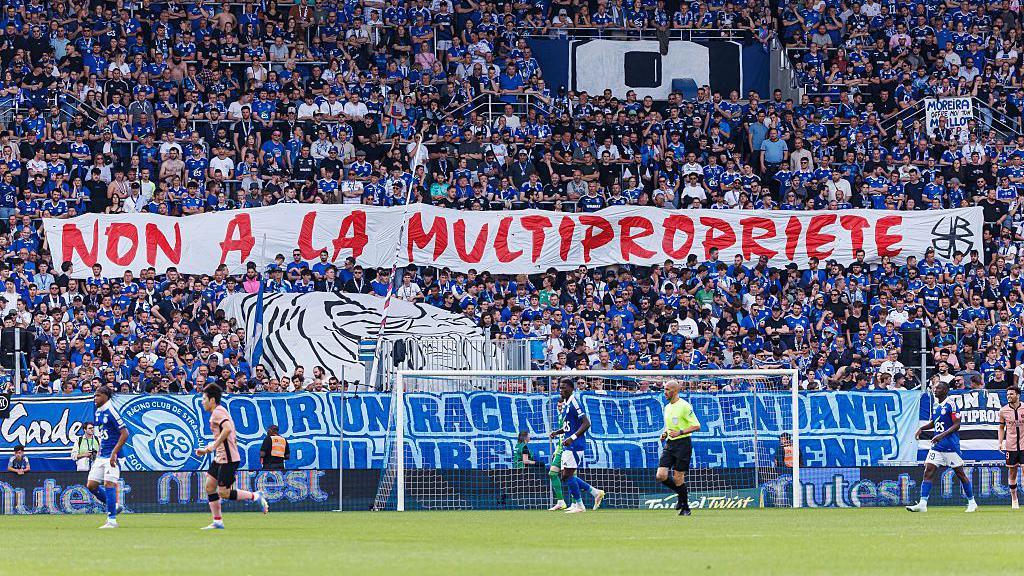
Some Strasbourg supporters have never accepted BlueCo. The club’s ultras stay silent for the first 15 minutes of every match in protest.
It reflects the opinion of a not-so-vocal minority. L’Equipe has reported how other supporters, attracted by the new signings and the team’s style of play, have booed the ultras.
But for the ultras, Rosenior’s move to Stamford Bridge reinforces their stance.
“The fact Rosenior is jumping on the Chelsea bandwagon is a symbol of everything that is wrong with modern football, and especially with multi-club ownership,” Alexandre, spokesperson for the Strasbourg supporters’ federation, told BBC Sport.
“It is different to legitimate ambition, and we know someone is going to, at some point, leave for a bigger club. No problem with that.
“But leaving your team in the middle of a season, that’s not OK. That’s not a thing you would do.”
Alexandre has long been a strong critic and described Strasbourg as a “Chelsea B team”.
It stings for club president Marc Keller, too. He took the club from financial ruin in the fifth tier of French football in 2012 and back to the top flight before selling to BlueCo.
Keller recently rejected suggestions Strasbourg had become Chelsea’s “feeder club” in an interview with BBC Sport. That came after it was announced star striker and captain Emmanuel Emegha would join Chelsea at the end of this season.
Rosenior taking the same path appears to weaken his argument.
Keller said he wanted to keep him but denied reports he had threatened to quit himself if Rosenior went to Chelsea.
“Liam’s departure wasn’t planned,” said Keller, a former midfielder at Strasbourg as well as West Ham, Portsmouth and Blackburn.
“I can understand the surprise, even the disappointment, of some of our supporters.
“And do you think I’m happy about it? The situation was neither planned nor desired by anyone at the club. Sometimes, you have to adapt in football.”
Keller said Rosenior rejected an offer from another Champions League club, believed to be Bayer Leverkusen, earlier this season but now wanted to be “closer to his family”.
 Getty Images
Chelsea and Strasbourg a ‘unique’ collaboration
Half of the Premier League is now in some form of multi-club ownership (MCO). But those clubs are at the top of the food chain and would not have experience of being the poorer relative.
The City Football Group has Manchester City as its core club, and full control of teams in Italy, France, Brazil, Australia, Uruguay and Belgium. It also owns 47% of Girona in Spain.
Red Bull is a majority owner of teams in Germany, Austria, the United States and Brazil, with minority stakes in other clubs, including Leeds United.
These are major football operations, MCO behemoths. Players and managers will move between entities. It is like an employee getting promoted through a multi-national company.
Head coach Jesse Marsch, for instance, went from New York Red Bulls to Salzburg to Leipzig. But never in the middle of a season.
Other MCOs are set up share ideas and enjoy relative growth, such as Tony Bloom’s interest in Brighton, Union Saint-Gilloise, Hearts and Melbourne Victory.
Sir Jim Ratcliffe’s Ineos owns 100% of Nice and Swiss club FC Lausanne-Sport, but only 28.94% of Manchester United. But his decisive influence in football operations at Old Trafford is enough to trigger one of Uefa’s indicators of an MCO.
Chelsea and Strasbourg’s two-club MCO is “unique”, football finance expert Kieran Maguire told BBC Sport.
While most MCOs tend to be football focused, he added BlueCo is more of a hedge-fund strategy. That means bringing in assets that are low value and selling them on high returns.
“Strasbourg are perhaps slightly adrift in the sense they are seen as a holding area of talent that perhaps Chelsea want to bring to the club at a later point,” said Maguire.
“You could argue that’s the case with Rosenior, to get experience at another part of the Chelsea empire.
“BlueCo target younger players, they put them on long-term contracts. The players deliver and the value of the player is locked in.”
Strasbourg have the youngest squad in Europe’s top five leagues, with Chelsea the fourth-youngest.
-
Strasbourg are not Chelsea’s feeder club – Keller
-
27 November 2025
-
-
More clubs could face European expulsion after Uefa ruling
-
9 December 2025
-
How both clubs are linked in the transfer market
Strasbourg now have a football team that appear to be going places, and that could not have happened without BlueCo.
It has worked the other way, too, in transfer spending.
Strasbourg twice broke their record fee received in 2025. First Sunderland paid £27.3m to sign academy product Habib Diarra. Then Nottingham Forest spent £30.3m on Dilane Bakwa, giving Strasbourg a £27.1m profit on a player who came from Bordeaux as one of the first BlueCo signings.
BlueCo would argue that without its involvement, these players – who are evidence of its strategic model – would be sold sooner, and for less.
Transfers by market forces are part of the game, as Alexandre alluded to, but the inter-MCO transfers have raised eyebrows.
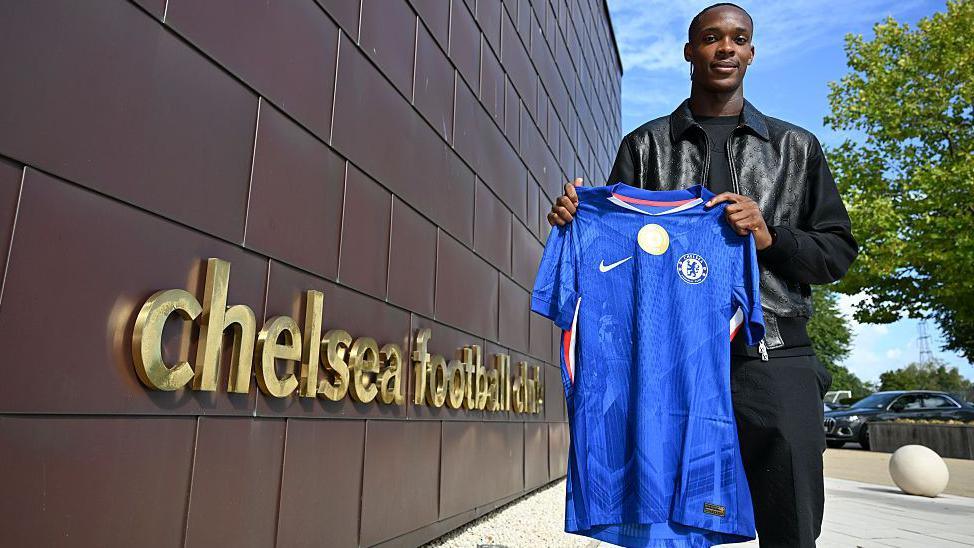
Eleven players have moved between Chelsea and Strasbourg, with the Ligue 1 club largely benefiting from loans and the arrival of England left-back Ben Chilwell in September.
There are strange cases, though, like Ishe Samuels-Smith, who moved to Chelsea from Everton‘s academy in 2023 and has never played a first-team game. In July, the 19-year-old full-back joined Strasbourg, only to return to Chelsea on transfer deadline day in September and immediately be loaned to Swansea City.
Defender Mamadou Sarr was sold to Chelsea in the summer, but made only one appearance as a substitute at the Fifa Club World Cup and is now back at Strasbourg on loan for this season.
Emegha will become the 12th player in July. With 14 Ligue 1 goals last season and seven in 11 in all competitions this campaign, the Dutch forward’s departure is more significant.
Another of BlueCo’s initial signings, he had only been made club captain weeks before the announcement. The ultras unfurled banners calling for the player to hand back the armband.
Could this mark a shift in opinion?
 Getty Images
Strasbourg are finding out that things are not always rosy down the food chain.
They are not the only fans to show their displeasure, either.
For instance, in May 2024 supporters of fellow French club Troyes, part of the City Football Group, protested by throwing flares on to the pitch and getting a match against Valenciennes abandoned.
Troyes had been facing back-to-back relegations to the third tier and were saved only by the bankruptcy of Bordeaux. They are now clear at the top of Ligue 2.
Fans can protest but there appears little football’s authorities can do to roll back on MCOs despite genuine concerns over the integrity of competitions.
Technically Fifa could restrict international transfers between the clubs, but that is not on the table.
Fifa does have jurisdiction within its own competitions. It removed Mexico’s Club Leon from last summer’s Club World Cup due to their association with Pachuca.
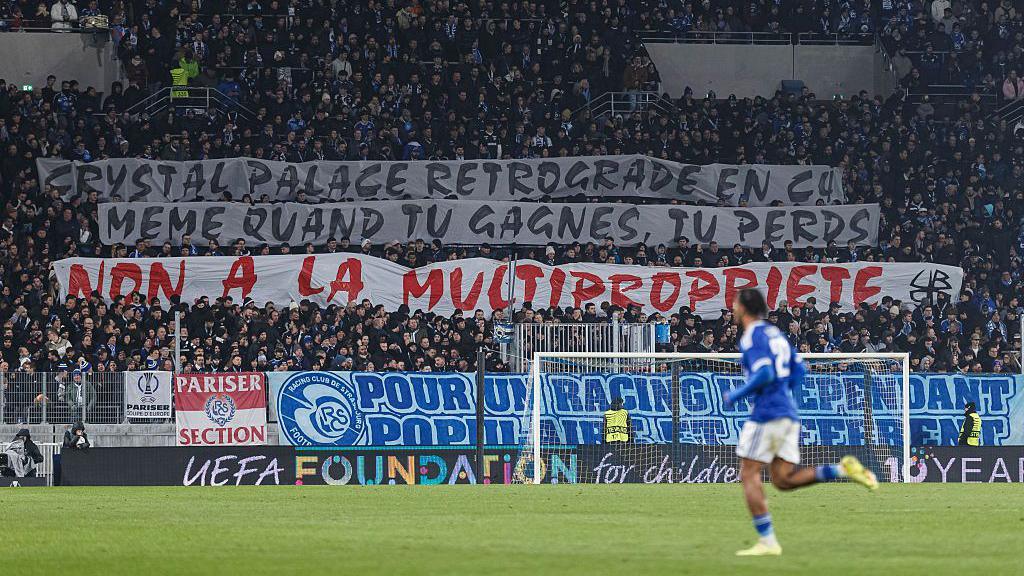
Uefa is getting tougher but has the same restrictions. Crystal Palace, Drogheda United and FC DAC 1904 became the first clubs ever to face demotion or removal from a competition this season for being in a multi-club structure.
It just so happened Strasbourg played Palace in the Europa Conference League. The French club’s ultras held up banners in solidarity with the Eagles when the two clubs met in November.
Last season Chelsea and Strasbourg could have been in the same European competition, but BlueCo took steps to be compliant with Uefa’s rules so both would be admitted. In the end that move was not tested, but it may be needed another time.
Uefa is expected to go further but whether it has the power to do anything which would halt MCOs is debatable.
That ship may have already sailed.
Related topics
-
-
17 October 2025
-
-
-
16 August 2025

-