
This post was originally published on this site.
Paul MurphyEast Yorkshire and Lincolnshire climate and environment correspondent
A nuclear bunker is “just a few days” away from falling into the sea due to coastal erosion.
The brick building, near Tunstall on the East Yorkshire coast, is thought to be about 70 years old and was designed as a look-out post in the event of nuclear war.
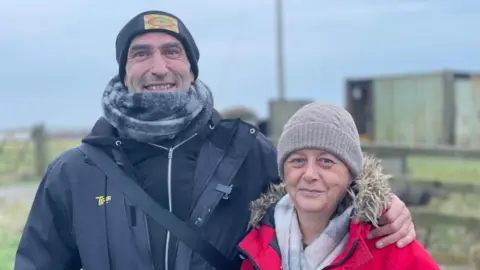
Amateur historian Davey Robinson, who is filming its final days, said: “We live on one of the most eroded coastlines in Europe and this bunker hasn’t got long left, perhaps just a few days,” he said.
East Yorkshire has some of the fastest eroding coastline in the UK, according to the Environment Agency.

Robinson and his partner Tracy Charlton have visited the site at Tunstall for the last nine mornings in the expectation that the bunker will fall into the sea.
“We are posting the footage on our YouTube channel and it’s getting interest from around the world,” Robinson said.
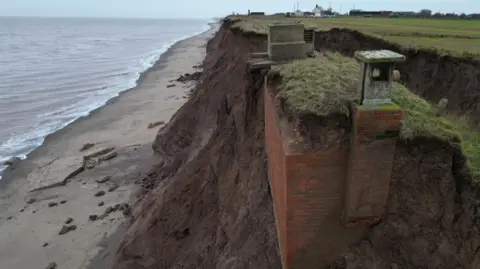
The clifftop bunker is one of a number of nuclear monitoring posts around the UK coastline, according to the historical research group Subterranea Brittanica.
Known as the Tunstall ROC (Royal Observer Corps) Post, it is believed to have been built in 1959 and decommissioned in the early 1990s.
Robinson said it contained sleeping and “very basic” living facilities.
“It was designed so that people could live inside it and just wait for a nuclear explosion to register and they could tell other people in other bunkers around the country,” he said.
“It never got used thank goodness.”
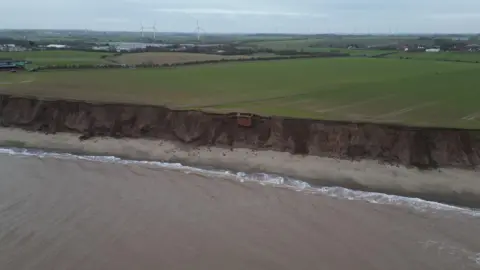
The Holderness coastline is eroding at an average annual rate of about 6.5ft (2m), according to the Environment Agency.
Approximately 3 miles (5km) of land is thought to have been lost since Roman times, including 23 villages, according to Internet Geography.
Robinson said the Tunstall bunker “adds a lot of meaning” to this process.
“It’s a symbol of erosion in this area,” he said.
“This whole area is eroding at a rapid rate and to see an actual physical thing moving it just shows what’s happening really.”
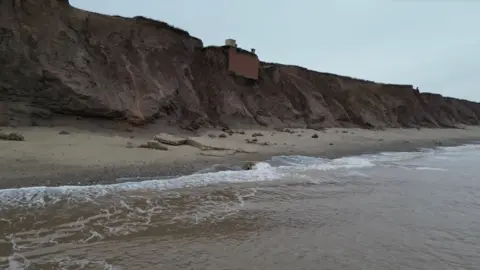
Charlton said they intended to keep visiting the site and filming the bunker in the days ahead as it “only had days left” before falling into the sea.
“We’re invested in this and I guess we’re obliged to keep visiting for the sake of the thousands of people who are now watching our videos on the YouTube channel,” she said.