
This post was originally published on this site.
Anthony ZurcherNorth America correspondent

A majority of the nine justices on the US Supreme Court appear inclined to uphold state bans on transgender women and girls competing in female school sports.
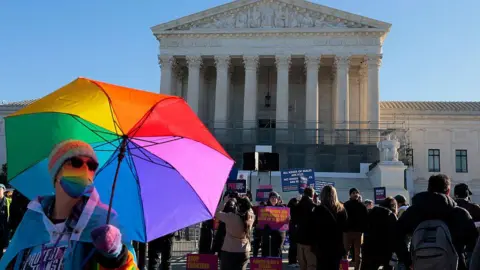
During oral arguments on Tuesday, the court considered cases from students in two different states who are challenging bans on participation. Both states require public school and collegiate sports teams to be designated based on sex recorded at birth.
In Idaho, a transgender college student argues the ban violates her constitutional equal rights protections. A West Virginia high school student also alleges that the state’s ban runs counter to federal civil rights law.
During more than three hours of arguments, at least five of the justices appeared to favour upholding the bans. The court has a 6-3 conservative majority.
In 2020, Idaho became the first state to implement a ban on transgender athletes competing in women’s and girls’ sports. Currently, more than two dozen states have similar legislation.
“Idaho’s law classifies on the basis of sex, because sex is what matters in sports,” said Alan Hurst, the Idaho solicitor general who argued for the state. “It correlates strongly with countless athletic advantages, like size, muscle mass, bone mass and heart and lung capacity.”
“We have to decide for the whole country,” said Justice Brett Kavanaugh, one of conservatives on the court. “When half the states are allowing transgender athletes to participate, half are not, why would we jump in and try to constitutionalise a role while there is still… uncertainty and debate?”
With six conservative, Republican-appointed justices who may be more inclined to side with the states, the court’s three liberals and the lawyers representing the two athletes tended to argue for a narrow decision on Wednesday – or no decision at all.
One of the athletes, Lindsay Hecox, a senior at Boise State University, has said she no longer wants to compete in university-sponsored sport and has attempted to withdraw her lawsuit. Justice Katanji Brown Jackson repeatedly asked why that case had not been dismissed because of this.
 Getty Images
During her time in front of the justices, Hecox’s lawyer, Kathleen Hartnett, said that if the justices chose to consider the merits of her case, they should draw a distinction between athletes who take testosterone-suppressing drugs, like her client, and other transgender athletes.
Responding to a question from Kavanaugh about whether allowing transgender athletes to compete in women’s competitions would have an adverse impact on sports, Hartnett said she was not asking the court to allow individuals to compete who have an “unfair biological advantage”.
“That would undermine the entire point of separate sports in the first place, which was to allow women to have a place to thrive, to be strong, to win,” she said.
But if “sex-based advantages” were mitigated, she said, transgender athletes should be allowed to compete. She added that it would be incumbent on the transgender athletes to provide evidence of such mitigation.
Lawyers for both sides noted the small number of individuals at issue in this case. In West Virginia, the plaintiff, Becky Pepper-Jackson, is the only student seeking such access. Her parents filed the case in 2021, when she was 11 years old and sought to join her school’s girls track team.
When asked by Justice Neil Gorsuch whether there is a history of discrimination against transgender individuals that merited giving them special protections, Hurst, the lawyer representing Idaho, responded that while there had been “significant discrimination”, it was expressed in laws that applied to everyone, such as bans on cross-dressing.
Transgender individuals, he continued, did not face the kind of denial of civil rights that black Americans and women faced, for which the legal and constitutional protections in question were intended.
“If we look at that history, and we compare it to the history of African-Americans and women who were not able to vote, who were not able to own property, who had express classifications based on their status written into the law for most of this country’s history, these things don’t compare,” he said.
According to an opinion survey last January by the New York Times/Ipsos, almost all Republicans and nearly seven in 10 Democrats oppose allowing transgender female athletes to participate in women’s sports.
Trump made the issue of transgender athletes in women’s sports a regular focus of his 2024 campaign. Since returning to the White House, his administration has moved to rescind anti-discrimination protections for transgender individuals, expel them from the armed forces and pressure states and athletic associations to prohibit transgender athletes in female competition.
Last year, the six conservative justices voted to uphold a Tennessee law banning gender transition treatment for young people. While the court did not directly address the issue of transgender discrimination, it has been viewed by some legal experts as a better indication of how the court will decide in the athletics cases than a 2020 case in which the court ruled that discrimination against transgender workers violated federal employment law.
It may not be long before the justices have a chance to weigh in on the topic directly, as the Trump administration is pursuing a lawsuit alleging that California’s policy allowing transgender athletes to compete is illegal.
In the meantime, the court is expected to issue a decision on these cases in June.