
This post was originally published on this site.
David Grittenand
Jon Donnison,Jerusalem

US envoy Steve Witkoff has announced the start of phase two of President Donald Trump’s plan to end the war in Gaza, with a technocratic Palestinian government established in the territory.
Under phase one, Hamas and Israel agreed a ceasefire in October, as well as a hostage-prisoner exchange, a partial Israeli withdrawal, and an aid surge.
Witkoff said phase two would also see the reconstruction and full demilitarisation of Gaza, including the disarmament of Hamas and other Palestinian groups.
“The US expects Hamas to comply fully with its obligations,” he warned, noting these include the return of the body of the last dead Israeli hostage. “Failure to do so will bring serious consequences.”
However, two key points of phase two could be problematic.
Hamas has previously refused to give up its weapons without the creation of an independent Palestinian state, and Israel has not committed to fully withdrawing from Gaza.
The ceasefire is also fragile at best, with both sides accusing each other of repeated violations. Almost 450 Palestinians have been killed in Israeli strikes since it came into force, according to Gaza’s Hamas-run health ministry.
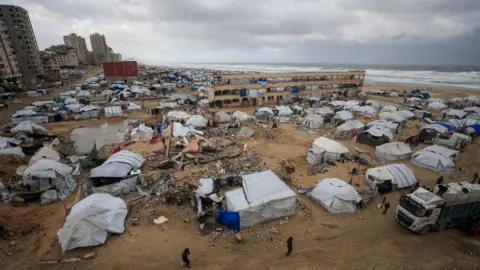
And humanitarian conditions in the territory remain dire, according to the UN, which has stressed the need for the unrestricted flow of critical supplies.
In his statement, Witkoff declared that with the launch of phase two of Trump’s 20-point peace plan on Wednesday, Gaza was “moving from ceasefire to demilitarisation, technocratic governance, and reconstruction”.
“Phase Two establishes a transitional technocratic Palestinian administration in Gaza, the National Committee for the Administration of Gaza (NCAG), and begins the full demilitarization and reconstruction of Gaza, primarily the disarmament of all unauthorized personnel,” he said.
Following the announcement, regional mediators Egypt, Gaza and Turkey welcomed the formation of what they called the “Palestinian Technocratic Committee to Administer the Gaza Strip”, saying it would contribute to “efforts aimed at consolidating stability and improving the humanitarian situation”.
They also revealed that the 15-member committee would be headed by Ali Shaath, a former deputy planning minister in the Palestinian Authority (PA), which governs parts of the occupied West Bank not under Israeli control.
Gaza’s transitional administration will operate under the supervision of a “Board of Peace”, which will be chaired by Trump, according to the 20-point plan he unveiled three months ago.
Announcements related to the board are expected in the coming days, including when the president visits the World Economic Forum in Davos next week.
Nickolay Mladenov, a Bulgarian politician and former UN Middle East envoy, is set to be the board’s representative on the ground in Gaza.
Trump’s plan says an International Stabilisation Force (ISF) will also be deployed to Gaza to train and support vetted Palestinian police forces.
Earlier on Wednesday, Hamas and its ally Palestinian Islamic Jihad (PIJ) said in a joint statement that they had agreed to support the efforts to form the technocratic Palestinian government “while providing the appropriate environment” for it to begin work.
The PA – which is dominated by Fatah, Hamas’s rival – also expressed support.
Vice-President Hussein al-Sheikh said Trump’s leadership urged all Palestinian factions, institutions and segments of society to “ensure the success of this critical transitional phase”. He also stressed the importance of linking institutions in the West Bank and Gaza in order to uphold “the principle of one system, one law, and one legitimate weapon”.
According to Trump’s plan, the PA will take over governing Gaza once it has completed reforms and can do so “securely and effectively”.
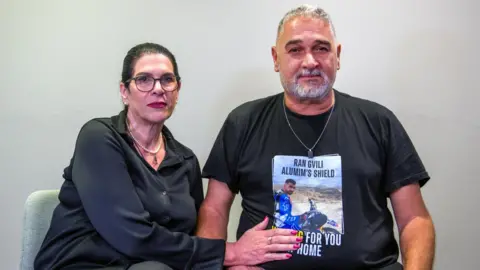
Israeli Prime Minister Benjamin Netanyahu’s office said he had spoken on Wednesday evening with the parents of Ran Gvili, the last dead hostage in Gaza.
He made it clear to Itzik and Talik Gvili that “Ran’s return is a top priority and that the declaratory move regarding the establishment of a technocratic committee will not affect the efforts to return Ran for a Jewish burial”, the office added.
The Hostages and Missing Families Forum insisted: “There is no phase 2 while Ran Gvili in Gaza. Phase Rani must come first.”
The Israeli government had accused Hamas of deliberately delaying the recovery of the 24-year-old police officer’s remains and said it will not reopen the Rafah border crossing between Gaza and Egypt – one of its obligations under phase one – until they are handed over.
Gvili was among the 251 people abducted during the Hamas-led attack on southern Israel on 7 October 2023, when about 1,200 other people were killed.
Israel responded to the attack by launching a military campaign in Gaza, during which more than 71,430 people have been killed, according to the territory’s health ministry.