

This post was originally published on this site.
Erica WitheringtonDisability producer

Changes to a flagship scheme that encourages firms to employ more disabled people don’t go far enough, campaigners say.
Disability Confident, a voluntary employer scheme, was launched in 2016 to get more businesses to recruit and retain disabled people.
It had faced criticism, including from the current disability minister, that it allowed employers to be accredited without them needing to actually employ disabled people.
The government today outlined plans it said would make sure firms who sign up were encouraged to make “progress”.
But charities have told BBC News employers will still be able to certify themselves without employing “a single disabled person”.
Disability Confident is one of the UK government’s flagship schemes aimed at getting more disabled people into work and giving them a better experience in the workplace.
It is the only scheme focused entirely on employers, whether they are a one-person business or a global company.
It is voluntary to join and works like a badge system, accrediting employers based on how supportive they are of workers with disabilities.
Employers sign up at Level 1 (“committed”) by pledging to be inclusive, then move to Level 2 (“employer”), by completing a form confirming they have put certain policies in place.
At Level 3 (“leader”), they submit evidence of their inclusiveness for peer review, and are audited by another Level 3 employer.
Critics of the scheme say that with no strict audit, and only self-certification until Level 3, there is no guarantee employers have implemented the practices they claim to have done, or actually employed anyone disabled.
Under today’s reforms, the government says organisations will no longer be able to sit at Level 1 – “committed” – indefinitely.
Membership at this level will be capped at two years, with no option to renew, to encourage employers to make progress, the government says.
Other changes include tailored support for small businesses, peer-to-peer learning, and guidance “shaped by the voices of disabled people”.
Sir Stephen Timms, Social Security and Disability Minister, said the government was “determined to see more disabled people in work” and that overall employment figures would be the “acid test”.
He described the scheme as having “enormous potential” but acknowledged that for “too long, it has not delivered enough support for disabled people, or for employers who want to recruit, retain and develop disabled people”.
“That’s why we are improving the scheme, through robust reforms to ensure a better service for all, including through greater support for SMEs and improving access to resources for employers.”
‘It’s just a badge’
However, there have been calls from campaigners and academics for employers at Levels 2 and 3 to be held to hiring targets – a minimum percentage of their workforce who are disabled – to maintain their accreditation.
This has not been introduced.
Timms had previously pressed for stronger criteria, challenging the then Conservative government in 2024 to deliver meaningful change.
As chair of the Work and Pensions Committee, he criticised the scheme for focussing on “process rather than outcomes”.
Pressed by the BBC on whether an employer would lose their accreditation if they did not go on to employ anyone disabled, Timms said: “No, we’re not changing the rules in that way.
“What we want to do is encourage employers to progress up the scheme.”
The disability groups Inclusion London and Scope said the reforms failed to address the core problem. James Taylor, an executive director at Scope, said the scheme “lacks the teeth, lacks the funding and probably lacks the ambition too”.
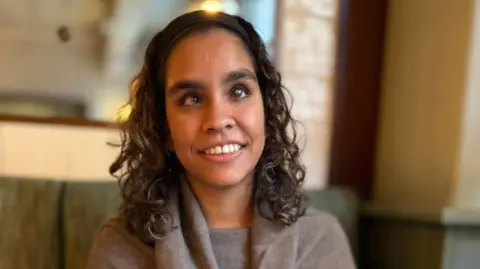 Jane Constance
HR professional and disability advocate Jane Constance, 25, says her experience applying to a series of Disability Confident employers felt “hopeless”.
She was astonished to be asked “silly questions” by recruiters, such as “‘Oh, so you’re blind. So how would you use a computer? How would you read?'”
In one case, a recruiter assumed she needed a sighted guide or a support worker.
“I use a BrailleNote,” she pointed out. “This was a hopeless conversation.”
Of the scheme, Jane says: “It’s just a badge – it doesn’t mean they’ll hire you.”
The scheme ‘just doesn’t work’
Professor Kim Hoque from Kings College London, who co-authored research into the scheme in 2023, says Disability Confident “just doesn’t work.”
His research found “very little evidence” Disability Confident employers hire more disabled people or provide better workplace experiences for disabled people than those not in the scheme.
Of today’s reforms, Hoque said: “The only bit with teeth is stopping people staying at Level 1 indefinitely.
“The rest looks incredibly fluffy – more of the same failed status quo.”
The Department for Work and Pensions said it would “continue engaging closely with a variety of stakeholders including organisations representing disabled voices, as we have done throughout our planning for the reforms”.
“We will also be engaging with the recently announced Independent Disability Advisory Panel,” it said.


