
This post was originally published on this site.
Anita Nkonge,BBC Africa,
Damian Zaneand
Lucy Fleming

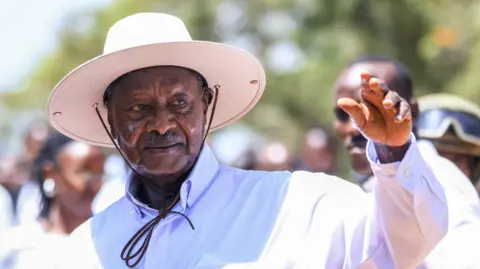
Ugandan President Yoweri Museveni has been declared the winner of Thursday’s election extending his four decades in power by another five years.
He gained 72% of the vote, the election commission announced, against 25% for his closest challenger Bobi Wine, who has condemned what he described as “fake results” and “ballot stuffing”.
Wine has not provided any details and the authorities have not responded to his allegations, but African Union election observers said they saw “no evidence of ballot stuffing”. Wine has called for non-violent protests.
Museveni, 81, first came to power as a rebel leader in 1986 but since then has won seven elections.
The election process was marred by violence and Wine, a 43-year-old former pop star, says that at least 21 people have been killed around the country in recent days.
The authorities have so far confirmed seven deaths.
Announcing the results, electoral commission head Simon Byabakama asked supporters of both factions to embrace unity and accept the results.
Beyond the national tallying centre, there have been minimal celebrations, with most roads in the capital, Kampala, empty and businesses closed.
However, pockets of violence have been reported in several neighbourhoods.
Access to the internet has been cut in the country since Tuesday, making it hard to verify information.
The authorities say the blackout was necessary to prevent misinformation, fraud and the incitement of violence – a move condemned by the UN human rights office as “deeply worrying”.
Wine has demanded that the internet be restored.
 Reuters
Leading the African Union observer mission, Nigeria’s former President Goodluck Jonathan told journalists that “the government should refrain from the suspension of internet access” close to the election.
He also denounced “reports of intimidation, arrest and abductions” saying they “instilled fear and eroded public trust in the electoral process”, AFP news agency reports.
Speaking to the BBC, Wine’s assistant Dan Magic alleged that security personnel entered the opposition leader’s home on Thursday night in order to take him. It is not clear what happened next, but Magic said that Wine’s whereabouts were unknown.
Wine had previously said he was under house arrest. On Saturday, he posted a statement on Facebook saying he had evaded an attempt to seize him.
This has not been confirmed by the police but spokesman Kituuma Rusoke said the politician’s movements had been restricted because his home was an area of “security interest”.
“We have controlled access to areas which are security hotspots,” Uganda’s Daily Monitor paper quoted him as saying.
“We cannot allow people to use some places to gather and cause chaos,” he said.
Wine says he represents the youth in a country where most of the population is aged under 30.
During the campaign, he promised to tackle corruption and impose sweeping reforms, while Museveni argued that he was the sole guarantor of stability in Uganda, a country with a history of conflict.
There were six other candidates but none got more than 2% of the vote. Turnout was 52.5%.
The campaign period was marred by the disruption of opposition activities – security forces have been accused of assaulting and detaining Wine’s supporters.
Rusoke, the police spokesperson, dismissed these complaints, accusing opposition supporters of being disruptive.
Additional reporting by Joseph Winter and Sammy Awami in Kampala
 Getty Images/BBC