
This post was originally published on this site.
Nichola RutherfordBBC Scotland News

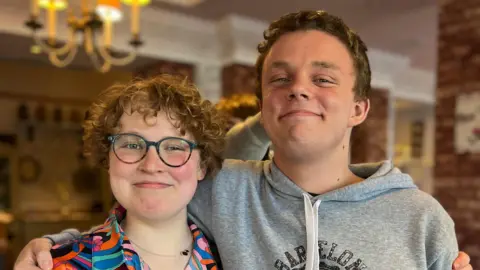
When Lachlan Lindsay was eight, he was diagnosed with a brain tumour. Surgeons acted quickly and he made a good recovery.
It was a painful experience for Lachlan and a worrying time for his family back home in Stonehaven, but one they hoped never to repeat.
Six years later Lachlan’s younger cousin Hazel Dempster, who lives in Kirkcudbright, began suffering from worrying headaches and her GP referred her for a scan.
“Imagine if we both had a brain tumour,” he joked in a phone call to reassure her ahead of her first MRI.
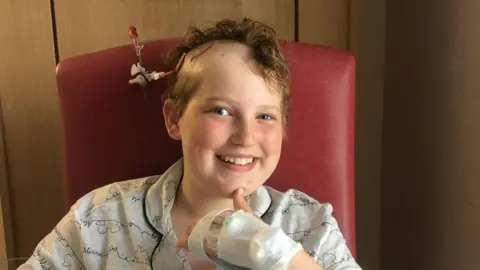
Within days, the 12-year-old was undergoing emergency neurosurgery to drain fluid from her brain caused by a growth bigger than a golf ball.
“It was a massive shock because the likelihood of [two cousins having brain tumours] is so miniscule,” said Hazel, now 16.
“But I think I’ve probably got a closer relationship with Lachlan now because it’s something me and him can relate to that practically nobody else in our life can.”
 Louise Dempster
Both teenagers are now living with their tumours as neither can be removed by surgeons due to their position in the brain.
Their conditions are not known to be genetically linked – and they say it’s just “bad luck” that it has hit their family twice.
“To be honest, we just joke about it… I don’t know if it’s a coping mechanism,” Hazel, who is studying for her Highers at Kirkcudbright Academy, told BBC Scotland News.
“To me, having a brain tumour is just part of me, it’s not something big or that big a deal. It’s just part of me, it’s like my arm, my leg, my brain tumour.”
Hazel has an optic chiasm pilocytic astrocytoma – a slow-growing tumour which presses on her optic nerve and affects her vision.
Since that first surgery following a blue-light ambulance trip to the Royal Hospital for Children in Glasgow, she has had six further operations.
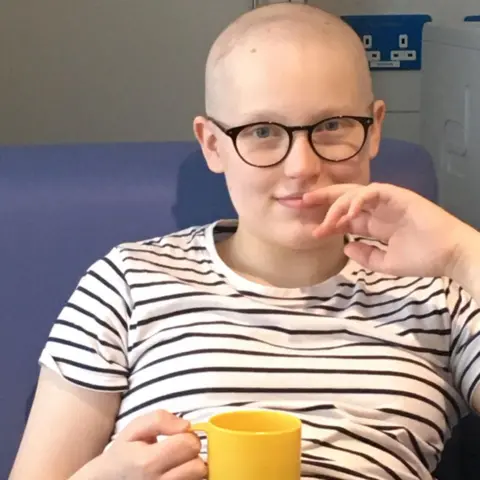
The schoolgirl also endured gruelling chemotherapy which caused a catalogue of side effects, including prolonged nerve pain which affected the way she walked and her ability to use her fingers.
“It feels like you’re wearing big winter gloves every day, all the time so you can’t actually feel what you’re doing like zips and buttons and laces on your shoes.”
A lowered immunity meant she had to be careful to avoid picking up infections, and she missed out on normal childhood experiences.
“I went to a trampoline birthday party in Carlisle and I just had to sit in the cafe because I wasn’t allowed to go on the trampolines,” she said.
 Louise Dempster
Now she takes a daily oral chemotherapy which enables her to lead a relatively normal life – interspersed with regular medical appointments.
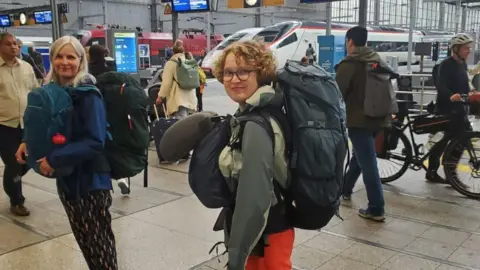
After several years of medically-enforced staycations, the family managed to travel abroad last summer for an ambitious rail trip across Europe.
Hazel also aced her National 5 exams, and as a young leader with her local Scout troop she was recognised by the Chief Scout with an Unsung Hero award.
“I don’t really think about what I do, you know, going to Scout camps on treatment and having to take meds in a tent before I go out,” she said.
“I don’t think of any of it as anything special, it’s just sort of my life. It’s just how I go about things, what I do. But it’s nice that people see it as something else, something bigger.”
 Louise Dempster
Her tumour will not shrink – but it remains stable.
Having spent so much time on the Schiehallion ward at Glasgow’s children’s hospital, she knows others who have not survived their illnesses.
“I’m enjoying and savouring feeling well because I know what it’s like to not to,” she said.
‘The worst pain I have ever felt’
Meanwhile Lachlan, now a first year student at the University of Aberdeen, tries not to think about his tumour – a relatively rare one called a tectal plate glioma.
A scan detected the benign mass on his brain after he developed a slight squint and suffered occasional painful headaches.
“I remember being taking to hospital. I remember the first ever MRI I had. I remember the diagnosis. I remember being told that I had a tumour and the hydrocephalus [fluid build-up] at the back of my head could kill me if it wasn’t treated,” he said.
His mum Claire insists he was not given the news quite so bluntly.
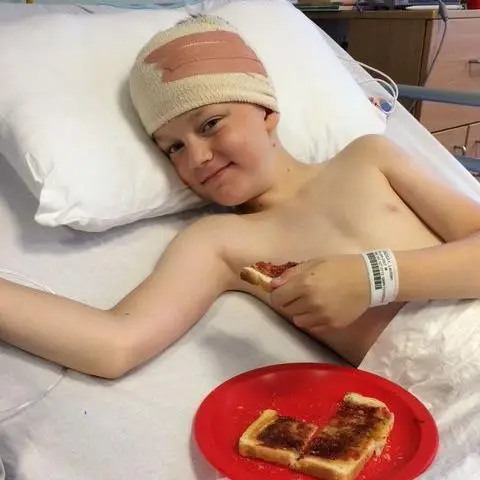
The following day they were sent to the old Sick Kids’ Hospital in Edinburgh where he had emergency surgery to remove fluid build-up from his brain.
 Claire Lindsay
“I woke up [from operation] and I experienced the worst pain I have ever felt in my life and nothing else has ever come close since,” the 19-year-old said.
“It was days before I could properly turn my head because of how much it hurt to do so. That was one of the lowest point of my entire life.
“I remember waking up that evening in the ward, and mum wasn’t there because she had gone to the accommodation, and just looking around and thinking – oh my god, where am I? What’s going on? That was terrifying.”
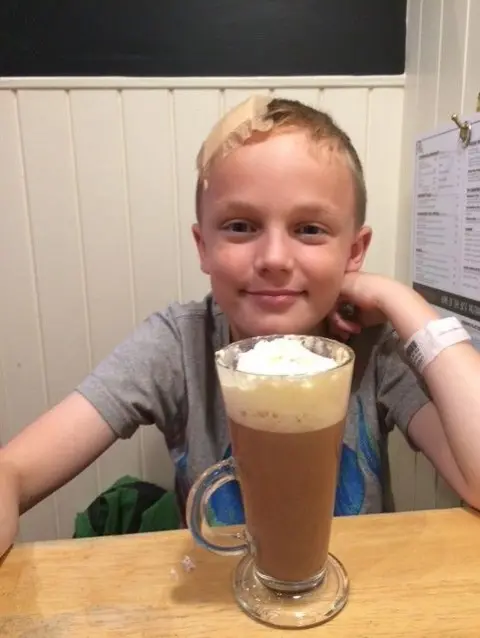
He says the tumour has given him dyspraxia – a condition affecting physical co-ordination – and his “processing speed” has slowed.
 Claire Lindsay
“Sometimes I will take longer to understand a question in a test because the tumour holds me back,” he said.
“My full potential is always going to be less than what it could have been if this wasn’t there. Sometimes that does really upset me.”
But he added: “I’ve managed to do pretty well for myself in spite of my limitations.”
Now studying English and Film & Visual Culture, he has dreams of becoming a Hollyood film director.
The cousins’ aunt, Emma Christie, is among family members affected by Lachlan and Hazel’s life-changing diagnosis.
An author, she has raised more than £3,000 for The Brain Tumour Charity while promoting her latest crime thriller.
“I’ve often felt helpless in the face of such a life-changing diagnosis but by supporting the charity and helping to raise funds for research, I feel like I’m transforming the grief into positive action,” she said.