
This post was originally published on this site.
Kate McGoughEducation reporter

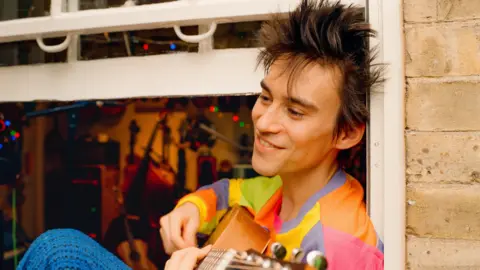
Grammy Award-winning artist, composer and producer Jacob Collier has told the BBC that singing together can combat social isolation in young people and “bypass the artificial digital boundaries created around us”.
He was speaking ahead of the launch of BBC Get Singing, a new music education initiative aimed at getting more teenagers across the UK to sing together.
Collier says he “wouldn’t be the person [he is] today” if he hadn’t been encouraged to start singing at school.
Recent research suggests singing together as a group is something children become less exposed to as they reach their teenage years.
A third of state secondary school teachers said their school didn’t have a choir, and over half of state secondary teachers (57%) said their pupils never sang together in assembly, according to a recent survey of approximately 10,000 teachers in England by the survey tool Teacher Tapp.
The BBC has now launched BBC Get Singing, its biggest music education initiative in a decade, aimed at getting thousands more 11-14 year olds singing together across the UK.
The three-year project can be accessed for free through BBC Bitesize, where there are arrangements of songs available, with additional videos to help teachers and students explore and learn each song, including tips on vocal warm-ups.
The two musical arrangements available from Tuesday are ‘Live More & Love More’, by Celebrity Traitors star Cat Burns, and ‘Piping Down the Valleys Wild’ by Bob Chilcott.
More newly-arranged songs will be released later this year, including Jacob Collier’s song ‘Something Heavy’.
Collier, a seven-time Grammy Award-winning artist, is ambassador for the scheme – a role he said was a “total no-brainer”, adding that he was “thrilled to be a part of the whole mission.”
“I think one of the challenges as a young person in this time is the isolation that comes about when you sit in your little bubble,” he said.
“Those of us who had the experience as children of singing in choirs never forget the feeling, because you’re part of something much bigger than yourself.
“It bypasses so many of the artificial digital boundaries that are created around us, and reminds us of something far more ancient than that.
“Music embeds a sense of confidence, I think, in the individual in a way that nothing else does. And that can be applied to anything that you go on in your life and do.”
Bekki Kosher, head of music at Parrs Wood High School in Manchester, says the mental health benefits of singing are clear among her students, though she admits it is “sometimes difficult getting students to see that music isn’t just something that happens on a phone”.
“It just gives them that lift,” she says.
“You can park everything else at the door and just be you, just have fun, just smile.”
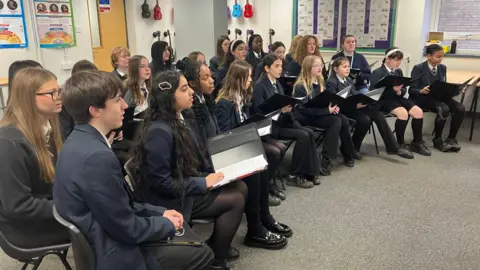 Kate McGough / BBC
Pupil Alesha, 14, says singing in the school choir brings everyone together.
“It’s how I express myself,” she says.
“So whenever I’m sad, angry, happy, I play music all the time and sing.”
Over the next three years, BBC Get Singing will expand with interactive singing workshops and performances for young people, and training opportunities for teachers and vocal leaders.
There are also plans to commission a research project to explore the benefits of collective singing on young people.