
This post was originally published on this site.
Yasmin RufoBBC News

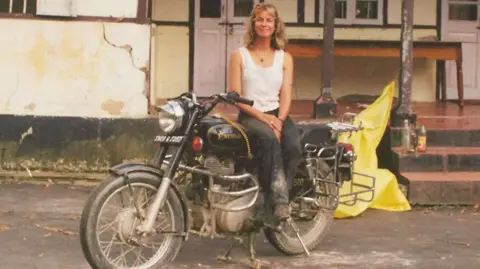 Jacqui Furneaux
An affair, a stalker and a sudden act of violence are undeniably big, disruptive events.
For three people, they didn’t just alter the course of their lives – they reshaped them completely.
Over time, the have rebuilt their confidence and identity. They share how they did it with Dr Sian Williams, host of Radio 4’s Life Changing series.
I’ve learnt to be happy with myself
 Jacqui Furneaux
At 49, Jacqui Furneaux, a nurse and mother of two from Bristol, had an affair which ended her marriage, but using her divorce settlement to fund a journey around the world, changed her life forever.
She says her daughters knew of the affair “a long time before I thought they knew” and despite moving in with the man she left her husband for, “it didn’t work out”.
“I hated myself. I felt I’d ruined a perfectly happy family,” Jacqui says.
Overwhelmed by guilt, and embarrassed she fled the country in a bid to escape her unhappiness, booking a one-way ticket to Bangok. It was the start of a seven-year journey across the world – from Thailand to Laos, through Pakistan and onto India – which ultimately helped her come to terms with her life and choices.
Her most significant decision was a relationship with a Dutchman, 17 years her junior, who she met in India. He was travelling through the country by motorbike and asked her to join him on the back of his bike.
“I’d been in India for long enough to know that the bizarre is normal,” she says. “I thought how often is life going to offer me this opportunity.”
Eventually she bought her own bike. She said taking the leap to have a long term relationship with someone she’d only met for two days undoubtedly enriched her life even though the pair split up after three years.
It was only when her daughter asked her how much longer she was going to be away as they “need a mother” that she realised she was still loved and needed.
“I hadn’t forgive myself for the affair and I didn’t think anyone else would either – I thought I would be forever in disgrace.”
Decades on, she says she’s forgiven herself “more or less” but the main thing is that she is “learning to be happy with myself”.
While she isn’t encouraging people to follow the same path as her, her travels have taught her a lot about herself.
“Everyone can push their boundaries a little bit to raise confidence,” she says.
‘I focus on what I can do’
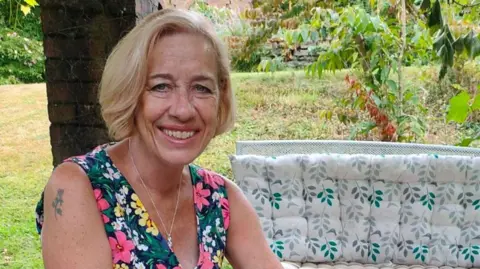 Angela Tilley
Angela Tilley was independent and fearless as a teenager but her confidence was shattered at the age of 16 after she became the target of relentless stalking in her first job.
The unwanted attention continued for more than a year, with threats, emotional manipulation and disturbing behaviour, none of which was taken seriously at work.
When the man was finally transferred, Angela felt relief, but soon after, she experienced her first panic attack on a train.
“I didn’t know they were called panic attacks. I just thought I was perhaps going mad,” she explains and remembers thinking: “Am I going to faint? Am I going to have a heart attack? Am I going to make a complete fool of myself in front of all of these people?”
The attacks started to become more regular and were “an overwhelming bodily feeling” which left her terrified of being “trapped” and gradually, everyday situations – commuting, shopping, sitting in traffic – became unbearable.
Diagnosed with agoraphobia, Angela forced herself to keep going. She married, raised children, tried therapies, read books and repeated the mantra “feel the fear and do it anyway”.
The real breakthrough came in 2015, when she bought a motorhome with her husband.
They would often borrow her parents’ caravan and the pair had always thought a motorhome might be a good thing.
Carrying her “home” with her gave Angela a sense of control she had never had before.
“It opened up my life and the more I challenged the big stuff the better the smaller challenges in my life became,” she explains.
Trips that once felt impossible slowly expanded from a 50-mile radius to journeys across Europe.
“I can’t do everything but I try to put my focus on the things I can do rather than the things I can’t,” says Angela.
‘I was told I’d never see again’
In 1977, Ed Stewart was a carefree 17-year-old with a new engineering job, a girlfriend and a motorbike.
Then, at a party, his life changed in an instant. After Ed challenged another teenager who was making threats, the boy raised a shotgun and fired “right between my eyes”.
Although the cartridge contained no shot, the blast of cork and gunpowder devastated Ed’s face. “It blew my face to pieces basically,” he recalls. “Straight away I was blind.”
Lying on the ground in agony, he remembers thinking, “God, please don’t let me die. I don’t want to die.”
In intensive care, the pain was “excruciating”, and although he knew he was “totally blind” he tried not to “dwell on it”.
Registered blind, Ed admits he did “some stupid, stupid things” in an attempt to feel normal, including standing on the edge of a multi-storey car park. “I think it was a cry for help,” he says now.
A year after the incident he was moved to a rehabilitation centre in Torquay which bought both anger as well as opportunity.
When told he would never see again, Ed “flew into a rage”, but a piano at the centre sparked a new path.
“I’d just sit there most evenings, tinkling on it,” he says and that curiosity led him to train as a piano tuner.
Years later, Ed decided to undergo a risky surgery at Moorfields Eye Hospital to remove a clot from his eye.
The gamble paid off and within four months he could see again in one eye, a moment which he describes as “incredible”.
Suddenly he could see his own face, and he could also witness other people’s reactions for the first time. “You’re self-conscious about that. It will always be there.”
There are times when he thinks, why me? But it doesn’t last long. “I’m lucky to be here,” he says.
A list of organisations in the UK offering support and information with some of the issues in this story is available at BBC Action Line