
This post was originally published on this site.
Vikas PandeyDelhi

 Reuters
The trade deal between India and the European Union is as much about geopolitics as it’s about intercontinental business relations.
The EU is already India’s largest partner with trade in goods reaching $142.3bn (£104.07bn) in 2024, amounting to 11.5% of the South Asian nation’s total trade. India is the EU’s ninth largest trading partner.
These are impressive numbers and reflect strong relations. And yet, trade talks were stuck for two decades.
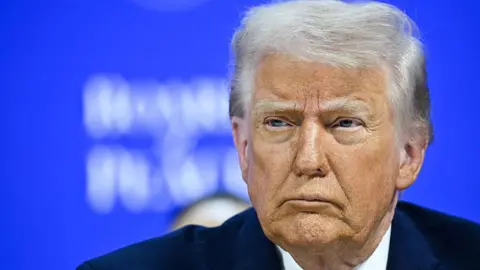
That raises the question: what’s changed now? The answer lies in the fast-evolving geopolitical landscape and the unpredictability of the US administration under President Donald Trump.
The US leader has used tariffs as a bargaining chip in some negotiations but he has often used them to punish countries, including partners, which don’t agree with his worldview.
The US has imposed 50% tariffs on Indian goods, which include a 25% penalty for Delhi’s refusal to stop buying oil from Russia.
Some EU countries recently faced fresh tariff threats from Trump as the US president was put out by their refusal to accept his proposed takeover of Greenland. He later withdrew the threat, but experts say it did rattle the EU.
The EU and India are not alone in looking to hedge their bets when it comes to the US – the free trade agreement (FTA) in Delhi was secured amid a flurry of countries striking deals and patching things up as they try to cope with global unpredictability.
The EU-India pact – the seventh trade deal India has completed recently – comes after Brussels signed a trade accord with South American trade bloc Mercosur earlier this month after 25 years of negotiation. Experts say the Trump factor helped speed that up too, though it’s now facing legal challenges in Europe.
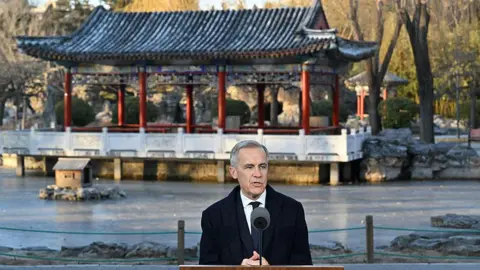
Canadian Prime Minister Mark Carney – who warned of a “rupture” in the post-war international order last week – is just back from a visit resetting ties in China which will boost trade ties, drawing Trump’s ire and fresh threats of 100% tariffs. Carney is also due to travel to India in the near future, with trade high on the agenda. UK Prime Minister Keir Starmer is heading to Beijing this week, accompanied by dozens of British business executives, following years of strained ties with China.
Against this backdrop, the India-EU trade deal, which is still subject to ratification, assumes greater geopolitical significance as it achieves more than just trade results – for both Brussels and Delhi.
It sends a message to Trump that global powers have started to look at ways to club together to protect themselves against his administration.
“One could argue that the Trump factor provided a very strong impetus to the deal because both India and the EU are facing shock US tariffs that they never expected,” said Michael Kugelman, senior fellow for South Asia at the Atlantic Council.
He added that Trump is a big reason why the EU and India have been able to overcome most of their differences and put issues they couldn’t resolve on the back-burner for future negotiations.
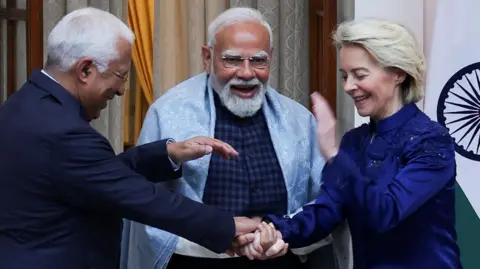
Indian Prime Minister Narendra Modi and President of the European Commission Ursula von der Leyen both called Tuesday’s agreement “the mother of all deals”.
“This is the tale of two giants – the world’s second and fourth largest economies – two giants who choose partnership in a true win-win fashion, a strong message that co-operation is the best answer to global challenges,” said von der Leyen, standing beside Modi after they exchanged agreements.
“By combining these strengths, we reduce strategic dependencies at a time when trade is increasingly weaponised… We are not only making our economies stronger – we are also delivering security for our people in an increasingly insecure world.”
Modi said the global order is in “great turmoil” and the trade deal would strengthen supply chains globally.
“This means it is not just a trade agreement. This is a new blueprint for shared prosperity,” he said.
The two leaders’ may or may not have intended the deal to annoy the Trump administration, but they appear to have done exactly that.
US Treasury Secretary Scott Bessent told ABC News on Sunday that the EU was “financing the war against themselves” by signing a trade deal with Delhi.
He was referring to India’s purchase of Russian crude, which US officials have often said was indirectly financing Moscow’s war in Ukraine. India has always denied this, saying the purchase of Russian oil secures energy needs of millions of its people.
The time-tested Delhi-Moscow relations are also the reason why India has been reluctant to abruptly cut business ties with Russia. It has long relied on Moscow for military hardware but today’s deal will help it build on already strong defence ties with France as it looks to diversify its defence imports portfolio with other European nations too.
The India deal also gives the EU access to another huge market and may help it reduce its reliance on China in the future.
“India will also look at this partnership as a way to counter China’s dominance in global trade, which it envisaged doing with the US. But it’s a different state of play right now. The EU likewise sees India as a useful country to partner within its own efforts to counter China,” Kugelman added.
But it’s worth remembering that behind the chest-thumping headlines, there is still plenty of work to do for both India and the EU. While negotiations around the deal have concluded, the formal signing of the agreement will take a long time.
 Getty Images
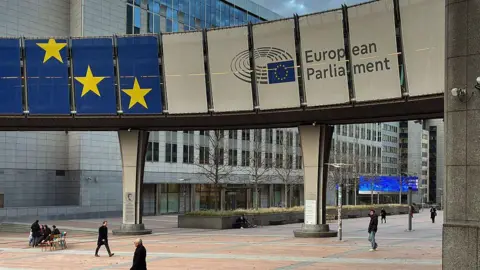
Legal experts from both sides will take months to finalise the text of the deal and then it will have to be ratified by member states and the European Parliament, which experts say is not going to be a cakewalk, as the Mercosur deal shows.
Mark Linscott, senior adviser for trade at the US-India Strategic Partnership, wrote on LinkedIn that there are still issues to be ironed out, including on intellectual property, agriculture and carbon emissions.
But business groups in Europe and Indian industries badly affected by US tariffs have broadly welcomed the deal for increasing market access in both directions.
Fredrik Persson, president of BusinessEurope, which represents business groups across the EU, said it was an important “first step”. But he added: “Implementation will be key to unlocking the agreement’s full potential.”
 Getty Images
Trump’s tariffs may have hastened the deal struck in Delhi but that is not the only reason it happened. Both the EU and India restarted serious negotiations in 2022 with the aim of reaching accord as early as possible.
The EU deal also underpins India’s renewed interests in signing more Free Trade Agreements (FTAs) with nations and blocs and opening its vast market, which has traditionally been protected.
The EU is India’s biggest trading partner – so no surprise that the size of the deal is much bigger than other FTAs, including the one with the UK.
In this context, India will not want to give up on its trade negotiations with the Trump administration as the US continues to be a vital and significant market for India. And the EU wouldn’t want to upset Washington either.
But if this deal helps them both get more leverage in future negotiations with Trump, they will gladly take it.
How Trump would react to it is impossible to predict.