
This post was originally published on this site.
Helen Willetts,BBC Weatherand
Kathryn Armstrong
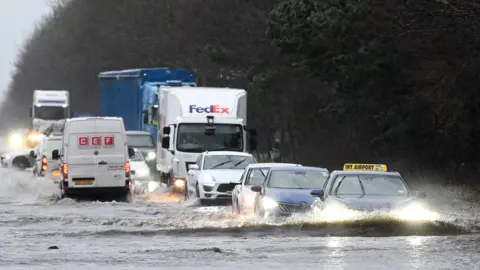
Large parts of the UK have been hit by strong winds and flooding as Storm Chandra sweeps across the country.
The third named storm of the year has caused road closures, as well as rail, ferry and flight cancellations.
Schools have closed in some parts of England and Northern Ireland, where thousands of properties were without power.
Yellow warnings for wind, rain and snow remain in force across parts of England, Scotland and Wales, while an amber warning for wind is in place in the east of Northern Ireland, including Belfast.
This latest weather front comes days after Storm Ingrid caused widespread damage and disruption over the weekend.

National Rail has warned that the poor weather could impact journeys across England, Scotland and Wales until Friday.
Rain in parts of south-west England is falling on already saturated ground, making flooding more likely.
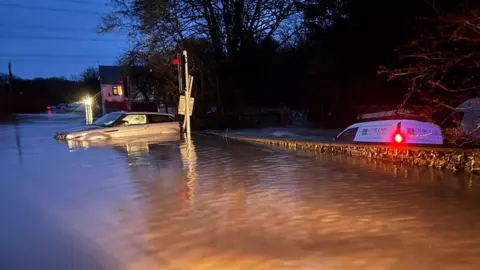
Firefighters in Devon and Somerset said they had rescued people from 25 vehicles that were stuck in floodwater on Tuesday morning.
Honiton and Sidmouth MP Richard Foord said there were reports of around 20 flooded properties across Devon and Cornwall – a figure expected to increase as river levels peak.
Oliver Kimber in Lostwithiel, Cornwall, said the lane he lives on was inundated with water.
“There was so much water and it was so fast that it just had nowhere else to go, and it was pushing it back up through the drains,” he told BBC Radio Cornwall.
 PA Media/Devon and Somerset Fire and Rescue Service
The severe flood warning, indicating a danger to life, has been issued in Upper Frome, Dorchester, while dozens more flood warnings and alerts are in place across the country.
Another severe warning ended earlier on Tuesday in Ottery St Mary, Devon – where the Environment Agency said the River Otter had reached its highest recorded level.
“At the moment, it’s a raging torrent,” Jackie Blackford, whose house overlooks the river, told BBC Radio Devon. “It is horrendous – I’ve never seen anything like it.”
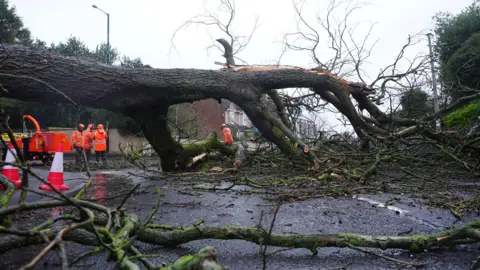
Sections of several roads in Dorset, Somerset and eastern Devon have been closed due to flooding and fallen trees.
Local police have asked people not to travel in Exeter, as well as east and mid-Devon, due to increasing reports of flooding. More than 40 schools have either fully or partially closed across the county.
The Met Office says further downpours are expected for the south-west on Thursday, which may lead to more flooding and transport disruption.
Some schools in the West Midlands have shut due to flooding, and flood warnings are also in place for parts of Yorkshire.
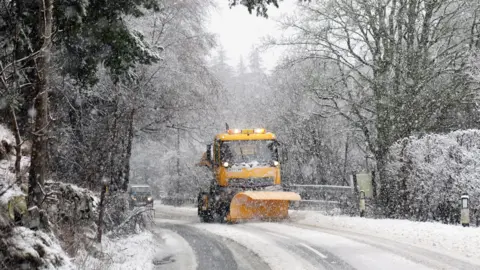
Rain is still forecast in south-east England, while the Met Office is warning of travel disruption due to rain and snow across a swathe of northern England, as well as in the Pennines and south-western Scotland, where the wind mixed with rain and snow could create blizzard-like conditions.
Up to 5cm of snow is predicted, while as much as 20cm could accumulate on higher ground. A section of the A66 between Bowes in County Durham and Brough in Cumbria has already been shut because of the snow.
Heavy rain has now cleared southern Wales but dozens of flood alerts remain in place in other parts of the country.
Flooding is expected around the River Monnow at Forge Road, Osbaston, as well as at a number of locations along the Afon Lwyd. Gwent Police earlier said the A40 was flooded between Abergavenny and Raglan.
 PA Media
 PA Media
Strong winds are still a hazard for several areas, particularly south-western parts of Scotland, England and Wales.
In Northern Ireland, more than 10,000 properties were without power and more than 300 schools were closed on Tuesday. Peak wind gusts reached 80mph at Orlock Head on the Ards Peninsula.
Several domestic flights to and from Belfast Airport have been cancelled, while Scottish regional airline Loganair cancelled at least 12 flights on Tuesday.
Ferry services between Belfast and Liverpool have been cancelled, and several scheduled services from Belfast and Larne have also been affected.
Outside the UK, the Electricity Supply Board (ESB) in the Republic of Ireland said around 20,000 homes, farms and businesses were without power.
Storm Chandra is the third major storm to hit the UK in January, arriving shortly after Ingrid and Goretti – the latter of which was described by the Met Office as among the most impactful to hit Cornwall and the Isles of Scilly in 30-35 years.
Skies are expected to clear on Tuesday, but plummeting temperatures after the heavy rains are expected to bring ice hazards.
The Met Office has issued yellow warnings for much of the UK on Wednesday as icy patches are expected to develop.
Additional reporting by Chloe Gibson and Christine Butler