
This post was originally published on this site.
Comprehending the basics of accounting is vital for anyone managing finances, whether personal or business-related. You’ll need to grasp key concepts like the accounting equation and the double-entry system. Start by identifying transactions and recording them accurately. Adjusting entries are fundamental for reflecting the correct financial picture. Once you’re comfortable with these steps, you’ll be ready to prepare financial statements that provide valuable insights into financial health. But where do you begin?
Key Takeaways
- Understand the fundamental accounting concepts like the accounting equation and double-entry system to build a solid foundation.
- Record transactions in a journal with clear details, ensuring each entry has both a debit and a corresponding credit.
- Make adjusting entries at the end of each period to accurately reflect accrued revenues and expenses in financial records.
- Prepare financial statements, including the income statement, balance sheet, and cash flow statement, to summarize financial performance and position.
- Utilize accounting software to streamline processes, automate data entry, and ensure accuracy in maintaining financial records.
Understanding Fundamental Accounting Concepts

Comprehending fundamental accounting concepts is essential for anyone looking to grasp the basics of financial reporting and business management.
The accounting equation, which states that Assets = Liabilities + Owner’s Equity, keeps a company’s financial position balanced. You should understand the double-entry accounting system, where each transaction impacts at least two accounts, ensuring accuracy through debits and credits.
Key accounting principles, like the matching principle, require you to record expenses in the same period as the revenues they generate, promoting precise reporting.
Furthermore, the conservatism principle advises recognizing potential expenses early, whereas only acknowledging revenues when assured.
Finally, grasping the economic entity concept is critical; it mandates that a business’s financial transactions remain separate from its owners’ personal finances.
These fundamental concepts guide you through the accounting process steps and lay the groundwork for effective financial management.
The Importance of Accurate Financial Statements

Accurate financial statements are crucial for comprehending a company’s financial health and guiding decision-making. They provide a clear picture of profitability, asset management, and liabilities, enabling stakeholders to make informed decisions. Key components include:
| Financial Statement | Purpose |
|---|---|
| Income Statement | Reflects profitability over a period |
| Balance Sheet | Shows assets, liabilities, and equity |
| Statement of Cash Flows | Tracks cash inflows and outflows |
| Financial Ratios | Analyzes performance and stability |
| GAAP Compliance | Guarantees credibility and comparability |
Regular preparation and review help identify discrepancies and trends, promoting timely adjustments for growth. Accurate financial statements are crucial for external stakeholders, like investors and creditors, who assess creditworthiness and investment potential. By adhering to financial accounting basics and GAAP, you guarantee the information is relevant and trustworthy, cultivating transparency and strategic planning.
Analyzing and Recording Transactions

When you analyze and record transactions, you’re identifying the financial impact of each event in your business.
This involves recognizing which accounts are affected and recording the details in journals with appropriate debit and credit entries.
Once that’s done, you’ll post these entries to the general ledger, ensuring a systematic approach to your financial records.
Identifying Business Transactions
Identifying business transactions is essential for any company looking to maintain accurate financial records and make informed decisions. You need to recognize and document all financial activities affecting your accounts.
Here are key details to track:
[embedded content]
- Transaction Dates: Record when the transaction occurred.
- Amounts: Document the financial value involved.
- Involved Accounts: Identify accounts like cash or accounts receivable.
- Descriptions: Provide context for future reference.
Maintaining clear and organized records sets a solid foundation for the accounting cycle.
Systematic gathering of evidence, like invoices and receipts, validates each transaction and aids audits. Furthermore, implementing digital filing systems can streamline the identification process, making it easier to analyze financial trends over time.
Recording in Journals
Recording transactions in journals is an essential step in the accounting process that helps maintain the integrity of your financial records. Each journal entry should include the date of the transaction, the affected accounts, the debit and credit amounts, and a brief description for clarity.
You’ll record accounting transactions in chronological order, ensuring an organized approach to capturing financial activities. Remember, the double-entry accounting system mandates that for every debit entry, there must be a corresponding credit entry, keeping the accounting equation balanced.
Regularly reviewing your journal entries for accuracy is important in preventing errors before they affect the general ledger. Utilizing accounting software can further streamline this process, reducing mistakes and enhancing efficiency in your financial record-keeping.
Posting to General Ledger
After you’ve recorded transactions in journals, the next step is posting those entries to the general ledger. This process is fundamental in the accounting cycle explanation, as it transfers journal entries to their respective accounts, summarizing all transactions.
Here’s how to post effectively:
- Identify the accounts involved in each journal entry.
- Transfer the debits and credits from the journal to the corresponding ledger accounts.
- Guarantee accuracy by regularly reviewing and reconciling ledger accounts.
- Consider using accounting software to link entries to accounts, minimizing errors.
A well-maintained general ledger is vital for generating accurate financial statements and maintaining the integrity of your company’s financial records.
Making Adjusting Entries

Making adjusting entries is a crucial step in the accounting process, ensuring that your financial records accurately reflect your business’s activities within the appropriate time frame.
By making adjusting entries, you adhere to the revenue recognition and matching principles, which require that revenues and expenses are recognized in the correct accounting period.
There are four main types of adjusting entries you’ll encounter: accrued revenues, accrued expenses, unearned revenues, and prepaid expenses.
Accrued revenues represent earnings that have been recognized but not yet received in cash, whereas accrued expenses are costs incurred but not yet paid.
Unearned revenues are payments received in advance for services or products to be delivered later, and they need to be adjusted as those services are provided.
Finally, prepaid expenses, like rent or insurance paid in advance, should be adjusted to reflect the portion incurred during the accounting period for accurate financial reporting.
Preparing Final Financial Statements

When you prepare final financial statements, you’ll start with the income statement, which summarizes your revenues and expenses to determine net income.
Next, you’ll generate the balance sheet to provide a snapshot of your assets, liabilities, and equity at a specific point in time.
Finally, the statement of cash flows will detail cash movements across your operating, investing, and financing activities, offering insight into your cash management during the reporting period.
Income Statement Preparation
Creating an income statement is an important step in preparing your final financial statements, as it provides a clear picture of your business’s profitability over a specific period.
Here’s a simple guide for your income statement preparation:
- List Total Revenues: Start with all earned revenues during the period.
- Subtract Cost of Goods Sold (COGS): Deduct the direct costs related to product sales.
- Include Operating Expenses: Account for regular business expenses, such as salaries and rent.
- Calculate Net Income or Loss: Subtract total expenses from total revenues to find your profit or loss.
Ensure your income statement aligns with your overall accounting records for accuracy.
This alignment is vital for compliance with accounting principles and provides a reliable financial overview.
[embedded content]
Balance Sheet Generation
After completing your income statement, the next step in preparing your final financial statements is generating a balance sheet. This financial statement provides a snapshot of your company’s assets, liabilities, and stockholders’ equity at a specific point in time. To begin, gather all asset accounts, listing them in order of liquidity. Next, report liabilities by their due dates. Finally, include stockholders’ equity, reflecting owners’ investments and retained earnings. Confirm the accounting equation holds true: Assets = Liabilities + Stockholders’ Equity. Here’s a simple overview:
| Category | Examples |
|---|---|
| Assets | Cash, Inventory |
| Current Liabilities | Accounts Payable |
| Long-Term Liabilities | Loans |
| Stockholders’ Equity | Retained Earnings |
This balance sheet generation solidifies your financial comprehension.
Cash Flow Statement
The Cash Flow Statement is an indispensable financial document that summarizes your company’s cash inflows and outflows during a specific accounting period, providing insights into its liquidity position.
It categorizes cash flows into three main activities:
- Operating Activities: Cash from daily operations, calculated using either the direct or indirect method.
- Investing Activities: Cash related to buying or selling physical assets, other companies, or securities.
- Financing Activities: Cash flows from borrowing, repaying debt, issuing stock, or paying dividends.
Ensure the cash balance at the end of the Cash Flow Statement matches the cash amount on the Balance Sheet for accuracy.
This alignment is vital for maintaining reliable financial reporting and comprehending your company’s overall financial health.
Double-Entry Accounting System
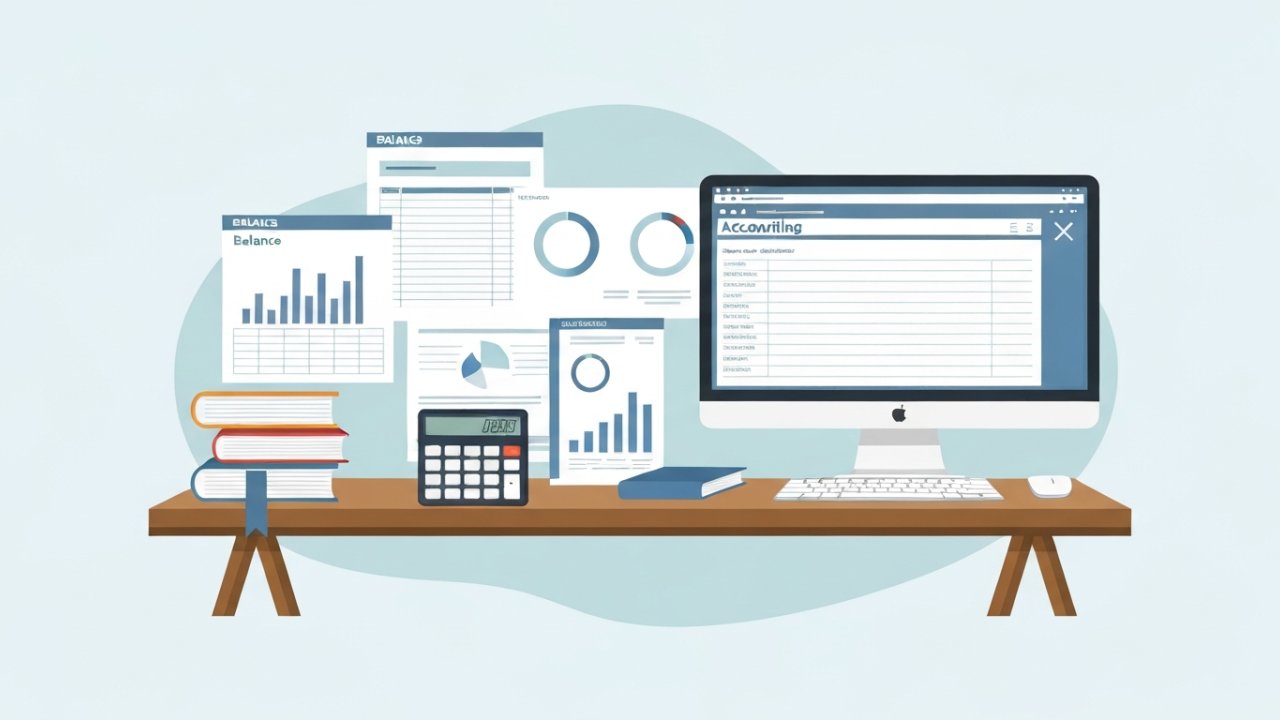
In a double-entry accounting system, every financial transaction influences at least two accounts, ensuring that the accounting equation—Assets = Liabilities + Equity—remains balanced. This system records each transaction as a debit in one account and a corresponding credit in another, providing a thorough view of your financial activity.
For instance, when you make a sale, you debit Cash (or Accounts Receivable) and credit Sales Revenue, reflecting both the increase in assets and income.
This method is vital for maintaining accurate financial reporting, as it helps you identify discrepancies and preserves the integrity of financial statements.
As you navigate the accounting cycle, using double-entry accounting allows you to prepare detailed financial documents, like the balance sheet and income statement, which are important for evaluating your business’s performance.
Utilizing Accounting Software

Utilizing accounting software can greatly streamline your financial management processes, making it an important tool for businesses of all sizes. By automating the recording and retrieval of financial transactions, you’ll save time on data entry and reduce errors.
Here are some benefits to reflect on:
- Real-time data access: Monitor cash flow and profitability efficiently.
- Built-in templates: Generate key financial statements like income statements and balance sheets easily, ensuring compliance with accounting principles.
- Integration capabilities: Improve operational efficiency by connecting with payroll and invoicing systems.
- Collaboration ease: Share up-to-date financial records with accountants or financial advisors for insightful analysis.
Best Practices for Maintaining Financial Records

Maintaining financial records effectively is crucial for any business, regardless of its size. To know how to do accounting properly, start by consistently categorizing transactions into the appropriate accounts in your chart of accounts. This guarantees accurate financial reporting and analysis.
Utilize accounting software to automate data entry, which streamlines the recording process and reduces errors. Regularly reconcile your bank statements with recorded transactions to identify discrepancies and maintain accurate cash flow management.
Implement a systematic filing system for both physical and digital documents, assuring easy retrieval during audits. Finally, schedule periodic reviews of your financial records and statements to assess your business’s financial health. This practice helps you make informed strategic decisions.
Frequently Asked Questions

What Qualifications Do I Need to Start Learning Accounting?
To start learning accounting, you don’t need formal qualifications, but having a high school diploma is beneficial.
You’ll want to develop a good comprehension of basic math and analytical skills. Familiarity with spreadsheets and accounting software can likewise help.
Online courses and community college classes are great options to build your knowledge.
Consider certifications like the Certified Bookkeeper for further credentials, as they can improve your insight and improve your job prospects in the field.
How Long Does It Take to Become Proficient in Accounting?
Becoming proficient in accounting typically takes several months to a few years, depending on your prior knowledge and the intensity of your study.
If you’re learning part-time, expect around one to two years to reach a solid level of comprehension.
[embedded content]
Nevertheless, if you engage in full-time study or work in an accounting role, you might gain proficiency faster.
Practicing regularly and applying concepts in real-world scenarios will improve your skills considerably.
What Common Mistakes Do Beginners Make in Accounting?
Beginners in accounting often make several common mistakes. One frequent error is misclassifying expenses, which can distort financial statements.
Another mistake is overlooking the importance of documentation; failing to keep accurate records can lead to compliance issues.
Furthermore, many beginners underestimate the significance of double-checking calculations, which can result in costly inaccuracies.
Finally, not comprehending accounting principles can lead to poor decision-making and financial mismanagement, hindering overall success in the field.
Can I Learn Accounting Online, and if So, How?
Yes, you can learn accounting online through various platforms. Start by enrolling in reputable courses offered by universities or professional organizations, which often include video lectures, quizzes, and interactive exercises.
Websites like Coursera, Udemy, and Khan Academy provide structured content. Consider joining online forums or study groups to improve your comprehension.
Practice with accounting software and real-world scenarios to reinforce your learning. Consistency and dedication will help solidify your grasp of accounting principles.
What Resources Are Available for Further Accounting Education?
You can find various resources for further accounting education.
Online platforms like Coursera and Udemy offer courses customized to different skill levels. Websites such as Khan Academy provide free tutorials.
Furthermore, professional organizations, like the AICPA, offer webinars and workshops.
You might likewise consider textbooks and e-books that cover advanced topics.
Joining local accounting groups or forums can help you connect with peers and gain insights from experienced professionals in the field.
Conclusion

In summary, mastering accounting involves comprehending key concepts like the double-entry system and the importance of accurate financial statements. By analyzing transactions, making adjusting entries, and preparing final reports, you can effectively manage financial health. Utilizing accounting software streamlines this process, enhancing accuracy and efficiency. Regular reviews and reconciliations further guarantee that your records remain up-to-date. By following these steps, you’ll develop a strong foundation in accounting that can support informed decision-making for your personal or business finances.
Image via Google Gemini