
This is Write Here, a column where authors and literary luminaries tell us about the travels they took to find inspiration and create their latest books.
In this installment, author Min Jin Lee recounts a factchecking trip to Sydney to polish American Hagwon, the followup to her books Free Food for Millionaires and Pachinko. In the new novel, the Kohs, devastated by the betrayal of a family friend and the 1997 Asian financial crisis, migrate from South Korea to Australia, then to the United States, all the while grappling with how much—and how little—their education and work experiences are valued around the world. Education is a central theme in the book: hagwons are private Korean cram schools meant to prepare students for tests and, by extension, the diplomas and degrees intended to secure prosperous futures. Below, Lee describes how a recent visit to Australia helped her fine-tune the novel in its final stages, what travel “at its best” can be, and where to find the best dessert in Sydney’s Chinatown.
“In 2025, after I turned in my manuscript for American Hagwon, I went to Sydney to do the book’s factchecking. The book is a global novel about middle-class families without generational wealth who are trying to educate their children. I had to continue fine-tuning what I knew about education systems in Korea, Australia, and the US, and how people make a living as immigrants—or as migrants, which is the term used in Australia. I’d been there four times already, but this trip in particular was richly rewarding because, in a way, I got to meet my novel’s characters.
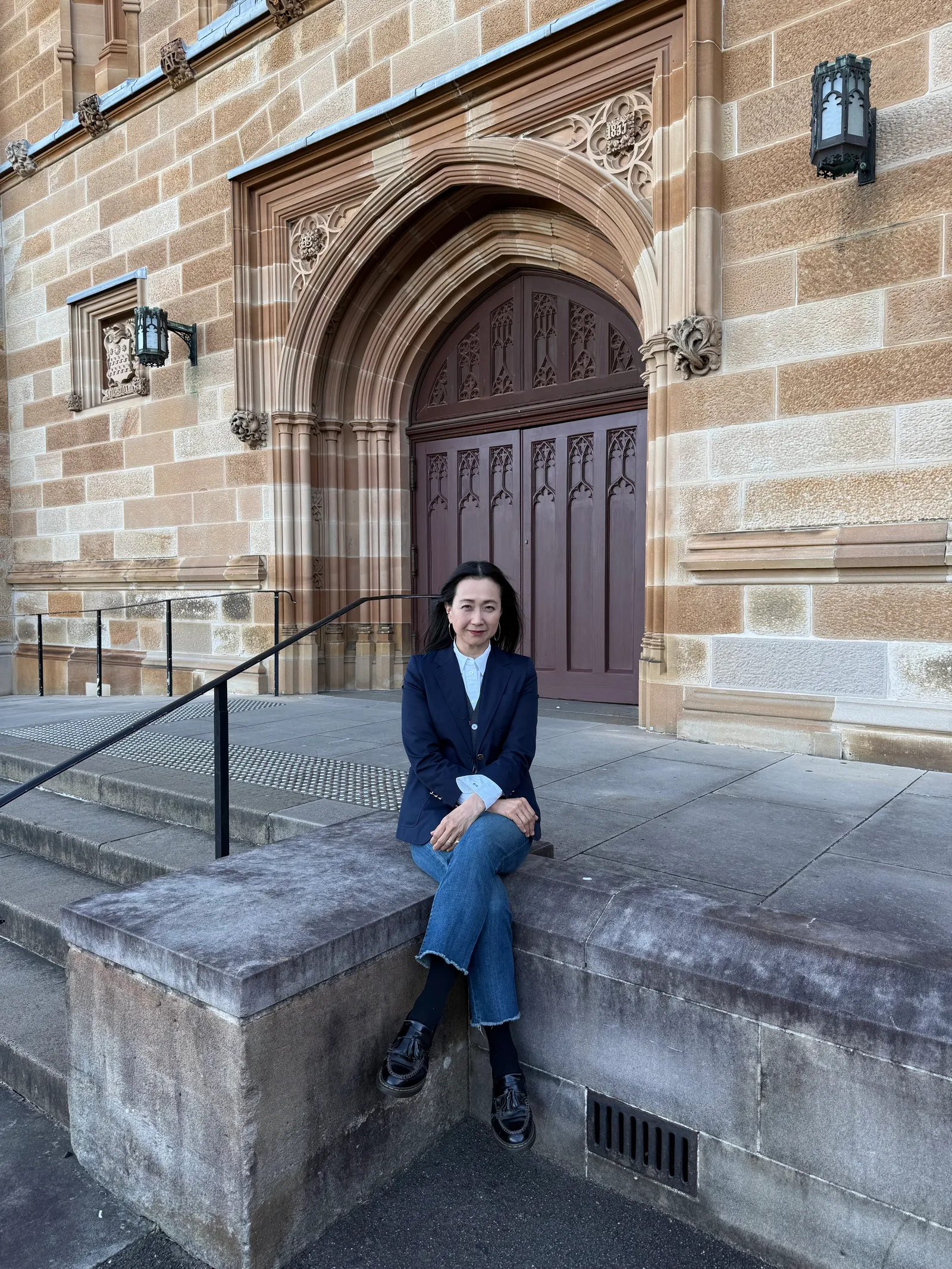
One of my characters attends the University of Sydney for a year, where she becomes less shy by joining this thing called SUDS, the Sydney University Drama Society. It’s Australia’s oldest continuously running theatre company. I visited the Cellar Theater where they perform, and I met actors and writers who were part of SUDS. I’m not a drama person and I didn’t grow up in that world, so I learned about the DIY aspect of university theater. Everyone’s willing to make posters or take tickets as well as be an actor on stage. I love the collaboration and the democratic ideals of, say, voting for a play that they want to produce. Seeing all that was a real gift for the book—and me. It changed the way I understood how a young person becomes a creative performer.
I also looked into how to become a lawyer in Australia. A friend who practices law in Sydney connected me with a barrister, who invited me to visit his chambers. I should say, chambers here just means the offices of a group of barristers. It turns out law practitioners in Australia have specialized roles, from solicitors who handle day-to-day legal tasks to barristers who litigate in court. It’s a completely different system to what we have in the US; as a former lawyer, I was kind of shocked. I talked to different barristers and even met some Korean Australian ones. It bizarrely led me to a person named Danbi, which is the name of a villain in American Hagwon, who’s a sort of femme fatale. But this Danbi was the furthest thing from my character: incredibly sober, very religious, and deeply moral. It was very funny to me.
Visiting those barristers and meeting the SUDS alums helped me understand the kinds of people that come out of the Australian education system. It seems to me that, compared to Americans, Australians don’t have this terrible fear of debt. There are programs like the Higher Education Contribution Scheme—HECS, they call it—where government loans for school tuition don’t accrue interest and you pay them off once your income crosses a certain threshold. It means education isn’t this millstone around one’s neck. There’s also the Technical and Further Education, or TAFE, a government-run pathway for vocational training, which pays people to learn how to become, say, hairdressers, machinists, bookkeepers. Someone who lost everything in the Asian financial crisis of the late 1990s could end up in Sydney and, through TAFE, retool themselves to become an air conditioning repair person. The whole system strikes me as more humane.