
AI is less regulated than milk, says Microsoft president
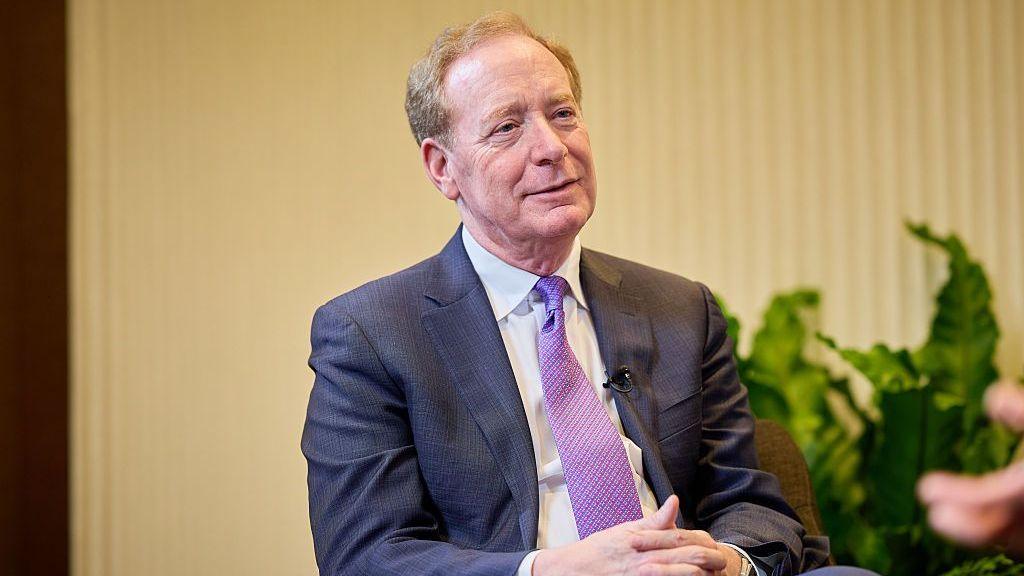 Image source, Bloomberg via Getty Images
-
Published
Milk and washing machines are currently more regulated than AI, the president of Microsoft has said.
Brad Smith said there needed to be global safety rules in place, including a legal obligation to tell a “victim” if their system is breached by a rogue AI agent as well as deciding when outside evaluators should sign off on an AI product before it is released.
His comments put him at odds with President Donald Trump, who said the sector should regulate itself so US firms don’t lose out to Chinese rivals.
But Smith said: “Right now, your washing machine is subject to more safety rules than AI. Every carton of milk that you see in the grocery store is subject to safety rules and inspection.”
Demands for laws and rules to control AI have grown after experts in the sector said they believed the technology its a threat to humanity.
The bosses of the US-based AI giants such as Anthropic, OpenAI and Google DeepMind have all backed the idea of an AI development slowdown, but Trump has pushed against this.
Speaking to the BBC’s Big Boss Interview, Smith called AI both a “tool and a weapon” that urgently needed to be regulated.
“Let’s get started today,” he said.
He said firms need “emergency brakes” – often known in the industry as ‘kill switches’ – to pause or slowdown AI if it got out of control in some way.
He also said there should be a legal requirement for firms to write “incident reports” and tell victims if the technology goes rogue. He also suggested that independent government evaluators should vet new AI technology.
“We know how to do this for other products,” Smith said. “We should build on that knowledge and think about how to apply it to AI.”
Smith said the UK was best placed to drive forward these global rules for AI because of its AI Security Institute, external, launched during former prime minister Rishi Sunak’s government as the AI Safety Institute.
“In the world of technology, in the tech sector, most people that I know would say, if you ask them, name the country that is the leader in having this technical capability, they would say, it’s very simple. It’s the United Kingdom. They are the best.”
‘The moment has arrived’
Smith’s views are very different to those of his president, who believes the US should be going full-steam ahead on AI.
Trump has repeatedly said that “whoever wins AI, wins”.
However, Smith does not believe the US government would be as opposed to UK-led AI regulations as Trump’s comments make it seem, suggesting the US would be more accepting of the UK making standards than the EU.
“In Washington DC, people don’t look at the UK and they don’t look at London the way they look at Brussels – that’s a strength,” he said.
“When you look at AI agents that have escaped human control, when you look at models that are so powerful that they’re putting the world’s cybersecurity at risk. I would say: The moment has arrived.
“Let’s speak calmly, maybe even softly, but firmly, and start to bring people together. I hope that’s the role we can play as a company. I hope that’s the role the UK can play as a country.”
To play this video you need to enable JavaScript in your browser.
This video can not be played
At the end of last month, Trump hosted the leaders of US tech giants OpenAI, Anthropic, Nvidia, SpaceX, Meta, and Google at the White House where the executives signed a “morally binding” document.
The companies agreed to work with “independent auditors” to assess whether their AI systems are working as intended and make sure they do not “hack or access technical systems in unintended ways”.
Smith said he applauds the statement and Microsoft is “happy to sign it”.
“It’s a good step, it’s a necessary step… But I don’t think it’s sufficient any longer.”
He added that the challenge for any “self-regulatory regime” is that “the good companies will do what you want”.
“It’s the companies that are not as responsible that you need to worry about.”