
This post was originally published on this site.
As long as there has been commerce, there have been questions. First, those questions were only for salespeople. Then, it was search engines. Now, AI has been thrown into the mix. But how do you know if your AI search efforts are even working?
![Download Now: The State of AEO in 2026 [Free AI Search Trends Report]](https://no-cache.hubspot.com/cta/default/53/07ca2318-c9e0-4b5d-bcba-95cec5cb4958.png)
AI search visibility ROI measures the business impact of your brand appearing in AI-generated answers across platforms like ChatGPT, Gemini, and even Google Overviews. It connects how often AI systems cite or mention your brand to real outcomes — traffic, pipeline, and closed revenue.
The problem: the impact of AI search is far from clear-cut, and that blur is expensive.
This guide helps get things back into focus. We’ll share how to use a three-layer measurement framework to understand the impact of AI search, measure AI search visibility ROI, and report back to leadership.
New to AI search and AEO? Start with AI search engines and how they differ from traditional search.
Why Attribution Is Difficult in AI Search
Some AI answers include citations that generate referral traffic, but many users might navigate to your site in a different window.
Let me explain. A common AI-influenced journey looks like this:
Buyer asks AI for recommendations → your brand is mentioned → buyer searches your brand name on Google three days later → buyer converts via paid brand ad → last-click attribution credits paid search.
Credit given to AI? Zero.
With U.S. organic search traffic falling 2.5% year-over-year in January 2026 and AI referral traffic to retail sites surging 693% over the same period, a real shift in where buyers begin their research is clearly happening. (Even if organic traffic isn’t dead.)
Unfortunately, AI search engines rarely share referral data, so their impact is lost throughout the buyer’s journey.
Now, the fix isn’t to throw out attribution. It’s to lean into awareness and add a measurement layer that can actually see AI touchpoints.
Which Metrics Prove AI Search Visibility ROI
AI search visibility ROI is the return on investment from your brand appearing in AI-generated answers.
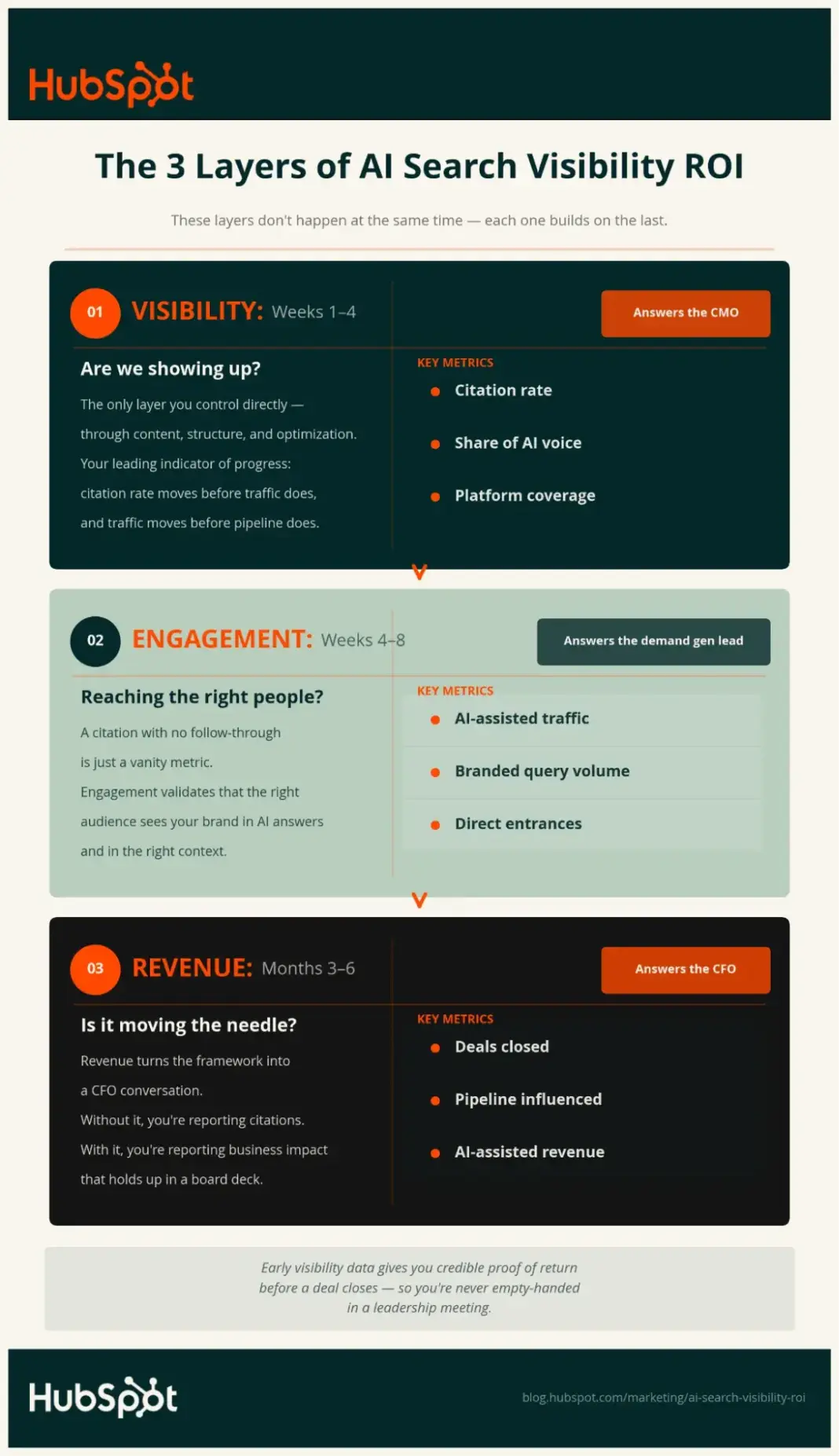
While the results may vary from team to team, AI Search ROI typically looks at three things, each one playing a distinct role:
- Visibility (i.e., Citations Rate, Share of Voice): This is how often your brand appears in AI answers. It’s the only layer you control directly through content and optimization, and it’s also your leading indicator of progress.
- Engagement (i.e., AI-assisted traffic, Branded Query Traffic): Do your AI appearances drive qualified traffic or action? A citation with no follow-through is just a vanity metric, right? It’s like having 1000 people see your billboard, but having none of them buy. Engagement validates that the right audience is seeing your brand in AI answers and in the right context.
- Revenue (i.e., deals closed, revenue): Does that traffic or engagement turn into pipeline and deals? Revenue is what turns the framework into a CFO conversation. Without it, you’re reporting citations. With it, you’re reporting business impact.
When it comes to reporting or analyzing performance, it’s important to recognize that these three layers create a delayed funnel or, in non-marketing jargon, they don’t happen at the same time.
- Visibility is seen first (weeks 1–4), with citations increasing as your content improves.
- Branded search lift and direct traffic follow weeks later (weeks 4–8), as AI-influenced users remember your name and search for it directly.
- Pipeline influence appears last (months 3–6).
Each layer also addresses a different skeptic in the room and provides context for the others.
- Visibility answers the CMO who asks: “Are we even showing up in AI answers?”
- Engagement answers the demand gen lead who asks: “Is that visibility actually bringing the right people to our site?”
- Revenue answers the CFO who asks: “Is any of this moving the needle on pipeline?”
Understanding the progression and interaction of these layers matters.
Without visibility, you cannot explain shifts in engagement. Without engagement context, leadership dismisses the data as vanity metrics.
On the plus side, early visibility metrics give you credible data on return even before a deal closes, so you don’t have to walk into a leadership meeting empty-handed as you wait for the numbers to mature. Work through all three over time, and you have a measurement framework that holds up in a board deck.
Let’s break these layers down into their corresponding metrics:
Visibility: How to Track Share of AI Voice and Citations
Share of AI voice (SAIV) is the percentage of tracked prompts where your brand appears in the AI answer. Citation tracking goes even deeper, measuring whether your brand is linked as a source, signaling that AI systems treat your content as authoritative.
How to Calculate
- Share of AI voice = [Prompts where brand appears] ÷ [Total prompts tracked] × 100
- Citation rate = [Prompts where brand is cited as source] ÷ [Total prompts] × 100
- Competitor share = Same calculation for 3–5 key competitors
- Platform coverage: Which engines mention you (ChatGPT, Gemini, Perplexity, AI Overviews)
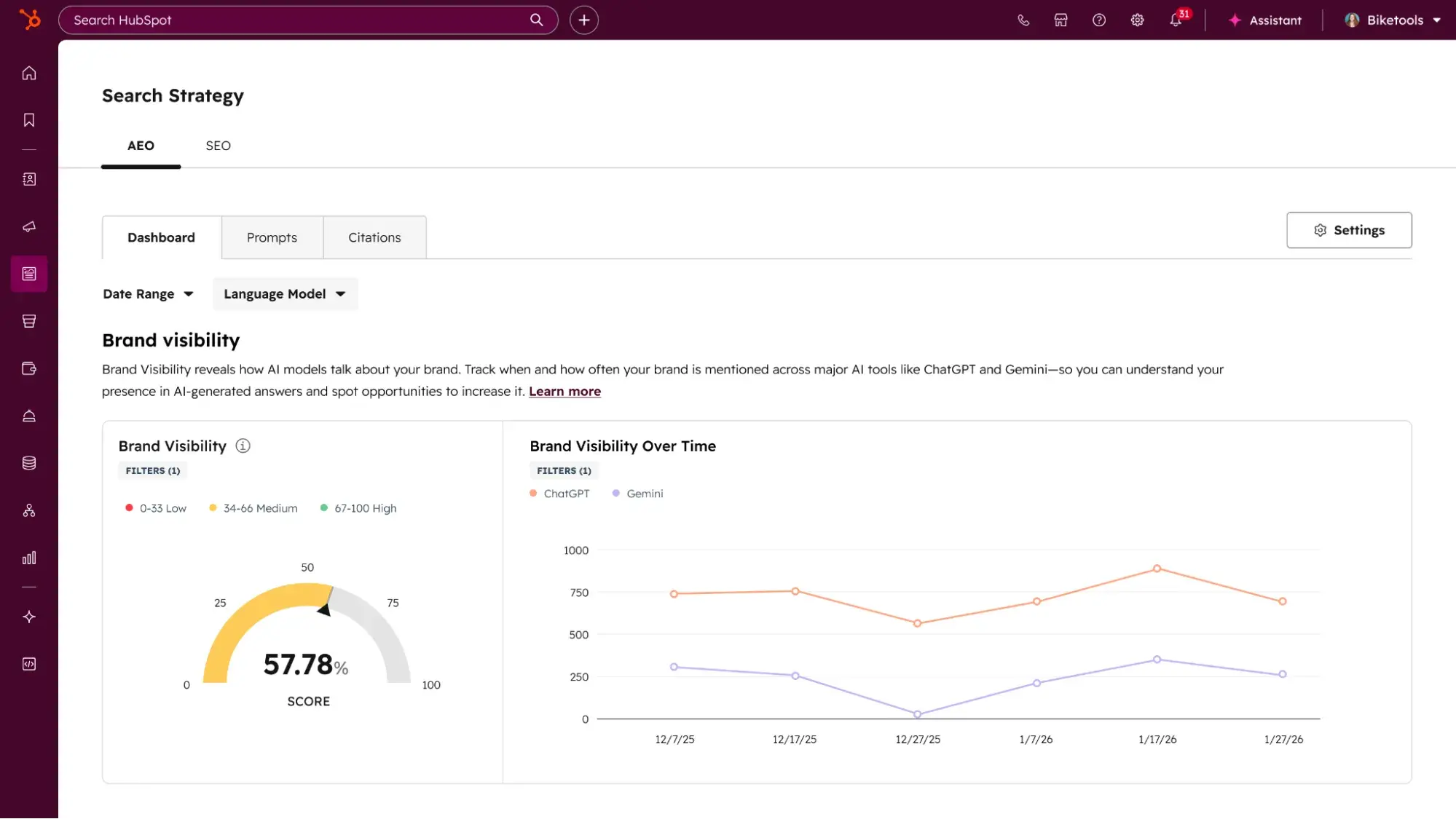
What we like: HubSpot AEO tracks your Brand Visibility Score across ChatGPT, Perplexity, and Gemini. It monitors competitor mentions within your prompt set, flags content gaps, and connects visibility data directly to your CRM.
Engagement: How to Use Branded Search Lift and Direct Traffic
When your brand appears in AI answers, users often search for it directly, later, showing up as branded keyword growth and direct traffic, even without a click from the AI answer.
How to Calculate
Monitor in Google Search Console and GA4:
- Branded query volume week-over-week in Search Console
- Direct traffic trends isolated by landing page and device
- “AI assistant” channel sessions (added to GA4 in May 2026)
A sustained branded search lift without a paid campaign is a strong signal that AI awareness is working.
Revenue: How to Attribute Pipeline Influence in Your CRM
Perfect AI attribution isn’t possible. Sessions often arrive via direct or branded search, if tracked at all. The goal is assisted attribution.
The data support this investment. According to HubSpot’s January 2026 survey of 3,000+ CRM purchase decision-makers, AI search was the single strongest predictor of purchase intent — ahead of demos, review sites, and sales calls. Buyers who used AI search were 36% more likely to purchase.
How to Calculate
Build a simple model:
- Tag contacts who arrived via AI referral domains (chatgpt.com, perplexity.ai, gemini.google.com). HubSpot CRM enables you to easily create custom properties and set up automation to populate fields.
- Flag deals where an early touch was an AI referral session.
- Compare close rate, deal velocity, and ACV for AI-influenced vs. non-influenced opportunities.
How to Benchmark Brand Visibility in AI Search
Benchmarking gives your visibility data two things it needs to be actionable: a competitive reference point and a trend line.
The competitive reference point tells you if you’re winning or losing share of AI voice relative to the brands your buyers are comparing you against, while the trend line tells you if your optimization work is actually moving the needle over time.
Without both, you can’t:
- Prioritize where to invest
- Explain why the pipeline is shifting
- Walk into a leadership meeting with anything more than “we’re getting cited more.”
With both, you have a story: we own these topic clusters, we’re losing ground here, and here’s what we’re doing about it. Here’s what you do.
1. Identify your answer competitors.
As with search engines, your SERP competitors aren’t always your product competitors; your AI answer competitors aren’t either. AI answers cite whoever it determines has the most authoritative, clearly structured content on a topic.
This often includes industry media sites, analyst blogs, review platforms like G2 and Yelp, and niche newsletters your team has never heard of. It also often includes a few lucky blogs and aggregators.
Knowing these competitors and the types of websites they are is key to shaping your strategy and knowing where to focus.
For example, if a media site is consistently cited instead of you for buying-stage prompts, that’s a content gap, not a product problem. You can fix a content gap.
For each topic cluster in your prompt set, document every source that appears in AI answers, not just direct competitors. Add all of them to your competitive tracking set. You’re mapping the full citation landscape, not just the brands on your battle cards.
2. Build a share of citations chart.
Run your full prompt set monthly. For each prompt, record every cited source and aggregate by topic cluster. The goal is a simple view of where you lead, where you trail, and where the gap is widest:
|
Topic Cluster |
Your Brand Citations |
Top Competitor Citations |
|
CRM software comparisons |
12/20 prompts |
8/20 prompts |
|
Sales pipeline management |
6/20 prompts |
14/20 prompts |
|
Marketing automation |
9/20 prompts |
11/20 prompts |
|
Email marketing tools |
15/20 prompts |
5/20 prompts |
In this example, sales pipeline management is the priority gap — you’re being outranked 6 to 14. That cluster gets the next content brief. Email marketing tools are a position worth defending — you’re winning 15 to 5, but a competitor investing in that cluster could close that gap within a quarter.
3. Interpret trends.
A rising citation share in a cluster means one of three things: your content improved, a competitor’s dropped, or an AI model update shifted source preferences.
Before you celebrate or panic, run a fresh baseline after any major model release — GPT, Gemini, Perplexity all update regularly, and each update can reshuffle citation patterns independently of your content quality.
The trend line matters more than any single snapshot. A single month of data tells you where you are. Three months of data tells you whether your strategy is working.
Once your benchmark data is consistently tracked, connect it to Marketing Hub to automate multi-touch attribution and reporting, so your AI citation share sits alongside paid, organic, and email metrics in one unified view, rather than living in a separate spreadsheet your leadership team will never open.
Plan for Measuring AI Search Visibility Over Time
1. Define your prompt set.
Pick 20–30 prompts that reflect how buyers research your category across funnel stages:
- Awareness: “What’s the difference between SEO and AEO?”
- Consideration: “Best marketing automation tools for mid-market B2B companies”
- Decision: “HubSpot vs Salesforce for a 100-person sales team”
2. Input prompts into your AI visibility tool.
Next, you can run your test prompts manually across your desired AI platforms (i.e., ChatGPT, Gemini, etc.), or use a tool like HubSpot AEO, which automatically updates your citations on ChatGPT, Gemini, and Perplexity every day.
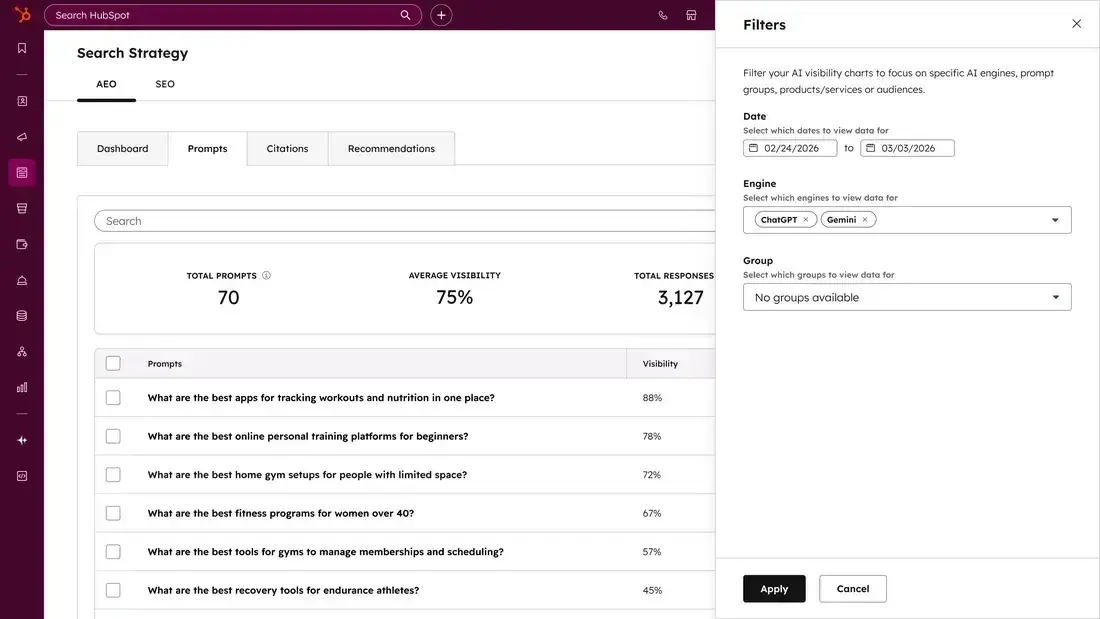
Multi-platform tracking is important as AI search visibility is no longer a one-platform story. Goodie’s 2026 Wave 2 report found ChatGPT’s share of B2B AI referrals dropped from 89% to 63% in just eight months, while Claude reached 18.5% and Gemini hit 10.6%.
That means prompt tracking needs to happen across all major surfaces:
- ChatGPT
- Google AI Mode / AI Overviews
- Perplexity
- Claude and Gemini
For a deeper look at how these platforms differ in retrieval logic, citation behavior, and user intent, HubSpot’s guide to AI search engines covers those key distinctions across platforms.
Note: HubSpot AEO doesn’t track Claude or Gemini yet, but you can easily test those platforms manually using a free account.
3. Record your Brand Visibility Score.
Score each prompt on a simple scale: not mentioned, mentioned, cited as a source, or recommended.
Aggregate into a Brand Visibility Score across all prompts and platforms. This is your baseline. Rerun every 30 days to track movement.
4. Audit your existing content.
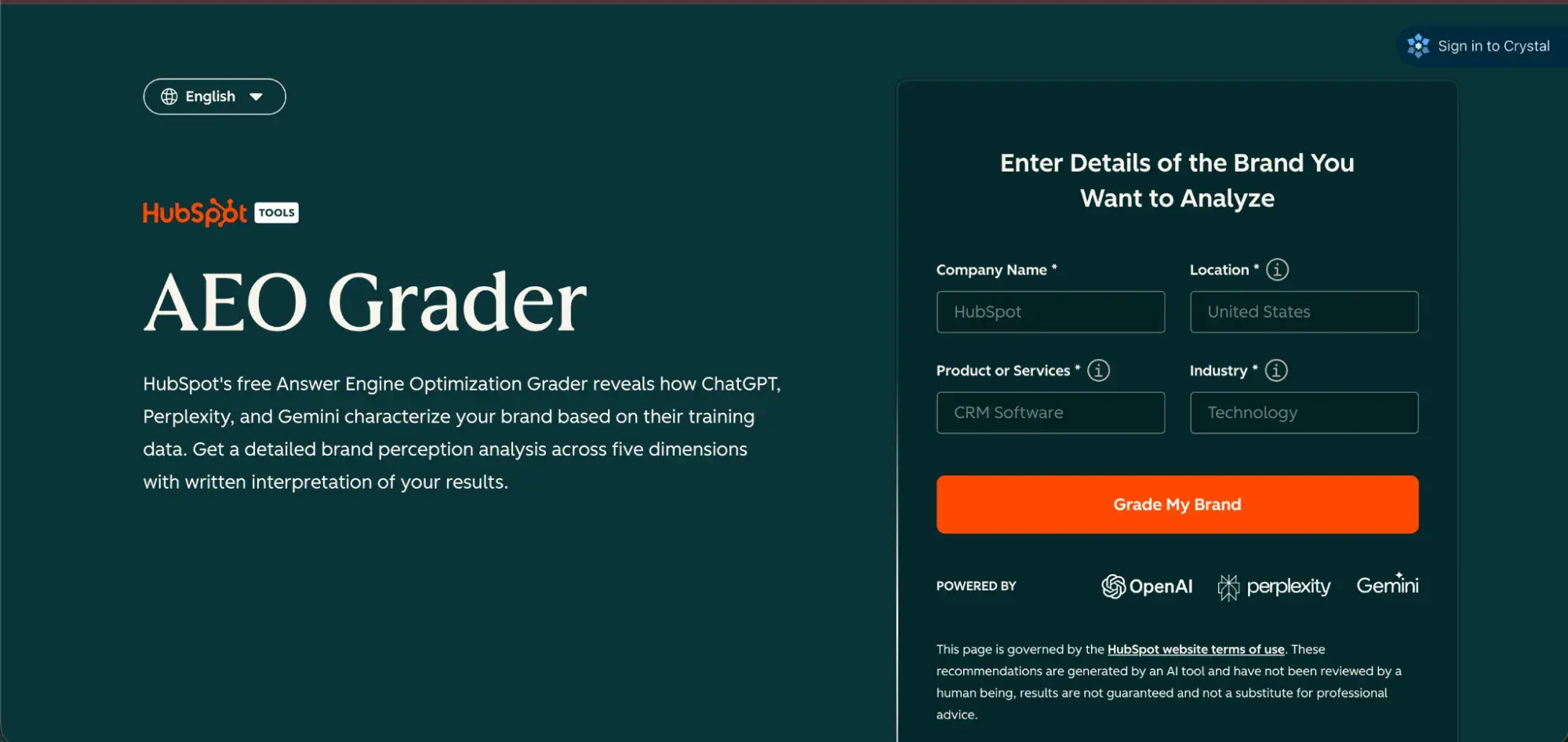
Run your AI search visibility audit with HubSpot’s free AI Search Grader. It shows exactly where your brand is visible and where competitors are claiming your answers.
Then use a table like this one to record your AI performance.
|
Date |
Prompt |
Platform |
Model Version (e.g., GPT-4o, Gemini 1.5) |
Brand Mention? (Y/N) |
Brand Cited? (Y/N) |
Competitor Cited? |
Answer Sentiment (Positive/Neutral/Negative) |
Response (verbatim or summary) |
|---|---|---|---|---|---|---|---|---|
One row per prompt per platform. Track 5–10 prompts per topic cluster across 3–4 platforms.
4. Repeat.
After implementing changes based on insights from your data, plan to run the same prompts again — tracking and analyzing on a consistent schedule. We recommend weekly or biweekly.
Calculating AI Search Visibility ROI
Since AI attribution is so ambiguous, AI Search Visibility ROI is understandably difficult to calculate. Not only do AI tools rarely share referral data, but they are also heavily influenced by SEO and even public relations.
Fortunately, you can still get a healthy gauge using visibility, engagement, and revenue metrics, and this formula:
ROI (%) = (AI-Assisted Revenue− AI Costs) ÷ AI Costs × 100
AI-assisted Revenue
AI search rarely earns direct click attribution, so marketers need to build an assisted revenue model that accounts for AI touchpoints where a contact showed AI-influenced behavior before converting.
This relies on three things:
- Self-Reported Attribution for AI Discovery (Asking people directly)
- Branded Search Lift and Direct Entrances (Reading indirect signals)
- Custom Fields in CRM for Revenue Attribution (Manually tagging contacts as AI-influenced)
Learn how to set up all these channels in my article “AI Search Performance KPIs Every Marketer Should Track,” which builds on traditional SEO KPI frameworks.
Pro tip: Unify visibility and pipeline in your CRM with HubSpot’s Smart CRM and custom fields, then use Marketing Hub to automate multi-touch attribution and reporting across all channels.
AI Costs
AI costs are a bit clearer than revenue. They typically include monthly or annual costs in:
- AI and LLM visibility tools (i.e., HubSpot AEO)
- Content and UX work (internal hours, headcount, or agency fees)
- Any extra infrastructure specific to AI analysis
AI Search Visibility ROI Example
Let’s bring these together into an example.
Say your team spends $2,000/month on AI visibility tools and content work. Over a quarter, your CRM flags $30,000 in pipeline where contacts had a confirmed AI touchpoint before converting. Applying a 25% assisted credit (since AI was one of several influences), that’s $7,500 in AI-assisted revenue.
Using our formula, that is:
ROI (%) = ($7,500 − $6,000) ÷ $6,000 × 100 = 25% ROI
That is a real, defensible number you can bring to leadership while the model matures.
How To Make the Leadership Case for AI Search
When you’re ready to present to leadership, structure your argument around three pillars (opportunity cost, competitive risk, and measurement), and lead with the cost of inaction, not the promise of results.
Opportunity Cost
AI-referred leads convert at 3x the rate of traditional search leads, according to HubSpot data. Every month you’re not measuring or optimizing for AI visibility is a month that high-intent buyers decide without your brand in the conversation. That’s not a hypothetical risk — it’s revenue that’s already leaving the table.
Competitive Risk
HubSpot customers actively optimizing for AI search generate 170% more MQLs and 82% more deals than comparable customers who aren’t. The gap between teams investing in AI visibility and those waiting to see how it plays out is already measurable — and it’s widening every quarter.
Measurement Plan
Leadership doesn’t fund vague promises. Come in with a concrete 30/60/90-day roadmap: a defined baseline, a prompt set, a clear metric framework, and a CRM attribution model that connects visibility signals to the pipeline. Show them exactly how you’ll know if it’s working — and when.
For the latest data to back your case, explore the latest AI marketing insights from HubSpot.
What Timeline to Expect
One of the biggest mistakes teams make with AI search visibility is expecting results on the same timeline as paid media or even SEO.
You can’t launch an AI visibility strategy on Monday and see pipeline movement by Friday — as great as that would be. AEO takes time, and your results build in layers. Visibility results are typically the first to show with your AEO efforts, but engagement and revenue data are needed to calculate ROI. Understanding that pacing is what separates a team that gets defunded after 60 days from one that gets a budget increase after 180.
Typical AI Search Visibility Milestone Windows
Use these guidelines to set expectations with your team and leadership before you start.
|
Timeframe |
What You Should See |
What to Report |
|
Days 1–30 |
Baseline established, prompt set running |
Visibility score, competitor benchmark |
|
Days 30–60 |
First citation data, branded search trend |
Share of AI voice, direct traffic delta |
|
Days 60–90 |
AI-influenced contacts appearing in CRM |
AI-influenced MQL rate, pipeline touch data |
|
Days 90–180 |
Pipeline influence data, revenue model live |
AI-assisted close rate, deal velocity |
Leading Indicators to Watch First
While you wait for pipeline data to accumulate, leading indicators tell you whether the strategy is working and give you something credible to report in the meantime. Watch for:
- Branded search volume rising without a new paid brand campaign — a sign that AI-driven awareness is sending people to search for you directly
- Direct traffic growing independently of email sends or paid pushes — another signal of AI-influenced brand recall
- Share of AI voice improving month-over-month across your core prompt set — confirmation that your content optimization is working
- Citation rate increasing specifically on high-intent buying prompts — the strongest early signal that you’re entering the consideration set at the right moment.
If two or more of these are moving in the right direction by day 60, you have a credible story to tell. You don’t need pipeline data to make the case that the strategy is working — you need a pattern of leading indicators that point to where the pipeline data will eventually land.
Back your case with data from the latest AI marketing insights from HubSpot.
Frequently Asked Questions About AI Search Visibility ROI
How do I improve visibility with an AI search optimization strategy?
Start any AI search optimization, GEO, or AEO strategy with your content structure.
AI systems favor content that leads with a direct, clear answer, not content that buries the point three paragraphs in. Rewrite your most important pages so the first 150 words answer the prompt directly, use question-based headings that match how buyers actually search, and add FAQ and Article schema so AI systems can easily parse your content.
Beyond your own site, AI answers also pull from third-party sources (e.g., review platforms, industry publications, and analyst sites). So, improving your AI visibility is partly a content problem and partly a reputation (or public relations) problem.
Getting your brand cited in authoritative external sources carries as much weight as optimizing your own pages.
Finally, don’t optimize for one AI engine. ChatGPT, Gemini, Perplexity, and Google AI Overviews all cite differently and draw from different source sets. A strategy built around a single platform leaves a growing share of AI-referred buyers on the table.
What timeline should I expect for improvements in AI search visibility?
Plan for 30–60 days before content improvements show up in citation rate changes, and 90–180 days before those citation gains translate into measurable pipeline influence. AI systems don’t index and update in real time the way search engines do. Changes to your content need time to be picked up, evaluated, and reflected in AI answers.
That said, some signals move faster than others. Branded search lift and direct traffic can start shifting within four to six weeks of consistent optimization work. Citation rate on lower-competition prompts can improve within a month. High-intent buying prompts, especially when competitors are already well-established, take longer to crack.
The practical implication: start tracking early, report on leading indicators in the first 60 days, and resist the pressure to call the strategy a failure before the pipeline data has had time to mature.
How should I pick prompts to track AI share of voice?
Pull from three sources: sales call recordings, customer support tickets, and your existing keyword research. The goal is to find the questions your buyers are actually asking, not the questions you assume they’re asking.
Prioritize specificity over brevity. “What’s the best CRM for a 50-person B2B sales team with a long deal cycle?” will give you more useful tracking data than “best CRM” — because it reflects a real buyer intent, and AI answers to specific questions tend to be more consistent and trackable over time.
Structure your prompt set across all three funnel stages: awareness prompts that reflect early-stage research, consideration prompts that compare solutions, and decision prompts that name vendors directly.
Aim for 5–10 prompts per topic cluster to start, and expand once your tracking process is running smoothly. Revisit and refresh your prompt set every quarter — buyer language shifts, and your tracking set should shift with it.
What if my brand is rarely mentioned today?
That’s actually the most useful place to start — because a low visibility score tells you exactly where the opportunity is, not just that one exists.
First, audit which topic clusters have the lowest citation rates and identify who is appearing in those answers instead of you. That tells you two things: what content is winning citations right now, and what gap your content needs to close.
Then work through the AEO content checklist on your highest-priority pages — the ones that should own the answers to your most important buying-stage prompts. Focus on content clarity, direct answers, and E-E-A-T signals before worrying about more advanced tactics.
Don’t try to improve visibility everywhere at once. Pick two or three topic clusters where the competitive gap is smallest and buyer intent is highest; win those first, then expand from there. Visibility compounds — once AI systems start citing you in one cluster, it becomes easier to earn citations in adjacent ones.
Expect 30–60 days before you see meaningful movement. Track your prompt set weekly so you catch early signals as soon as they appear.
Start measuring before your competitors do.
Buyers have always had questions. And whoever answers those questions best (read clearly, credibly, and at the right moment) wins the business.
AI search has changed where those answers come from. It hasn’t changed that truth.
The good news is that you don’t need a massive budget or a dedicated AI team to get started. Start where you are. Run your first prompts this week with HubSpot AEO — it tracks your Brand Visibility Score across ChatGPT, Perplexity, and Gemini daily, so you’re not manually stitching together results from four different tabs.
Flag your first AI-influenced contacts in your CRM. Watch your branded search trend for the next 30 days. The picture gets clearer faster than you’d expect, and every data point you collect now is a head start on the leadership case you’ll be making six months from now.
The shift is already happening. The only question is whether your brand is in the answer.