


This post was originally published on this site.
Artificial turf & coaching revolution – how Norway shaped golden generation
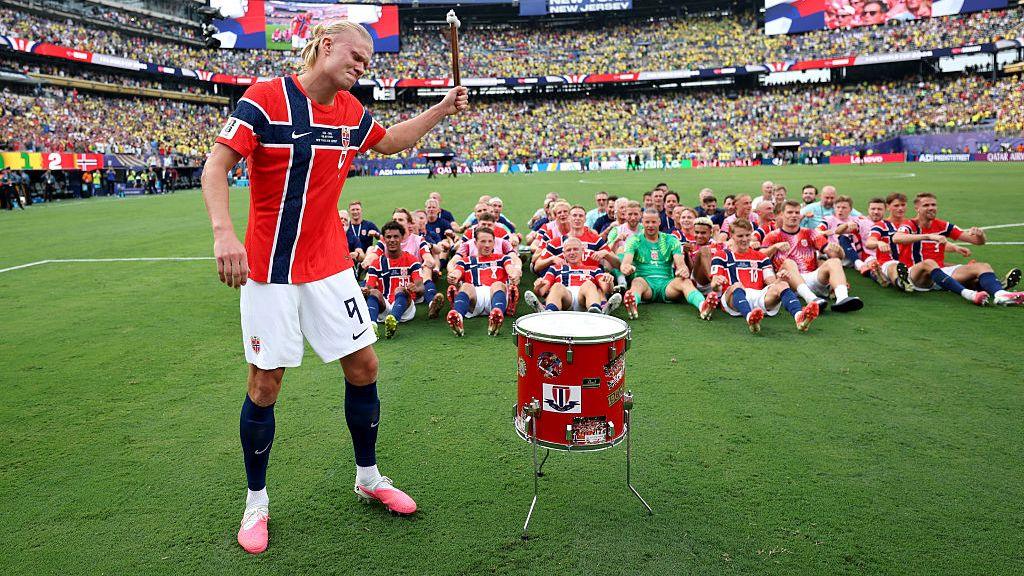 Image source, Getty Images
-
Published
Norway – a country with a population almost the same size as Scotland – have become a football powerhouse at the World Cup and it’s not just down to Erling Haaland.
The Manchester City striker, who has seven goals under his belt at the tournament, is the poster boy for the side along with Martin Odegaard, who captains both Arsenal and the national team.
However, they are not the only successful products of the Norwegian youth system. Of their 26-man World Cup squad, 17 play in Europe’s top four leagues – the Premier League, Bundesliga, La Liga and Serie A.
The majority were mentored in Norway’s national youth football training system, the National Team School (NTS), which was established in 2013.
The comparison with Scotland is not favourable to the latter. While both countries are similar in size, there is a growing gulf in football terms.
Both nations spent 28 years away from the World Cup following the 1998 finals in France. But while Steve Clarke’s men failed to get past the group stage in 2026, Norway will face England on Saturday in a quarter-final, having beaten the Ivory Coast and Brazil in the knockout phase.
Hakon Grottland, head of player development at the Norwegian Football Federation, said we are now witnessing a result of more than two decades of planning to transform Norway – a country synonymous with winter sports – into a football nation.
“When I started with the football federation in 2010, it was my dream that Norway could compete at the World Cup because we had too many years of talking about 1998,” he told BBC Sport.
Grottland attributed Norway’s success to two main factors – an investment in artificial pitches in the period 2000-2010 and a coaching revolution ignited by the establishment of the NTS.
Gambling proceeds help provide sports facilities
Since 2000, Norway has invested in a huge number of artificial pitches. Between 2016 and 2025, 539 were built, with a further 586 being renovated, external.
For a country that experiences harsh winters, this had a big impact.
“Football in Norway went from a summer sport to a whole year-round sport,” explained Grottland. “Back in my day, we had to play on horrible pitches in the winter, on ice and things like that.”
During the 1990s, Norway were synonymous with an effective but workmanlike style of defensive football. Playing on predictable surfaces has led to a more technical style of football – epitomised by their skipper Odegaard, 27.
“It’s partly about artificial pitches, but it’s also about influences,” added Grottland.
“Everyone wanted something a little bit different. But now, this has gone too far because we don’t create enough defenders.”
Norway is one of the world’s richest countries thanks to its significant oil reserves, the largest in Europe after Russia.
The strength of its economy, as measured per member of its population, is almost twice that of the UK and bigger than that of the US, external.
However, one unique factor in the way Norway funds domestic sport is how the country uses revenue from gambling. Betting is strictly regulated and the main, state-owned operator Norsk Tipping donates 64% , externalof its proceeds to sporting purposes, with the main distribution going towards facilities in the country.
In 2026, Norsk Tipping generated more than 2bn Norwegian kroner (£152.7m) for sports facilities.
-
Can Scotland learn from history-making Norway?
-
Published3 days ago
-
-
How do England stop Norway – and Haaland?
-
Published20 hours ago
-
‘I’ve never seen anyone like Odegaard as a child’
Alongside the development of artificial pitches, Grottland cited a “revolution” in the period 2010-2020, “where Norwegian football, the top clubs, the federations and the districts started to invest heavily in player development”.
After failing to qualify for Euro 2012, the Norwegian Football Federation established Landslagsskolen, known as the NTS, in 2013.
Of the 15 players who played in Norway’s 2-1 victory over Brazil, 14 had represented the national team at youth level and 11 of those were part of the NTS pathway from under-15 or under-16s.
Grottland clarified the NTS was not an academy nor a centralised school, such as the famed Clairefontaine in France, but “a national development structure connecting grassroots clubs, districts, top clubs and the federation”.
“It’s not like in other countries where the top clubs are working on talent development and the grassroots clubs are just having fun,” he added.
“In Norway, everyone’s in it together.”
The importance of that grassroots system was acknowledged by the national team before the World Cup, when the squad posed for a team photograph wearing kits from their first clubs.
In England, many promising talents are selected by Premier League academies at the age of eight, but children in Norway stay with their grassroots clubs until 12.
“One important part of the philosophy is that we are not trying to close doors too early,” said Grottland.
He used Haaland, 25, as an example of why this philosophy has worked as he added: “He was part of national talent camps within the National Team School (NTS) structure from the age of 14, but at that time nobody thought he would become the best player in that age group.”
The one player Grottland was sure about from a young age was Odegaard, admitting the whole philosophy of the NTS was inspired by encountering him at 11.
Having been coveted by Europe’s leading clubs, the midfield prodigy signed for Real Madrid aged 16 for 4m euros (£3.4m).
“In Norway, a talented player is a player who loves the game the most – a player who has ownership for his own development and who takes ownership for the team’s development,” added Grottland.
“We don’t measure ball handling and speed and things like that. We start with: ‘does the player love this game?’
“That was inspired by Odegaard – I’ve never seen anyone like him as a child.”
To play this video you need to enable JavaScript in your browser.
This video can not be played
No player is bigger than the team
The most important lessons the NTS instils, said Grottland, are “safety, security and togetherness”.
“This is what we’re seeing as a result at the World Cup. No one player is bigger than the team.”
For him, the Norwegian spirit is epitomised by the Viking row that’s taken over Times Square and stadiums around this summer’s World Cup – a clear example of a nation pulling in the same direction.
“The rowing, it’s about togetherness,” he added.
The question remains, though, whether the NTS can enrich Norway’s domestic league.
Only four of Stale Solbakken’s squad play on home shores, with three of them representing Bodo/Glimt, whose fairytale Champions League run to the last 16 last season may hint at a better future.
“One of our main goals in Norwegian football is to produce and sell players to the big leagues,” said Grottland.
“At the same time, the last couple of years, our own league developed. The two things work together.”
Norway manager Solbakken told BBC Sport: “We have players who are around 30 or older, we have players who are around 18 and 20 and then players who are in the middle who are peaking.
“I don’t know if it’s a generation but it’s hard work from the clubs, hard work from the federation.”
To play this video you need to enable JavaScript in your browser.
This video can not be played
To play this video you need to enable JavaScript in your browser.
This video can not be played
-
-
Published3 hours ago

-
-
-
Published2 July

-


