
At least five arrested over Renoir museum theft
-
Published
At least five people have been arrested in France in connection with the theft of two paintings by Pierre-Auguste Renoir last month, local media report.
The two suspected burglars are said to be among them.
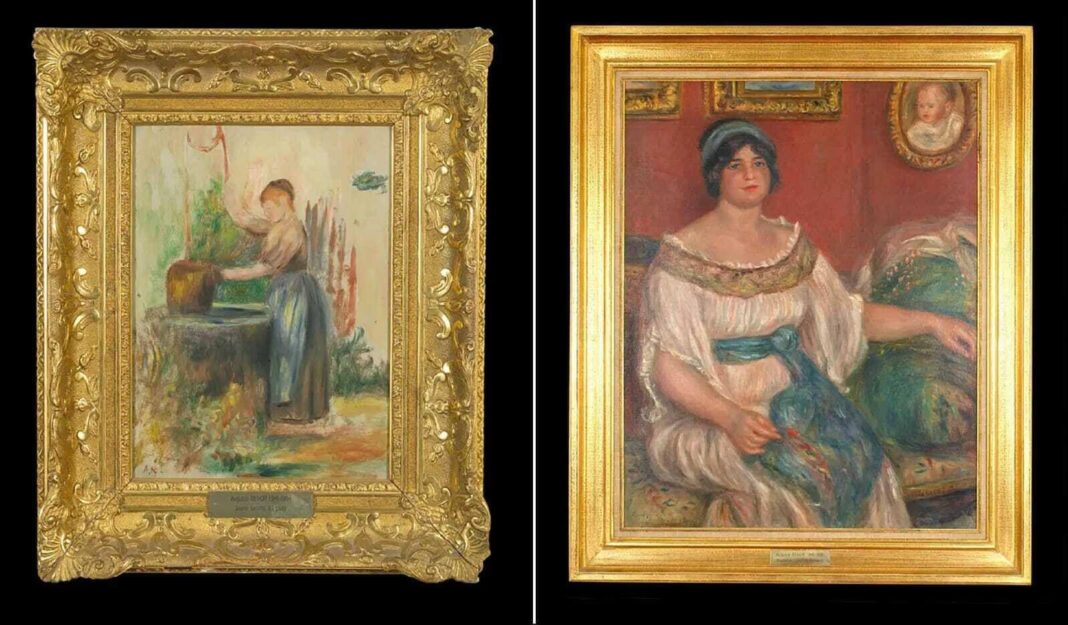
Two of the masterpieces stolen from the Renoir Museum in Cagnes-sur-Mer, a suburb of Nice, have yet to be recovered. Two other works were abandoned by the thieves as they rushed to leave the museum.
The heist was the latest in a series of high-profile art thefts in Europe which thrust the security of galleries and museums into the spotlight.
The suspects cut through a fence to enter the museum’s tree-lined grounds at dawn on 8 September, smashed a window to get inside, and used an electric saw to cut through the frame mountings.
The two missing paintings are the Portrait of Madame Colonna Romano (1910) and Jeune fille au puits (1886).
According to the Nice-Matin newspaper, which first broke the news of the arrests, the suspects could be part of an organised criminal gang. Some French news outlets, including Nice-Matin, say the number of those arrested is six.
Local prosecutors have declined to confirm the arrests when contacted by the BBC.
The Renoir Museum is home to 12 of the famous painter’s artworks.
Opened in 1960, it was Renoir’s last home before his death in 1919, and also features many things that once belonged to him, including his easel and wheelchair, as well as photographs and personal letters.
Several European museums and galleries have seen major thefts in recent months.
In August, paintings by Renoir, Paul Cézanne and Henri Matisse were stolen from a museum in Italy, in a heist that lasted just three minutes. They were later recovered.
One of the most high-profile such incidents was in October last year, when France’s crown jewels were stolen in broad daylight from the Louvre in Paris.
The thieves, disguised as construction workers, broke into the Louvre’s first-floor Apollo Gallery during the museum’s opening hours. Using a angle-grinder to open display cases, they made off with €88m (£78m) of jewels that once belonged to 19th-Century queens and empresses.
The Louvre was subsequently criticised for under-investing in security.