
This post was originally published on this site.
Bank holds interest rates but says it is ready to raise them if Iran war escalates
To play this video you need to enable JavaScript in your browser.
This video can not be played
-
Published
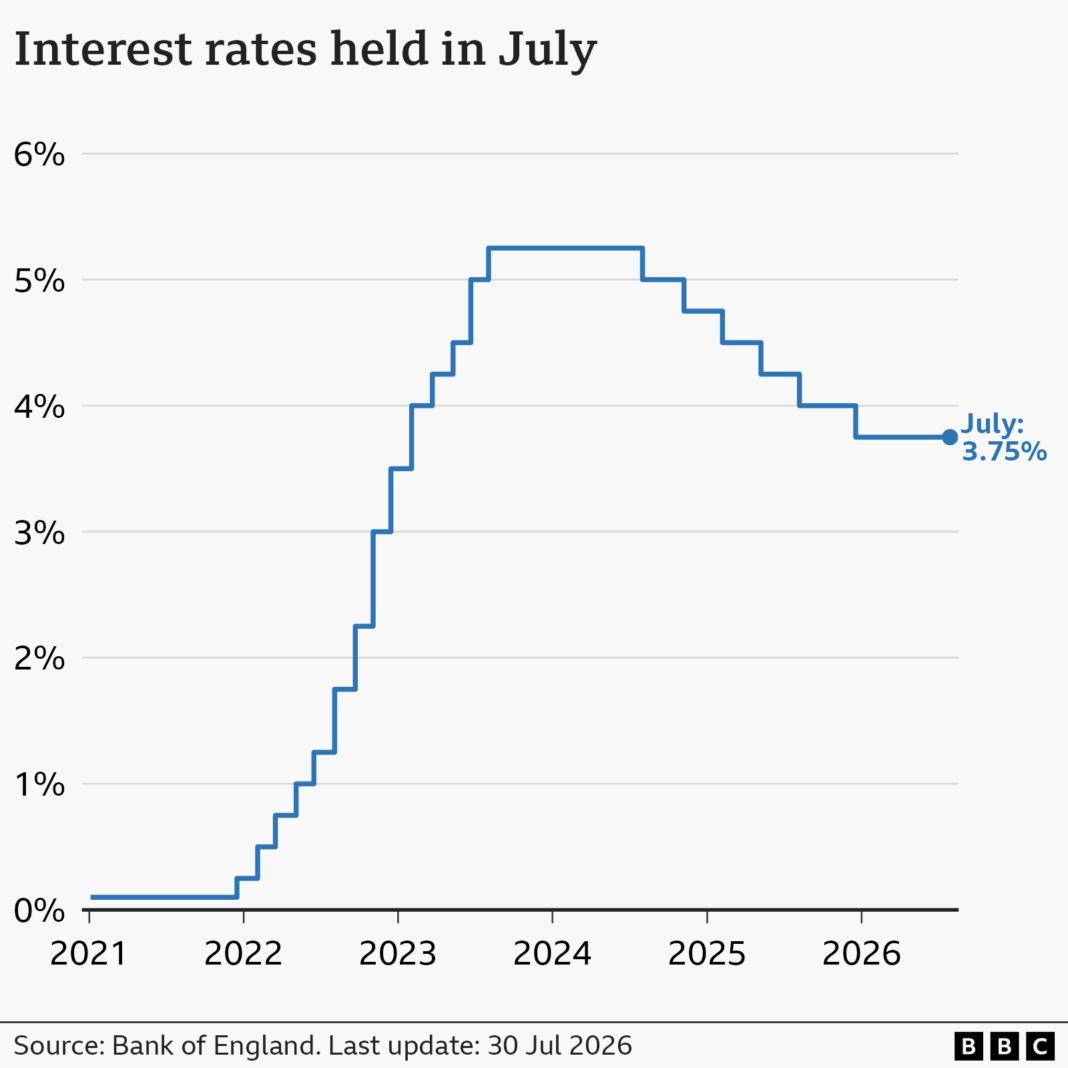
The Bank of England has kept interest rates unchanged for the fifth meeting in a row but has indicated it could raise them if the Iran war escalates.
It expects inflation – the rate at which prices rise – to pick up due to volatile oil and gas prices caused by the Middle East conflict, although the peak will be slightly lower than previously thought.
The Bank voted to hold interest rates at 3.75% at its latest meeting.
Bank of England governor Andrew Bailey warned the future of UK interest rates depended on whether the US led war against Iran continues.
While major uncertainties remain because of the war, the Bank predicts the UK economy will grow this year by more than previously forecast.
Bailey told the BBC: “If we get a continuation of this conflict going on and oil prices stay above $100 a barrel… the odds are that interest rates will have to go up higher.”
But he also said if a ceasefire, and memorandum of understanding, is established and sticks that would make a difference.
“So it depends on how the events in the Middle East, frankly, unfold. And sadly, we all know this is highly unpredictable,” Bailey said.
“What goes on in the Gulf is not, I’m afraid, under our control.”
Three members of the Bank’s nine-member rate-setting committee voted for a hike, one more than the previous meeting – with that member explicitly citing the collapse of the US-Iran memorandum of understanding for their vote to raise rates.
However, speaking at an earlier news conference, Bailey said the Bank was not currently moving towards raising interest rates.
“Please do not leave this room thinking that the Bank of England is edging towards a hike, because frankly, there’s nothing in what I said, and I think any of us have said along those lines,” he told reporters.
If the Iran war continues and oil prices hover around $100 a barrel, then a rate rise seems likely. But many in the markets expect tensions to subside in the coming weeks, ahead of crucial elections across the US in the autumn.
Oil and gas prices have seen wild swings in recent days because of uncertainty over the status of the conflict.
On Monday, the price of crude fell as US President Donald Trump said there were “very friendly negotiations” happening between Washington and Tehran.
On Wednesday, oil shot up to more than $91 per barrel as Trump said of Iran: “We’ll be hitting them hard. They’re going to get a beating.”
Recent data showed that UK inflation eased to 2.6% in the year to June, when diesel and petrol prices fell during a brief lull in hostilities between the US and Iran.
Bank governor Bailey said: “Inflation has fallen faster than expected but the conflict in the Middle East continues to mean high and volatile energy prices. That will cause inflation to rise again this year.
“However, as the conflict unfolds, our job is to make sure any increase in inflation is temporary and that it comes back to our 2% target.”
‘I need mortgage rates to come down’
 Image source, Priya Kapadia
Priya Kapadia has owned her home for two-and-a-half years and is coming to the end of her original fixed-term deal with an interest rate of over 5.5%. She says she needs rates to come down to save money on her mortgage so she can pay other bills.
“We are already paying twice what we were paying as rent for our mortgage,” she says, adding it’s “eroded about 50%” of the money they had to spend on other things.
“I’m not even talking about luxuries or comforts. I haven’t had a holiday… we don’t go out to eat,” she says, adding that bills such as gas, electricity and council tax have risen.
“If [the Bank of England’s rate] stays at the 3.75% as it is now, and if the lenders out there don’t come down significantly… then I’m going to probably save about £10 or £20 a month.”
If the rate goes down further, she thinks she could save up to £150.
-
What’s happening to UK interest rates and what does it mean for mortgages?
-
Published6 hours ago
-
The Bank of England examined a range of scenarios of what might happen to inflation and the economy depending on the Middle East conflict.
Inflation was previously expected to reach 3.5% this year.
In a worst-case scenario, where oil prices reach $100 a barrel, the Bank now projects that inflation could reach 3.2% in 2026.
In a scenario where oil prices are around $76 before falling back to $71, inflation could reach 3%.
While better than previously forecast, that remains above the Bank of England’s 2% target.
The UK economy is expected to grow by 1.1% this year, ahead of forecasts the Bank made in April.
The Bank of England is ready to raise rates if the war in the Gulf continues to escalate, leading to higher oil costs and, in particular, elevated gas prices as Europe refills its storage capacity ahead of winter.
But the judgement on that changes day to day, depending on the responses of the US and Iran. If, as seemed to be the case just a month ago, a ceasefire returns and holds, then energy prices could fall rapidly and raise the prospect of a rate cut.
Megan Greene, one of the three members of the Bank’s rate-setting committee who voted to raise rates to 4%, said that while there was uncertainty because of the Iran war, other “risks loom” over inflation.
These include a second choke point for global energy supplies in the Red Sea – Houti rebels in Yemen recently attacked oil tankers passing through the region.
There are also new factors that the Bank is considering. Droughts around the world and the prospect of a “super El Niño” weather pattern could hike food prices.
The price of technology could also be affected by the current convulsions in the market for microchips.

Get in touch
How are interest rates affecting your standard of living? Is your mortgage up for renewal?