
This post was originally published on this site.
To play this video you need to enable JavaScript in your browser.
This video can not be played
The most consequential decision in the history of the video assistant referee in the Premier League was played out over four minutes 11 seconds of nerve-shredding drama inside London Stadium.
That time span, which felt like an age, became the moment that has the capacity to alter the immediate course of history for Arsenal and West Ham United.
In the wider context, it is the incident and VAR decision that might be seen as the season-defining moment at both ends of the table.
Arsenal were leading 1-0 deep into stoppage time through Leandro Trossard’s 83rd-minute goal when West Ham substitute Callum Wilson hammered home a finish in a packed penalty box following a corner.
West Ham celebrated, Arsenal manager Mikel Arteta turned away with his head in his hands fearing a vital win had slipped through their fingers with only seconds left – then the protests began.
Has there ever been such drama involving VAR? Have there ever been such consequences riding on a decision in the Premier League?
And the fact it came so late in a tense, high-stakes game made the wait near unbearable for those with a vested interest.
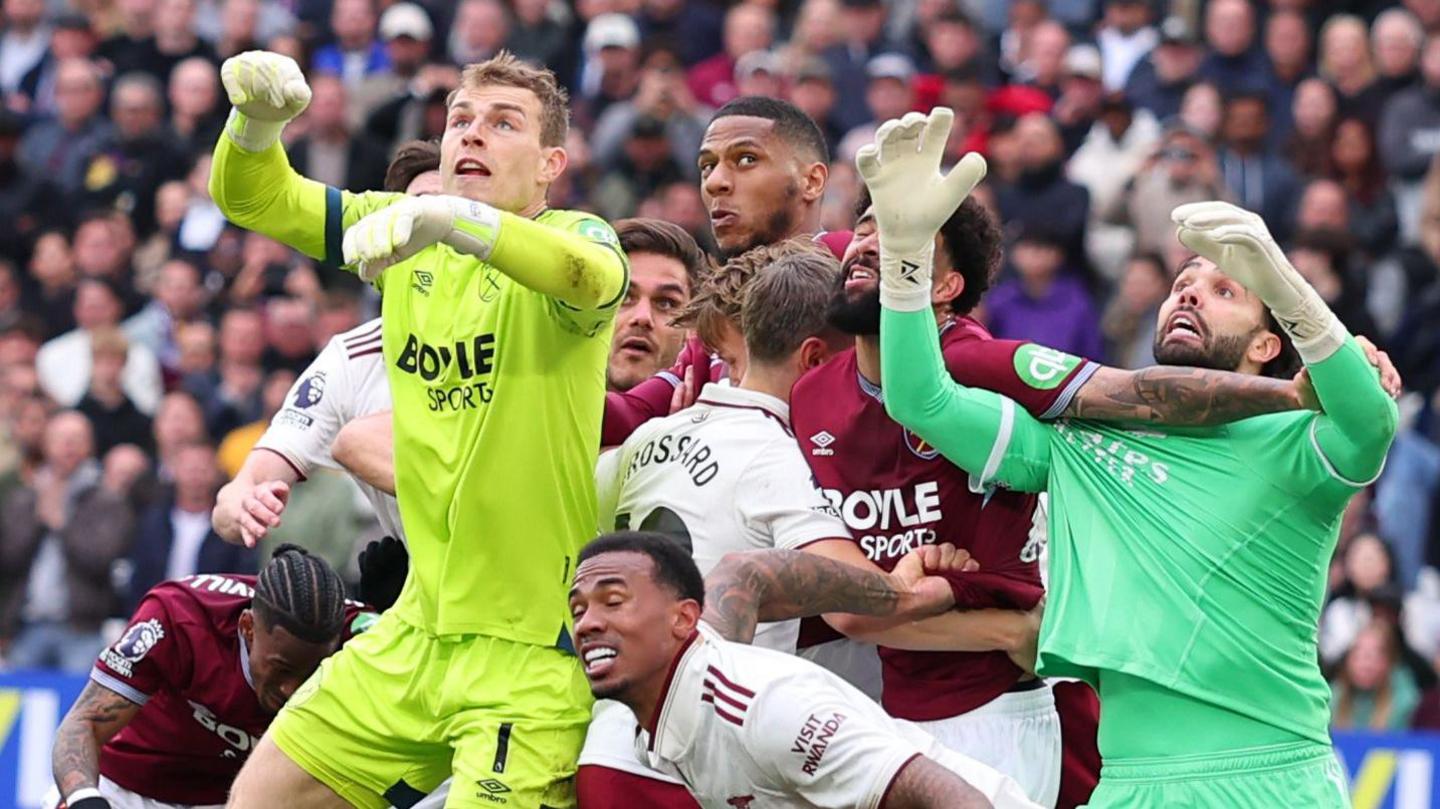
Arsenal insisted goalkeeper David Raya had been fouled by Pablo, with his West Ham opposite number Mads Hermansen flying across in front of him in a blur as a sign of the home side’s desperate plight.
Darren England then had to pore over the most significant domestic VAR decision since its inception in 2019 before sending referee Chris Kavanagh to the screen.
VAR decisions have been important before – but none have been quite so heavy, with the consequences potentially giving Arsenal a decisive push towards their first Premier League title in 22 years, while at the same time sending West Ham towards the Championship.
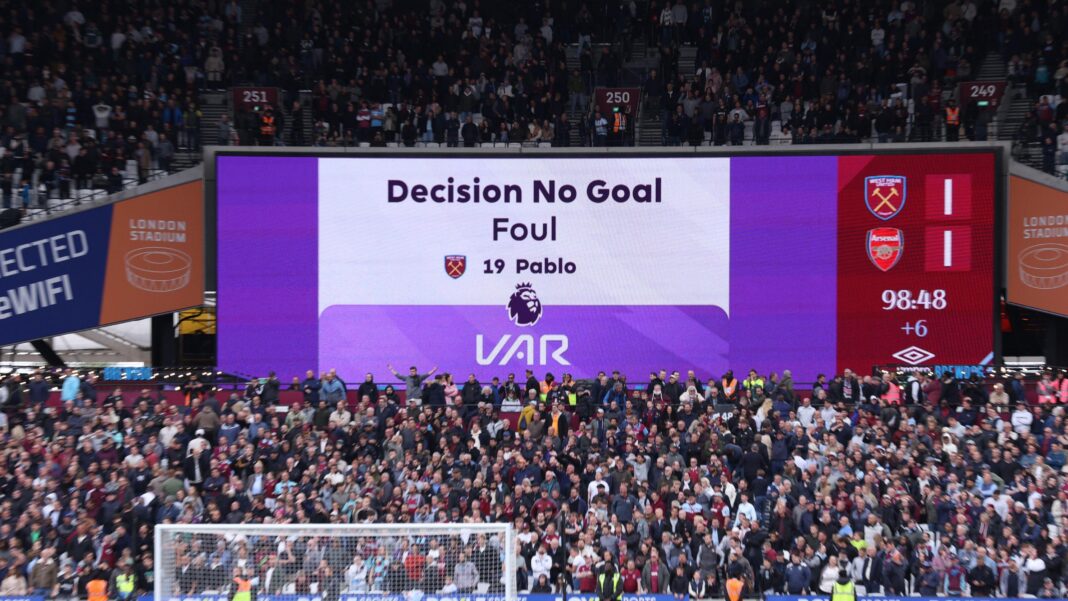
When Wilson’s shot crossed the line, West Ham fans exploded in delirium and then everyone held their breath before Arsenal‘s followers, packed into a corner of the stadium, reacted in similar fashion when the referee announced: “After review, West Ham number 19 committed a foul on the goalkeeper.”
And with those few fateful words, Arsenal now hold a position of huge strength five points ahead of Manchester City – having played a game more – while West Ham look increasingly doomed, sitting a point behind Tottenham Hotspur, who play their game in hand at home to Leeds United on Monday.
West Ham and their fans melted into a mutinous fury that continued long after the final whistle, feeling they had been robbed of a vital point in their fight for survival, as Arsenal celebrated a victory of huge importance.
 Getty Images
While weighing up whether to instruct Kavanagh to take a trip to the sidelines, England also looked at potential fouls by Trossard on Pablo and Declan Rice on Crysencio Summerville.
He decided the first foul was Pablo’s on Raya.
This seemed like an incident that has been a long time coming given the regular push-and-pull that now takes place involving so many players inside the penalty box.
How this can be eradicated is almost impossible to work out as it is a situation that is now close to being beyond the control of officials.
Reactions were contrasting everywhere you looked. On the pitch. On the sidelines. In the stands. And then in the aftermath.
To play this video you need to enable JavaScript in your browser.
This video can not be played
Arsenal manager Arteta praised how “brave” the officials had been to make the decision – and yes, those of a West Ham persuasion said: “Well he would say that wouldn’t he?”
Arteta added: “Probably today I have realised how difficult and how big a referee’s job is. I realised for the referees to be in that position, to make that call and change the course of one of the two teams… What a responsibility. What a big call.”
He told BBC Radio 5 Live: “It was a massive call but it was clearly the right call. My first instinct was foul but then the time goes by, the referee is waiting for the VAR decision – but when you look at it, the contact affects the way David Raya lifts his hands, the way he catches the ball. It is almost on his throat.
“Massive decision, especially when the two teams are fighting for such big things.”
West Ham manager Nuno Espirito Santo was desolate, insisting everyone in the game is now confused as to what constituted a foul in the penalty area at set-pieces.
He told BBC Radio 5 Live: “Look, I did not see it quite well. I would have to see a replay but I trust a lot of what my players felt. They see it, they are on the pitch and said it was not a foul. We are so sad and we are so disappointed.
“I’m going to see it now and try to understand it better. I am not here to judge the work of the referee or the work of the VAR. It is just the lack of consistency in the last few seasons.”
He added: “With the allowance of grappling, blocking, holding, I think we have lost a bit of what is a foul and what isn’t a foul. Previously it would be judged differently so that’s what upsets me.”
Nuno tried to put on a brave face and deliver fighting talk as he is now facing a battle against all odds to keep West Ham out of the Championship.
On such decisions, futures and histories can be made.
‘Foul on Raya had direct impact on play’
Imagine being in England’s position as the VAR in Stockley Park.
The pressure on the official must have been huge. He cannot hear the Sky commentary, he has no idea what public opinion is.
This is the referee who, in September 2023, was responsible for the biggest VAR mistake the Premier League has seen.
It was England who misinterpreted an on-field offside decision, causing a goal for Liverpool‘s Luis Diaz to be wrongly disallowed at Tottenham.
England had to fight his way back up to top-flight refereeing after that.
Today he was presented with a decision that could decide the fate of two clubs.
You can’t blame him for taking his time. He had to get this right.
England spent two minutes 41 seconds poring over every angle of the footage, checking the possible foul, the potential penalties.
We have seen pushing, shoving, grabbing and pulling on corners all season. Goalkeepers have been pressuring and harried too.
Is this different? Crucially, it was.
Pablo had his arm across Raya and he was holding on to the goalkeeper’s left arm too.
It is hard to argue that the Spain international was not impeded. Without the foul contact by Pablo, Raya would surely have had a simple catch.
England checked the other possible fouls too, by Trossard on Pablo and Rice on Summerville.
Importantly, the first foul that had a direct impact on play was Pablo on Raya. You cannot give a penalty for a foul that may come after this.
England had to get that right – and he did.
Referee Kavanagh spent one minute 15 seconds at the monitor. He too would have known the consequences of his final decision.
In total, four minutes 11 seconds potentially deciding the title and the final relegation place.
If it takes that long, can it really be clear and obvious? That is the wrong way to look at it. With such a huge, season-defining call, take as long as necessary to make sure you are getting it right.
England will have spent the final few minutes of the game wondering if he’d made the right call.
There are no communications inside the VAR room, no mobile phones, no way of gauging if you’ve done the right thing.
Imagine the relief when he walks out of the room and is told he’s got it right, that Pablo has impacted Raya from playing the ball.
On Saturday, England will take charge of the FA Cup final between Manchester City and Chelsea.
That was unthinkable two and a half years ago. Now he’s got the landmark game on the football calendar – and he’s exorcised his VAR demons.