

This post was originally published on this site.
Even if you do not invest much in bonds, the bond markets are hugely important. Jim Leaviss, the former M&G bond guru, who sadly passed away last month, was fond of saying that “there is nothing more fascinating than a fixed-income instrument”. There is a lot of truth in this. The bond markets directly reflect consensus about inflation, growth, government finances and more, while influencing the price of many other assets.
So while investors who are willing to take greater risk in other investments such as shares are likely to earn higher long-term returns, they should still be looking at bonds.
Take long-term government bonds, with 20 or 30 years to maturity. Very few of us probably hold these consciously. Yes, they will be part of many funds and exchange-traded funds (ETFs): bonds with maturity of more than 20 years are around 16% of the iShares Core UK Gilts ETF (LSE: IGLT). And you could certainly buy something like iShares USD Treasury Bond 20+yr ETF (LSE: IBTL) if you think yields are getting too high and you want to bet on them falling. Yet with yields at 5.7% for the 30-year gilt and 5.2% for the 30-year Treasury, they are not exactly compelling to most individual investors. Longer-dated bonds appeal to institutional investors who for various regulatory reasons need to hold “low-risk” assets against their liabilities.
Sign up to Money Morning
Don’t miss the latest investment and personal finances news, market analysis, plus money-saving tips with our free twice-daily newsletter
Don’t miss the latest investment and personal finances news, market analysis, plus money-saving tips with our free twice-daily newsletter
What’s going on in the bond markets?
That said, long-bond yields have been crawling up (in some cases, such as Japan, moving a lot faster than a crawl) as institutions become less keen on holding them. There can be multiple factors behind this, including technical ones such as changes in the preferences of specific institutions for specific maturities in specific countries. However, the broad-brush conclusion is that investors are worried that high government deficits will mean high bond issuance for many years in the future. All else being equal, that’s bad for bond prices (on the basis that supply will increase faster than demand).
What it does not (so far) seem to be signalling is any consensus that inflation will be structurally higher. Inflation breakevens – the difference between yields on nominal bonds and comparable inflation-linked bonds – are not moving. If we use US bonds (the deepest market with fewest technical distortions), the 20-year breakeven is at 2.4% and the 30-year at 2.2%, both around the bottom of their range for the last five years.
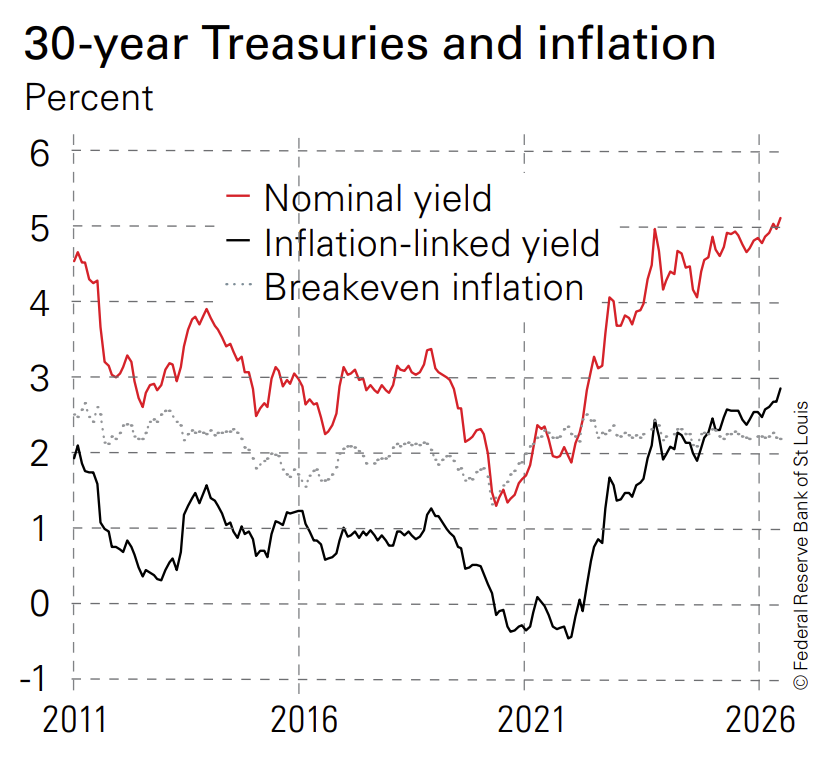
(Image credit: Federal Reserve Bank of St Louis)
I find this hard to reconcile. If major governments continue to run large deficits – and it is difficult to see how they will not – they will surely respond to rising long-term bond yields by issuing more short-term debt (this is already happening) and by pressuring central banks to keep short-term rates down to make that as affordable as possible (this is starting with Donald Trump‘s demands on the US Federal Reserve). That seems to be a recipe for higher inflation, yet the bond market shows little sign of pricing that risk in.
This article was first published in MoneyWeek’s magazine. Enjoy exclusive early access to news, opinion and analysis from our team of financial experts with a MoneyWeek subscription.