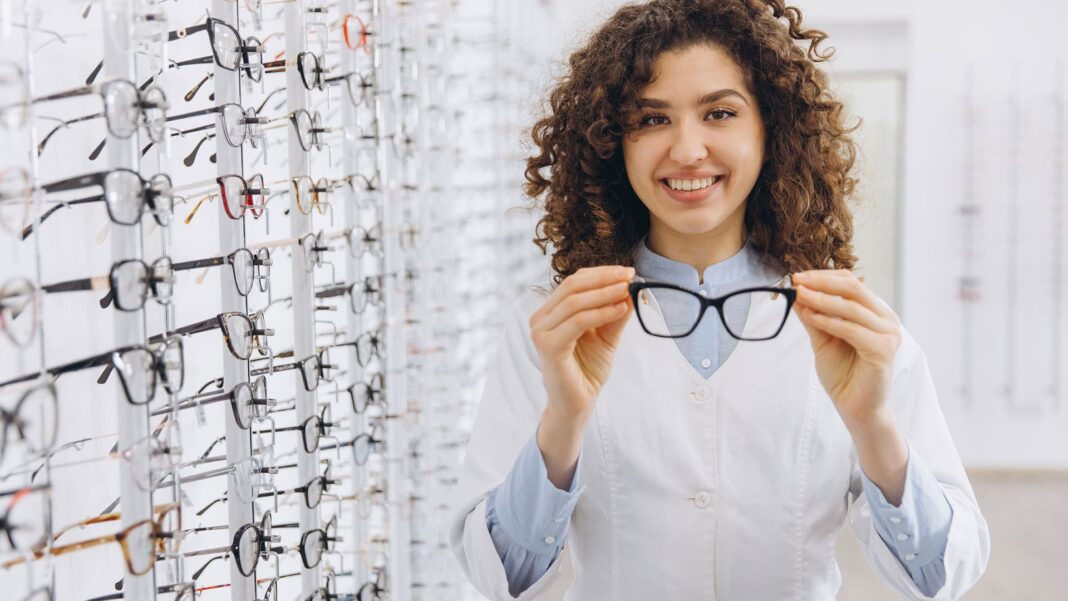

The online eyewear market has changed the equation significantly. The price difference between a high street pair and an online equivalent is now substantial, and in many cases the lenses are made in the same facilities to the same optical standards.
Understanding what you are actually paying for, and what you are not giving up, makes buying cheap prescription glasses considerably less stressful.
What Drives the Price of Prescription Glasses
The cost of a prescription pair breaks down into three elements: the frame, the lenses, and the dispensing. High street practices bundle all three and price them together, which obscures what each component actually costs. Online retailers separate them, which is partly why the total looks so different.
Frames vary enormously in cost depending on material, brand, and whether the name on the front is a designer label or a house brand. The lens cost depends on the index, the coatings, and whether the prescription is straightforward or complex. A standard single vision lens in a mid-index material with an anti-reflective coating is not an expensive product to manufacture. The high street price reflects the environment it is sold in as much as what the lens itself costs to make.
What Not to Compromise On
Cheap does not have to mean compromised, but some corners are worth refusing to have cut regardless of the price point.
Anti-reflective coating should come as standard. Without it, the lens surface reflects light back toward the eye, which adds low-level visual effort that accumulates across a full day of wear. Many budget frames online include this. Many cheap prescription glasses at market stalls and discount shops do not.
UV protection matters in any lens with a tint. UV400 certification should be stated explicitly rather than implied. Scratch resistance extends the lifespan of the lens meaningfully and is worth confirming before ordering.
Optical accuracy is non-negotiable. The prescription values must be reproduced correctly in the finished lens, with the optical centre positioned at the pupillary distance provided. This is where the clinical oversight of the retailer matters. A GOC-registered dispensing optician overseeing fulfilment is the standard that separates a reputable online optician from a low-quality operation that happens to have a website.
Lens Index and Why It Affects Price
The refractive index of a lens determines its thickness for a given prescription power. A standard index lens in a strong prescription is noticeably thick. A higher index lens achieves the same correction in a thinner, lighter profile. Higher index costs more.
For mild to moderate prescriptions, a standard or mid-index lens looks fine in most frames and the saving over high-index is real and reasonable to take. For stronger prescriptions, the extra cost of a higher index lens is worth paying because the visual and aesthetic difference is significant enough to affect whether the glasses are worn consistently.
Where to Buy Cheap Prescription Glasses Online in the UK
The UK online optical market has matured to the point where there are genuinely trustworthy retailers operating at accessible price points. The key markers to look for are GOC registration, a clear returns policy with a UK address, stated lens specifications, and customer service that is reachable if something goes wrong.
Feel Good Contacts is one of the most established and trusted names in UK online optical retail. Feel Good Contacts has expanded its glasses range to offer prescription frames alongside its core contact lens business. For buyers who want to manage both contact lens and glasses needs through a single trusted supplier, it is a natural and well-regarded choice. The combination of competitive pricing, genuine clinical oversight, and an established UK customer service track record makes it one of the more reliable options in the affordable prescription glasses space.
Other reputable options in the UK online market include Glasses Direct, which offers a home trial programme for frames before committing, and Clearly, which carries a broad range at competitive price points. Each has built a track record over years of operation that gives buyers reasonable confidence in prescription accuracy and returns handling.
Getting the Most From an Affordable Pair
An up-to-date prescription is the starting point. A prescription more than two years old is worth refreshing before ordering, both because prescriptions change and because the eye test checks health as well as correction.
Pupillary distance is the measurement most people forget to request from their optician. It is needed to position the optical centres of the lenses correctly and is not always included on the standard prescription printout. Asking for it at the time of the eye test is simpler than obtaining it later. Some online retailers offer a PD estimation tool using a phone camera, which works adequately for straightforward prescriptions.
A simple frame in a shape that suits the face, combined with a mid-index anti-reflective lens in the correct prescription, is a practical pair of glasses at a genuinely low price. The result is optically equivalent to a high street prescription at a fraction of the cost, provided the retailer meets the clinical standards that make the comparison fair.