
Education, Barcelona & Basque culture – why Spain are dominating football
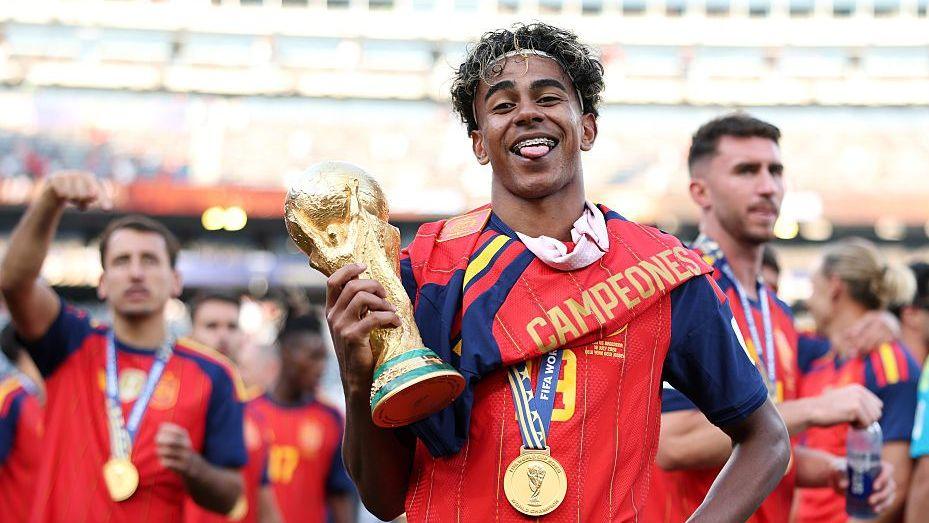 Image source, Getty Images
-
Published
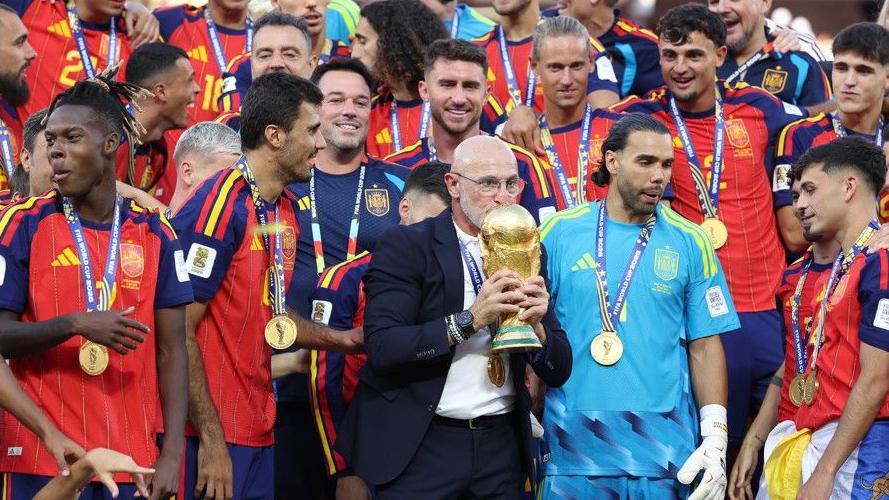
World champions. European champions. Olympic champions. Undefeated in two and a half years. Spain are the dominant force in men’s world football.
Of the past 10 major international tournaments, they have won five.
Going into Saturday’s Nations League meeting with England at Wembley (19:45 BST), they are on an international record 38-match unbeaten run. They have not lost since a 1-0 defeat by Colombia in a 2024 friendly.
And the success does not stop with the senior men’s team. During that time, Spain have also won:
-
Six Under-19 European Championships
-
Three Under-21 European Championships
-
The Women’s World Cup in 2023
At club level, Spanish teams have won half of all available Champions League and Europa League titles since 2009.
Spain football expert Guillem Balague told BBC Radio 5 Live there are “three pillars” that explain Spain’s coaching culture and its unprecedented success.
“The first one was university, and in particular something called the National Institute of Physical Education,” he said. “University entered physical education in Spain a long time ago, in the 1990s, and they created physical coaches and football coaches with a deep understanding of learning and training processes.
“Some of those fitness coaches became really big managers, like Rafa Benitez or Marcelino Garcia Toral. They came from learning and studying what football was about ahead of anybody else.
“The second pillar is the Basque culture. The Basque Country represents historically a special reference within Spanish football because they relate to work ethic, massive work ethic, daily effort.
“And the third pillar is what everybody knows: the Barcelona influence, Johan Cruyff and the tactical revolution that followed through him.”
To play this video you need to enable JavaScript in your browser.
This video can not be played
The Barcelona influence
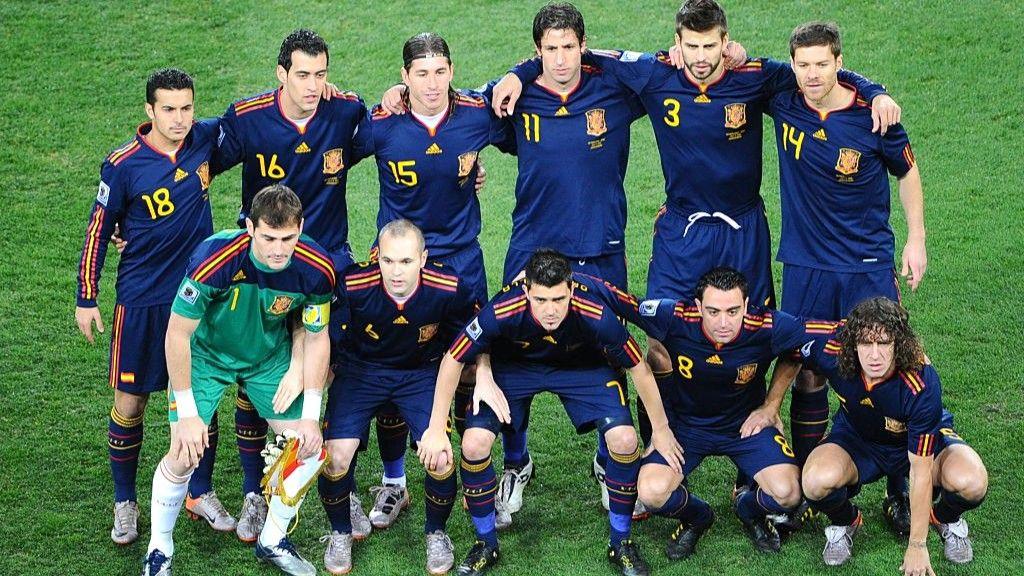
Eight players from Barcelona’s La Masia academy were in the Spain squad who won the 2010 World Cup under Vicente del Bosque, and another eight were in Luis de la Fuente’s group as they lifted the trophy again this summer.
Barcelona won their first European Cup in 1992 under Cruyff playing total football – a style pioneered by the Netherlands team of the 1970s in which he played, and later mirrored at the Nou Camp under Pep Guardiola’s management between 2008 and 2012.
That was a period where Barcelona won three consecutive La Liga titles, while Spain won back-to-back European Championships in 2008 and 2012 either side of their 2010 World Cup triumph.
Xavi, Andres Iniesta and Sergio Busquets were brought through in a system where players learn the art of ball possession and positional play in its purest form.
Jordi Gratacos, Barcelona’s international director of academies from 2009 to 2011, and then from 2016 to 2020, told BBC Radio 5 Live: “The number one thing is to understand the tactical meaning of the technical action. What I mean is to create intelligent players [who are] very good in technical aspects.
“In this level, all players are very good in the technical aspects. The most important are these players who always decide the best option inside the field and make others better.
“The main objective is to prepare the players to take the position. It’s an open education when you create some scenarios, context and ecosystem where the player needs to decide, and the coach needs also to say: ‘This was the best option – next time, take the other option.’
“The most important thing is that they need to decide inside the game.”
In his first two seasons as Barcelona manager, Hansi Flick is repeating what Guardiola did – not only in the sense that he has won two La Liga titles in a row and chasing a third.
Academy products form the engine of his project, with Lamine Yamal, Dani Olmo and Pau Cubarsi forming key components of success at both club and international level – just as the generation of 2008-12 did.
Spain have found the formula to repeat success, and Barcelona are at the heart of it.
To play this video you need to enable JavaScript in your browser.
This video can not be played
The Basque Country
If Barcelona and Catalonia represents the artistry of Spanish football, the Basque Country represents its character.
Five players in the 2026 World Cup squad were from the region and came through at either Athletic Bilbao or Real Sociedad – clubs where eight players were playing at the time Spain won Euro 2024.
Then there is Mikel Merino, who scored a quarter-final winner against Germany at Euro 2024, before going on to score six goals in six games in World Cup qualifying, and late winners against Portugal and Belgium over the summer.
Although not Basque, Merino is from Pamplona in the autonomous community of Navarre – a region that has a significant influence of both Spanish and Basque culture.
Just five kilometres away from Pamplona is Zizur Mayor – the town where former Chelsea captain and Spain international Cesar Azpilicueta grew up.
When asked to describe Basque culture, Azpilicueta told BBC Radio 5 Live: “The discipline, the culture of working hard, of not giving up or being resilient, not very flashy.
“Normally, people want to display this culture of fight, being tough – like English football – more duels, more physical, less technical.
“But also in terms of tactical approach, more compact, great knowledge of knowing where to go, and with the ball keep it simple and try to go forward as quick as possible.”
The five Basque players from the 2026 squad have formed an important part of Spain’s recent success and are an embodiment of what Cruyff thought of players from that region.
Cruyff once said: “The first thing I did as a coach, was to sign four players from the Basque region. They are not afraid of anything.”
For current Spain boss De la Fuente in 2026, Unai Simon played in goal, with former Manchester City defender Aymeric Laporte a key cornerstone of a defence that conceded just one goal in eight matches all tournament.
Nico Williams assisted the winning goal for Ferran Torres in the final against Argentina, Martin Zubimendi made a positive impact from the bench in both the Euro 2024 and World Cup finals, while Mikel Oyarzabal has scored 18 goals in his past 20 Spain appearances.
This influence stretches beyond the pitch as Basque coaches are in charge at four of England’s biggest clubs – Mikel Arteta at Arsenal, Unai Emery at Aston Villa, Xabi Alonso at Chelsea and Andoni Iraola at Liverpool.
Education of the coaches
On to the final pillar – education.
Former Liverpool boss Rafael Benitez explained: “We were creating in Spain a group of fitness coaches who knew about football.
“I went to Liverpool John Moores University to see the programme of the sports scientists and they didn’t have the knowledge in football that we had.
“They were really good in fitness, but with the ball and on the pitch, they didn’t know how to manage. So you didn’t have in England, this professional, this specialist in football, sports medicine and everything that we were studying in university.
“That was a crucial part of the formation of why Spain was improving and has been improving since then.”
-
-
Published17 July
-
-
-
Published20 July
-
-
-
Published16 July
-
Play quizzes
-
-
Published20 April
-
-
-
Published3 April
-
-
-
Published26 May
-