
This post was originally published on this site.
England advised to avoid alcohol around matches
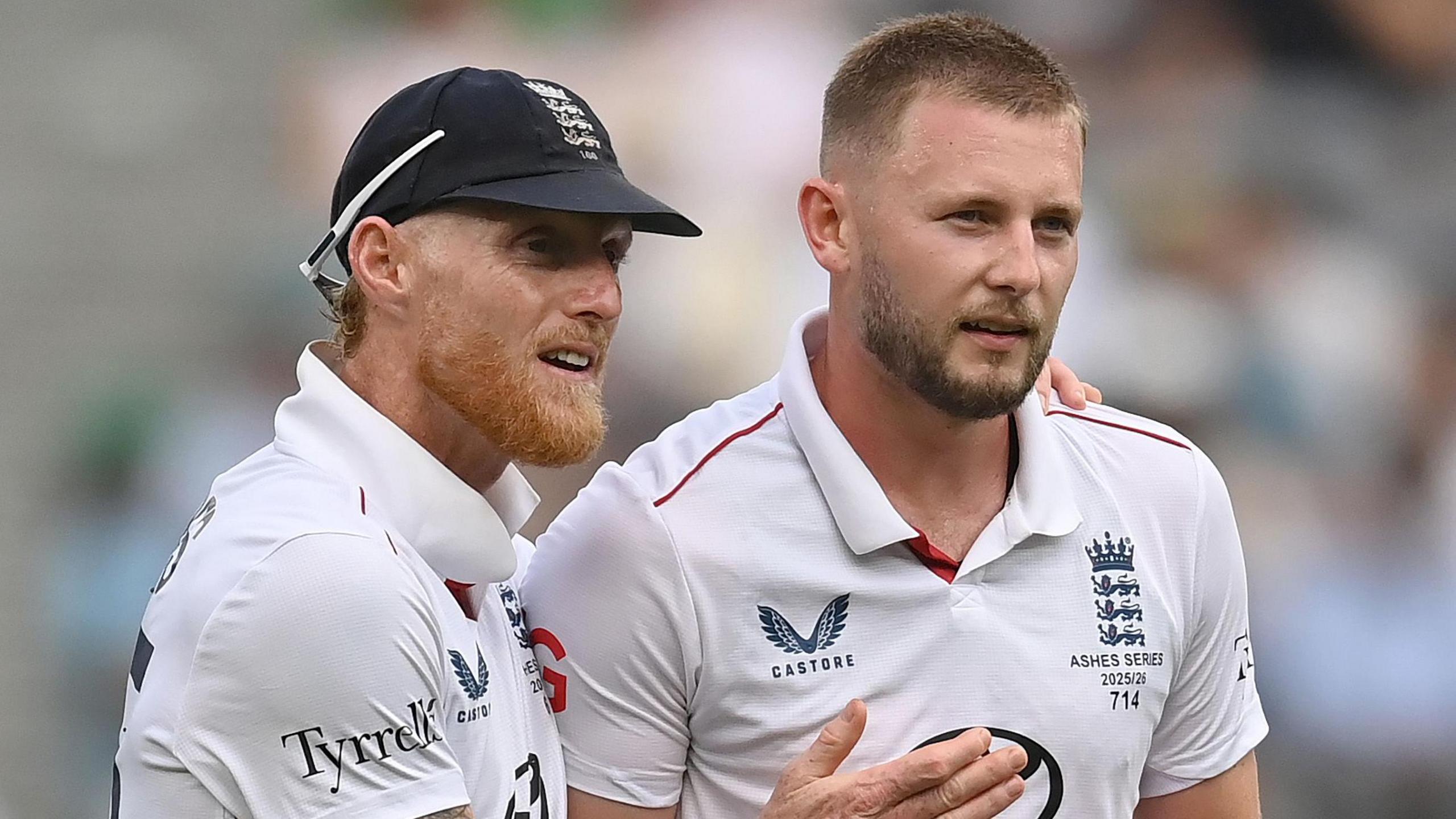 Image source, Getty Images
-
Published
England men’s players have been advised to avoid drinking alcohol on the day before and the day after matches, under new behaviour guidelines.
A midnight curfew was introduced following an Ashes tour blighted by off-field problems, but ambiguities around the curfew were a factor in the nightclub controversy involving Ben Stokes and Gus Atkinson.
In the aftermath of that incident, England players were issued new guidance, as reported by the Telegraph, external.
The updated policy confirms the midnight curfew is in place on every day of a series at home or on tour.
It also recommends that no alcohol be consumed on the day immediately before, during or the day immediately after a match. If, for example, a Test runs the full five days, the recommendation extends to the following day.
The head coach and director of cricket, in this instance Brendon McCullum and Rob Key respectively, have the discretion to relax the recommendations when they see fit.
That way, the hierarchy can allow players the freedom to celebrate a win or keep with traditions such as an end-of-series drink with the opposition at the conclusion of an Ashes series.
Players were allowed to drink immediately after the third Test against New Zealand at Trent Bridge, to mark Stokes’ international retirement.
The recommendations apply only to players, rather than staff.
If players do choose to drink in the period before, during or after matches, it should not be in public.
They have also been strongly discouraged from drinking in private, in order to aid preparation, recovery and professionalism.
It has not been confirmed if the guidelines apply only to the England senior men’s teams, or all England teams – including the senior women and pathway programmes.
Regarding the curfew, there are periods when players would naturally leave the England camp, either because there is a long gap between matches or they have been released to their counties. It is unclear if the curfew would still apply.
-
‘Conversation needed over cricket drinking culture’
-
Published9 January
-
-
Stokes and drinking give England another headache
-
Published9 June
-
-
Booze, beach, beaten – how England lost the Ashes
-
Published21 December 2025
-
The curfew was first introduced to the England men’s white-ball teams in January for their tour of Sri Lanka and the T20 World Cup that followed.
It came after Harry Brook was punched by a nightclub bouncer in Wellington, with Jacob Bethell and Josh Tongue present, and following Ben Duckett being filmed, apparently drunk, on England’s mid-Ashes holiday in Noosa.
In the build-up to the summer, Key confirmed the curfew remained in place.
However, after England won the first Test against New Zealand at Lord’s, Stokes and Atkinson were at a London nightclub into the early hours of the following day. They were present when a member of England security staff was struck by a Saracens rugby player.
Stokes and Atkinson were made unavailable for the second Test, pending an investigation into the incident.
In the aftermath, Key said Atkinson was not aware that the curfew was in place. Key also suggested a total alcohol ban, which has not come to pass.
Stokes and Atkinson were eventually cleared of violent conduct but were instead found to have breached “specific contractual obligations”.
As the pair were once again made available for the third Test, McCullum admitted to ambiguity over the terms of the curfew and said it would be clarified so players are left with no confusion over behavioural expectations.
Now, in addition to the clarification over the terms of the curfew and the recommendations over when they should drink, players also must inform team management or security if they are out of the hotel after 22:00.
Players also cannot appear under the influence of alcohol in public, or post on social media about alcohol-related activities.
-
-
Published1 day ago
-
-
-
Published29 June
-
-
-
Published8 June
-