

This post was originally published on this site.
 Getty Images
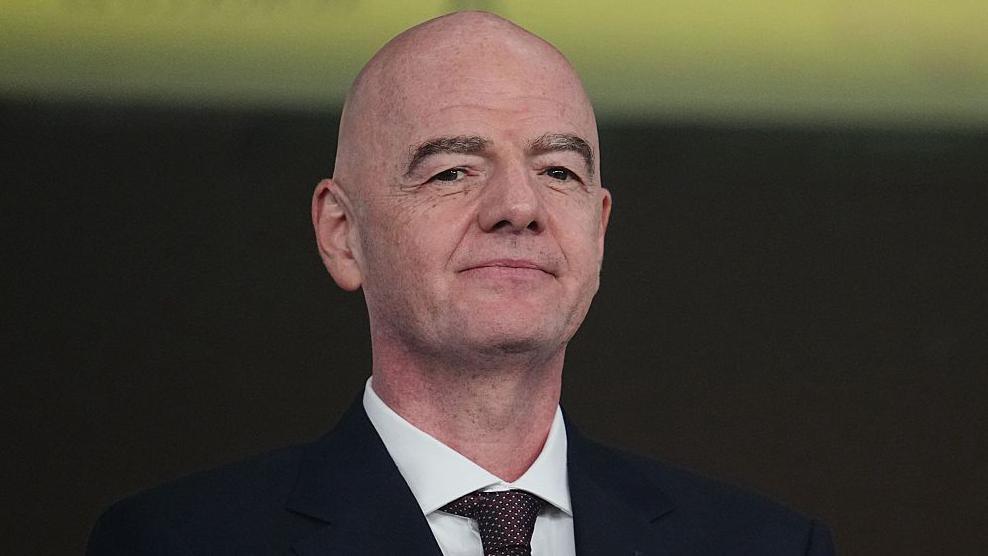
Maybe Fifa president Gianni Infantino just thought he was making a light-hearted quip.
But it fell flat in England.
Referencing concerns about this year’s World Cup in north America and criticism in the build-up to Qatar 2022, Infantino said: “For the first time in history, also, no Brit was arrested during a World Cup.”
To laughter at the World Economic Forum in Switzerland, he added: “Imagine. This is something really, really special.”
Understandably the comments angered the Football Supporters’ Association, which accused Infantino of making “cheap jokes” about England fans.
The terminology “Brits” may well have annoyed fans from Wales, Scotland and Northern Ireland too.
A lot has been done to try to repair England’s name at major tournaments after it hit one of its lowest points on the international stage at Euro 2000. That was after a long history of hooliganism.
So what do the World Cup statistics show? Was the lack of arrests in Qatar unusual? Was this how England fans are still seen internationally or just a low blow?
-
Who are the 2026 World Cup debutants?
-
5 December 2025
-
‘Comment said in jest not helpful’
Infantino’s comments were made directly in relation to World Cup appearances.
It is fair to make the point that since France 1998 there has only been one World Cup (Germany 2006) which has been easily accessible for English fans.
At the 2002 World Cup, England played all five of their matches in Japan.
There was only one arrest for violence or public disorder among the 8,000 supporters who flew to Asia.
In Germany for the 2006 World Cup an estimated 350,000 watched games in stadia and at fan parks. Yet there were just 21 arrests for football-related offences.
The most violent scenes at the tournament surrounded a game between Germany and Poland when 429 arrests were made, including 119 from Poland and 278 from the host nation.
The next two World Cups were long-distance affairs in Africa and South America.
Recorded figures show that, contrary to Infantino’s claim, there were no England fans arrested at the 2010 World Cup in South Africa – an estimated 30,000 made the journey.
In Brazil for the 2014 World Cup there were 15 football-related arrests – none for violence – among the 20,000 travelling fans. Thirteen were for ticket touting and two for offences against property.
The 2018 World Cup saw the tournament return to Europe in Russia. Some 20,000 England fans visited, with six arrests, of which four were for football-related anti-social behaviour.
Only around 4,000 supporters made the journey to the 2022 World Cup in Qatar which, as Infantino said, saw no arrests for supporters of England or Wales, who had also qualified.
Across six tournaments in total, there were 55 arrests out of 432,000 fans, with 28 non-violent offences.
There are no available comparison figures for other nations – but that single Germany and Poland game at the 2006 tournament was eight times England’s total over six World Cups.
Chief Constable Mark Roberts, national lead for football policing said: “For the record, ‘British’ fans behaving at World Cups is the norm, not something special.
“While these things may be said in jest, it is neither helpful nor accurate to make this sort of comment.”
Euros disorder forms stereotypes
It has to be re-emphasised that over the last 20 years, World Cups have been played in some far-flung countries and others which are not obvious destinations for football supporters.
It is far more likely that trouble might occur when a tournament is close to home – and there have been more arrests around the European Championship at times.
In the ugly scenes of Euro 2000, England were on the brink of being thrown out of the tournament after violent clashes in Charleroi and Brussels.
Official figures show 945 of their supporters were arrested, despite the team only playing three matches in Belgium and the Netherlands.
In the aftermath, the Football (Disorder) Act 2000 was rushed through parliament. It strengthened banning orders and enabled police to withhold passports.
There were also clashes with Portuguese police in the Algarve at Euro 2004. Official figures show one arrest, but there were court reports of many more. Around 60,000 fans travelled.
Once the Euros went out to Ukraine and Poland in 2012, there were no football-related arrests of England and Wales fans. High costs meant only around 10,000 flew out.
With the Euros back in western Europe in 2016, there were violent clashes in the French city of Marseille – England supporters claimed they were targeted by Russian fans leading to running battles.
Nine British nationals were arrested after the Marseille trouble.
Sixty-five arrests were made at the tournament: 45 English, 11 Northern Irish and nine from Wales.
Then there was the delayed Euro 2020 when England played Italy in the final at Wembley Stadium – and perhaps this is what created a recent bad image of their fans in the modern era.
Videos of drunken disorder appeared online before thousands stormed the gates at the ground to gain entry.
Uefa ordered England to play one match behind closed doors as punishment for the unrest, and the Football Association was fined £84,560 for “the lack of order and discipline inside and around the stadium”.
It was unfair to associate all fans with what happened that day, but it perhaps reinforced a long-held stereotype of what England supporters were like for some.
Related topics
-
-
17 October 2025
-
-
-
16 August 2025

-