
This post was originally published on this site.
Jonathan Josephs,
Adam Hancockand
Archie Mitchell,Business reporters

The European Parliament has suspended the approval of a key US trade deal agreed in July in protest at Donald Trump’s demand to take over Greenland.
The suspension was announced in Strasbourg, France, on Wednesday, as the US president addressed the World Economic Forum in Davos.
The move marked a fresh escalation in tensions between the US and Europe, as Trump continues to threaten tariffs against European countries in his bid to acquire Greenland.
Despite Trump ruling out the use of force to take control of the territory, the stand-off has rattled financial markets, reviving talk of a trade war and the possibility of retaliation against the US.
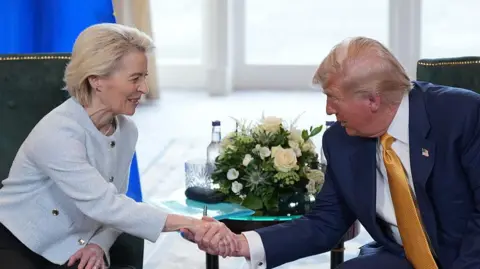
Trade tensions between the US and Europe had eased since the two sides struck a deal at Trump’s Turnberry golf course in Scotland in July.
That agreement set US levies on most European goods at 15%, down from the 30% Trump had initially threatened as part of his “Liberation Day” wave of tariffs in April. In exchange, Europe had agreed to invest in the US and make changes at on the continent expected to boost US exports.
The deal would have still required approval from the European Parliament to become official.
But on Wednesday, days after Trump threatened US tariffs over Greenland, Bernd Lange, chair of the European Parliament’s International Trade Committee, said it was “left with no alternative but to suspend work on the two Turnberry legislative proposals”.
He said work to implement the trade plans would be on hold “until the US decides to re-engage on a path of cooperation rather than confrontation, and before any further steps are taken”.
Lange warned that Trump’s actions had “threatened the territorial integrity and sovereignty of an EU member state”, and that the European Parliament was showing its “unshakable commitment to the sovereignty and territorial integrity of Denmark and Greenland”.
In a press conference following the announcement, Lange said there will be “no possibility for compromise” until Trump’s threats end and raised the prospect of the use of an “anti-coercion instrument” of retaliatory measures, nicknamed a “trade bazooka”.
It came after Manfred Weber, an influential German member of European Parliament, said “approval is not possible at this stage”.
Shares on both sides of the Atlantic had fallen on Tuesday, with European stock markets seeing a second day of losses.
But those losses were recovered on Wednesday after Trump’s promise not to use military force to take over Greenland.
In the US, the Dow Jones, S&P 500 and the Nasdaq all rose by around 1% in early trading on Wednesday. Meanwhile the FTSE 100 in London was around 0.25% higher.
The price of gold continued to make gains as it rose above $4,842 (£3,604) an ounce for the first time. The price of silver remained slightly lower than Monday’s record high of $95 an ounce, hovering around $94.
Precious metals are seen as safer assets to hold in times of uncertainty, and the prices of both gold and silver have soared over the past year.
Speaking in Davos, Trump had repeated his interest in the US acquiring Greenland from Denmark, but said “I don’t have to use force, I don’t want to use force, I won’t use force”.
However, he called for “immediate negotiations” with the country about how he could take over the island, which he has argued is crucial for US and global security.
The decision to suspend the trade deal opens up questions about whether the EU will move forward with threats to retaliate against the US.
The bloc had announced a possible €93bn ($109bn, £81bn) worth of American goods that could be hit with levies last year in response to Trump’s “Liberation Day” tariffs before putting the plan on hold, while the two sides finalised details of a deal.
But that reprieve ends on 6 February, meaning EU levies will come into force on 7 February unless the bloc moves for an extension or approves the new deal.
French President Emmanuel Macron is among those urging the EU to consider its retaliatory options, including the anti-coercion instrument, nicknamed a “trade bazooka”.
Lange said he supports the move and that a decision on the use of the measure would be made on Monday.
American response
The US and the 27-nation European Union are each others’ single biggest trade partners, with more than €1.6tn ($1.9tn, £1.4tn) in goods and services exchanged in 2024, according to European figures. That represents nearly a third of all global trade.
When Trump started announcing tariffs last year, it prompted threats of retaliation from many political leaders, including in Europe.
In the end, however, many, opted to negotiate instead.
Only China and Canada stuck by their threats to hit American goods with tariffs, with Canada quietly withdrawing most of those measures in September, concerned they were damaging the Canadian economy.
In a speech in Davos on Tuesday, Canadian Prime Minister Mark Carney urged “middle powers” to unite to push back against the might-makes-right world of great power rivalry that he warned was emerging.
“When we only negotiate bilaterally with a hegemon, we negotiate from weakness. We accept what is offered. We compete with each other to be the most accommodating,” he warned. “This is not sovereignty. It is the performance of sovereignty while accepting subordination.”
Looming in the background of the trade tensions is a pending Supreme Court decision over whether many of the tariffs Trump announced last year are legal.