
FA Cup tie to be replayed after ref’s error – will it set a precedent?
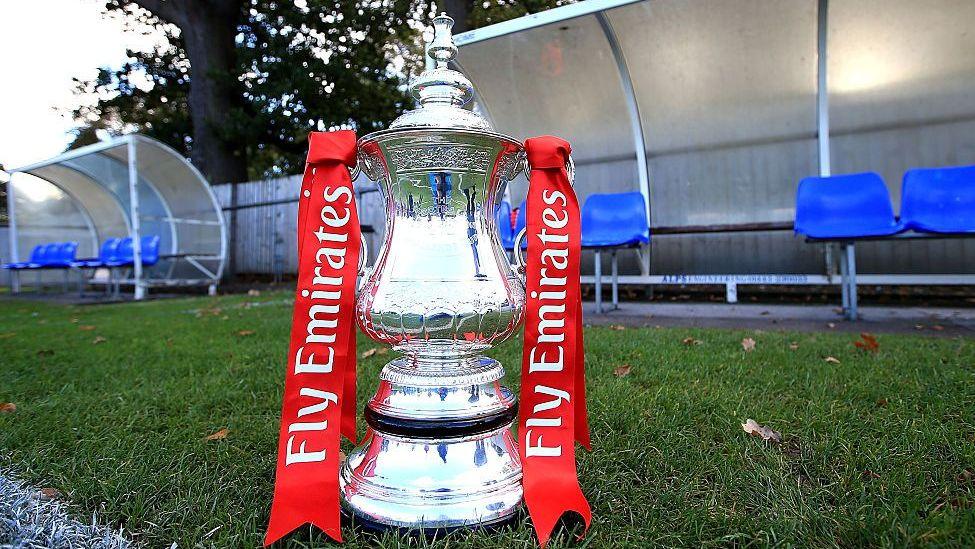 Image source, Getty Images
-
Published
An FA Cup tie between Mulbarton Wanderers and Woodford Town is making the headlines because of a refereeing error which has caused a replay.
So what sets this apart from other matches impacted by an error from officials? And could we see it happen in leagues which have the video assistant referee (VAR)?
For example, there were 25 VAR errors last season. This season an error has already been publicly acknowledged after Manchester United lost 1-0 at home to Manchester City.
Mulbarton, who won the tie 2-1 on the day, say they are “deeply upset” after their opponents lodged a protest because a goal scored from a penalty was ruled out.
The referee disallowed Woodford’s goal for encroachment by a number of attacking players and awarded Mulbarton an indirect free-kick.
Law 14 states, external that the referee should have ordered the penalty to be retaken.
A Football Association sub-committee found there had been a technical error by the referee and ordered the match to be replayed on Tuesday.
So deciding if a game should be replayed comes down to whether a referee has made a simple subjective judgement call, or whether the decision should not have been given because it is not part of the laws of the game.
Why Mulbarton v Woodford will be replayed
Mulbarton, who play in the Isthmian League North, claim the decision to replay the game could lead to “wider implications regarding the finality of results” and the “integrity of the game as a whole”.
Yet matches being replayed because of a misapplication of the laws is more common than you might think, and it can happen for a variety of reasons.
A Spartan South Midlands League fixture between Edgware Town and Harefield United in 2006 is thought to be the first in English football to be ordered to be replayed, external because of a referee’s error.
It was a carbon copy of the Mulbarton-Woodford situation. Edgware scored a penalty, the referee spotted encroachment by the attacking team and gave an indirect free-kick to Harefield. It should have been a retake.
Ordering a replay is far more likely to happen in a cup game, as the incorrect decision is considered to have had a direct impact on the outcome of a competition tie. In the league, it is just one match of a season-long tournament.
Uefa made such a judgment for the first time in 2015 following a European Championship qualifier between England Under-19 women’s team and Norway.
Trailing 2-1, Leah Williamson scored England’s stoppage time spot-kick, but the goal was disallowed because of attacking encroachment. Again, it should have been a retake.
Uefa ordered the match to be restarted from the moment of the penalty, and the players reconvened five days later. Williamson scored from the spot, the game finished 2-2 and it took England to the Euros.
There are other recent examples in England, too. An FA Vase tie was replayed last season after a referee’s error over a penalty shootout.
Last year, Bridlington Town were forced to replay their 2-1 FA Cup win against Knaresborough through no fault of their own. The refereeing team was wrong in law to refuse Knaresborough a fifth substitute during extra time.
Crucially, it cannot just be a matter of subjective opinion or judgement – like getting a corner wrong, or awarding a disputed penalty.
With the laws on encroachment relaxed in recent years, now requiring it to cause clear impact on an opponent, there was little case for an offence by Woodford.
With the goal being scored, the only offence possible would be the encroaching attackers having put off the goalkeeper. It would be a stretch but still subjective.
But even if you could justify the decision to disallow the goal, the restart should have been a retake. Other than the kicker committing illegal feinting, there was nothing in the laws about giving an indirect free-kick.
Redbridge-based Woodford said the decision “ensures the tie can be concluded in accordance with FA Cup rules”.
The winners will host Gloucester City of the Southern League Premier Division South in the third qualifying round on Saturday, 3 October.
Could we see this happen after VAR errors?
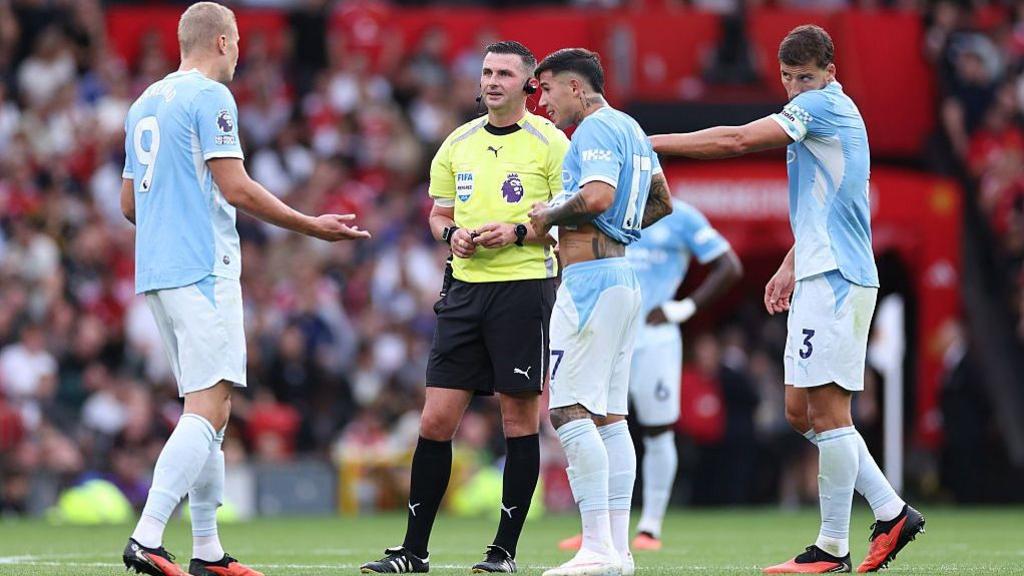 Image source, Getty Images
The International Football Association Board is clear when it comes to mistakes by the video official.
It states a match is not invalidated because of “wrong decision(s) involving the VAR”.
Let’s take the goal in the Manchester derby.
The VAR, Matt Donohue, did not make a judgement on the potential offside offence by Fernandez.
Even then, this would still be a subjective assessment of Fernandez’s impact on United’s Lisandro Martinez and goalkeeper Senne Lammens.
Even if Donohue had properly looked at it, this would not be considered a misapplication of the law, but just a mistake.
The same would apply to Luis Diaz’s disallowed ‘offside goal’ for Liverpool at Tottenham three years ago.
The VAR, Darren England, came to the correct decision in law, but communicated this to the referee incorrectly. This is not considered an error of the laws of the game.
In July 2020, the operator of the Premier League’s goalline technology system had to apologise after an error denied Sheffield United a goal in their 0-0 draw at Aston Villa.
Villa goalkeeper Orjan Nyland carried Oliver Norwood’s 42nd-minute free-kick over the line but referee Michael Oliver did not receive a signal to indicate a goal.
Also buried within VAR protocol is a clause which states “malfunction(s) of the VAR technology” cannot invalidate a result.
-
‘Let’s go, let’s go’ – inside catastrophic derby VAR mistake
-
Published16 September
-
-
VAR did not even consider if Fernandez was offside – Webb
-
Published15 September
-
-
Left in the dark – will fans ever get to hear live VAR audio?
-
Published14 September
-
There was a fascinating case in the Eredivisie in December 2024.
PEC Zwolle’s late winner against RKC Waalwijk was ruled out for offside. The problem? The offside was given from a corner, which was not possible under the laws.
A number of appeals failed, with the Dutch FA saying that the referee applied the rules correctly and only an incorrect judgment was made.
Perhaps the best case study comes from the Belgian Pro League in December 2023.
The incident occurred in Genk’s 2-1 defeat by Anderlecht when Yira Sor scored a rebound from a missed penalty.
The VAR disallowed the goal because Sor encroached in the area but the video official did not identify encroachment by two Anderlecht players. It should have been a retake rather than a free-kick.
Genk successfully protested for a replay based on the laws being “misapplied”.
Belgium’s Court of Arbitration for Sport overturned that decision and the result stood. Its reasoning gives good insight.
It said that the decision was not “a violation of the laws” and just “carelessness in the assessment of the game situation”.
You could apply both to Fernandez and Diaz.
“Football clubs must realise that referees are not robots and, just like footballers themselves, make mistakes,” the court added.
A decision in Belgium does not, of course, have any bearing in the Premier League, or any other competition with VAR.
But we are not about to see a raft of appeals against results just because of the misapplication of the law in some cup games.
-
-
Published7 days ago
-
-
-
Published6 days ago
-
-
-
Published4 September

-