
This post was originally published on this site.
BBC Verify

 BBC
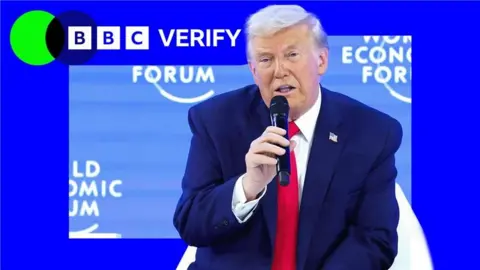
BBCIn a free-wheeling speech to world leaders at the World Economic Forum in Davos, Switzerland, President Trump made a series of contested claims.
Trump touched on his desire to obtain Greenland from Denmark – which he referred to as a “small ask”, America’s contribution to Nato, and wind energy in China.
His address – which lasted for more than an hour – contained a number of false assertions which BBC Verify has been looking at.
Did the US ‘give Greenland back’ after World War Two?
For weeks, Trump has spoken about his desire to acquire Greenland, a largely self-governing territory of Denmark. He has said it is critical to US national security.
At Davos, he said that after World War Two “we gave Greenland back to Denmark,” adding: “How stupid were we to do that?”
But it was not America’s to give back.
In 1933 an international court – a predecessor to the International Court of Justice (ICJ) – ruled that Greenland belonged to Denmark.
In 1941 – following Denmark’s surrender to Germany the previous year – the US and Danish representatives signed an agreement allowing the US to defend Greenland to prevent the Nazis from taking it over.
This led to the construction of US bases on the island as well as the deployment of US troops.
However, the agreement did not involve a transfer of sovereignty, meaning Greenland never became US territory.
Is the US paying for ‘virtually 100%’ of Nato’s defence?
The US president criticised Nato and claimed that “the United States was paying for virtually 100% of Nato”.
He said of the level of contributions from countries which are members of the military alliance: “They didn’t pay the 2% and now they’re paying the 5%”.
Neither of these claims are correct.
In recent years US spending on defence accounted for about 70% of the total spent by Nato countries.
In 2024, that went down to 65% and, in 2025, it is estimated to have been 62%, as all Nato members were set to have spent at least 2% of their GDP on defence for the first time.
The US president has got these countries to commit to spending more on defence but the 5% that Trump is talking about is a long-term aim – to be achieved by 2035.
Currently, no Nato member spends that much, as even Poland – the country spending the most of its GDP on defence – is estimated to have spent just below 4.5% in 2025.
Has the US got nothing back from Nato?
Trump claimed that the US had “never gotten anything” from Nato and “we’ve never asked for anything”.
The Nato website states that “collective defence is NATO’s most fundamental principle” and Article 5 of its founding treaty states that “an armed attack against one NATO member shall be considered an attack against them all”.
The US is the only member of the alliance to invoke Article 5, doing so in the aftermath of the 9/11 attacks.
Nato nations contributed troops and military equipment to the US-led war in Afghanistan which followed.
Among the countries that contributed was Denmark, which suffered among the highest per capita casualty rates of the US allies. They were largely deployed to heavily contested areas alongside British forces in Helmand province.
 Getty Images
Does China have no wind farms?
Trump also criticised wind energy – a familiar target which he said was part of a “new green scam”.
He singled out China, claiming that although it made lots of wind turbines, he had not “been able to find any wind farms in China.”
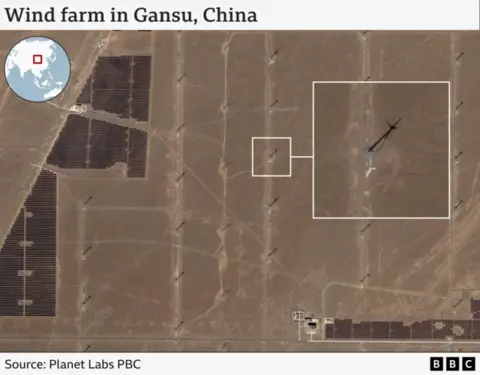
China has one of the largest wind farms in the world at Gansu, which can be seen from space.
China generates more wind energy than any other country, according to Our World in Data. Its statistics show that in 2024 China generated 997 terawatt-hours from wind.
That was more than double that of the US – which was in second place.
Does the UK take 92% of North Sea oil revenue?
President Trump also singled out the UK, criticising its energy policies.
Referring to North Sea oil, Trump incorrectly said: “They [the UK] make it impossible for the oil companies to go, they take 92% of the revenues.”
Oil and gas firms operating in the North Sea pay a 30% corporation tax on their profits and a supplementary 10% rate on top of that. This is higher than the 25% corporation tax paid by other large companies.
In November 2024, the government raised the windfall tax on oil and gas companies from 35% to 38%.
That takes the total tax on North Sea Oil to 78%, which is paid on profits not revenue.
The windfall tax, which was introduced by the Conservatives in 2022 as a response to rising energy bills, is due to expire in 2030.
Has Trump secured $18tn worth of investments for the US?
President Trump also spoke about the investments his administration had secured for America.
He said, “we’ve secured commitments for a record-breaking 18 trillion dollars”, and later on repeated, “18 trillion dollars is invested”.
He has made similar claims before – in October he said the US had attracted investments worth $17tn (£12.7tn) – but there is no publicly available evidence to support figures this big.
A White House website, last updated in November, aims to track “new investment in U.S. manufacturing, technology, and infrastructure”. It states that investments under Trump total $9.6tn (£7.1tn).
The biggest amount on the list is a $1.4tn (£1tn) investment in manufacturing and industry by the United Arab Emirates (UAE).
The website for the UAE embassy in Washington DC says the UAE is “working with the Trump Administration to make a historic $1.4 trillion investment in the US over the next decade”.
Greg Auclair, a statistician at the Peterson Institute for International Economics, told BBC Verify the White House tracker “includes pledges that may not materialize – for example the EU trade deal now appears frozen due to Greenland tensions”.
On Wednesday the European Parliament’s international trade committee said it was suspending the ratification of the deal “until the US decides to re-engage on a path of cooperation rather than confrontation”.
Auclair added that although there has been an uptick in foreign investment in the US over the past year, “it will take several years before the results of the Trump administration’s investment push become clear”.
Reporting by Tom Edgington, Lucy Gilder, Matt Murphy, Nicholas Barrett and Anthony Reuben.