
This post was originally published on this site.
Infantino sorry for errors but stays Fifa president
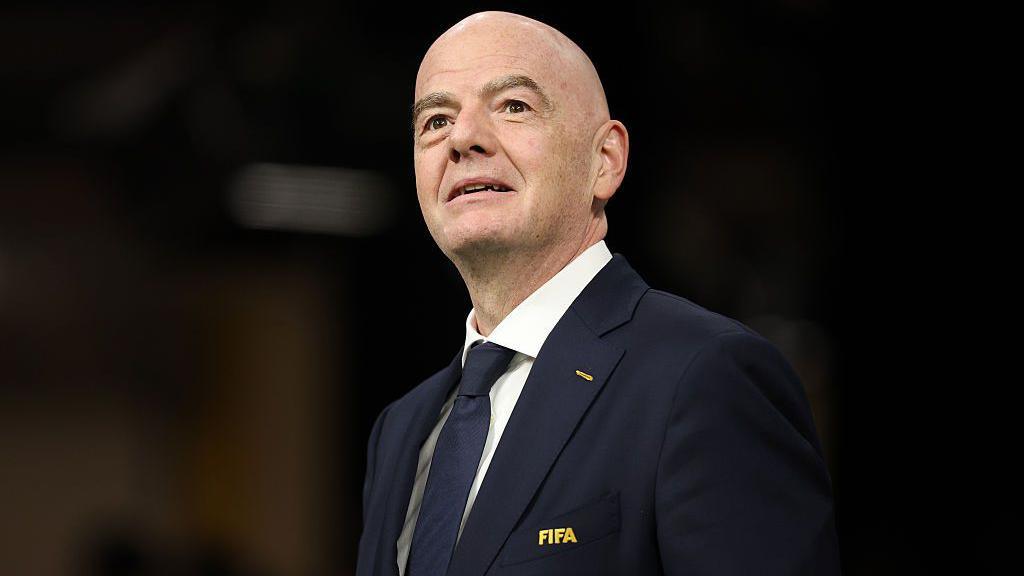 Image source, Getty Images
-
Published
Gianni Infantino has apologised for “errors” he made in controversial plans to sell off stakes in competitions to private investors, but will remain Fifa president after receiving the backing of senior executives in a meeting in Morocco.
Infantino summoned members of the management board to Fifa’s Africa office in Rabat on Wednesday following mounting criticism of his aborted proposals, with world football’s governing body releasing a statement of support four hours after the meeting ended.
European football’s governing body Uefa said at the weekend that it has lost confidence in Infantino, calling the Fifa Forward Enterprise (FFE) proposal a “shabby, back room, opaque deal”.
Much criticism has come from within Fifa, including secretary general Mattias Grafstrom, who was at Wednesday’s meeting. In an internal memo sent to Fifa staff on Tuesday, he wrote that the situation is “a sad and reproachable series of events”.
However, in a statement following the meeting, Grafstrom and the managament board “reaffirmed their full support” for Infantino as president.
Infantino and Grafstrom also sent a signed letter – seen by the BBC – to Fifa’s vice-presidents, council and 211 member associations saying they “sincerely apologise” for their errors and “commit to them not happening again”.
The two were pictured attending a Women’s Africa Cup of Nations match together in Rabat after the meeting.
Infantino had offered all associations $40m (£30m) if they backed a proposal for private investment in its tournaments, including the men’s and women’s World Cups, through a new subsidiary, FFE.
Fifa said that during Wednesday’s meeting “mistakes” regarding FFE were “acknowledged”, saying it was “not the intention” for the Fifa council and members association to “feel excluded from the process and that the process should have been handled differently”.
The governing body added it “acknowledged that errors were also made after the proposal was leaked to media” – with the Times breaking the story of Infantino’s plan on 28 July.
However, the statement also said the organisation “will no longer tolerate any attacks on its integrity, good governance and due process and will take all necessary measures to protect and safeguard its name and reputation”.
Earlier, Fifa denied a story in the Times that Infantino had promised Morocco it will host the 2030 World Cup final in exchange for its support.
Fifa said it was a “false and misleading” claim and that a decision on where to hold the final, with the tournament also hosted by Spain and Portugal, will be made “in due course”.
To play this video you need to enable JavaScript in your browser.
This video can not be played
-
Courting controversy and befriending Trump – the story of Fifa boss Infantino
-
Published4 days ago
-
-
Infantino calls executive meeting as criticism mounts
-
Published1 day ago
-
-
Infantino opponents threaten ‘non co-operation’ with Fifa
-
Published2 days ago
-
Internal support after more criticism
Infantino will hope that this begins to draw a line under the latest, and perhaps biggest, controversy that has beset his 10-year tenure.
However, this show of support from Fifa executives followed yet more stinging criticism of the Swiss.
Canadian Prime Minister Mark Carney, whose country hosted the recent World Cup with the United States and Mexico, said he no longer had confidence in Infantino.
Former Barcelona, Real Madrid and Portugal winger Luis Figo, who ran for the Fifa presidency against Infantino’s predecessor Sepp Blatter in 2015 before withdrawing, called on him to immediately resign.
Figo said: “Infantino has debased the office that he promised to elevate.
“It is too late to save his dignity but it is not too late to save football.”
But Infantino, 56, looks set to fight for re-election for a fourth term.
Rivals have until 18 November to put their names forward to stand against him, with the election to be held at the Fifa Congress in Morocco in March 2027.
A candidate requires 106 votes from Fifa’s 211 members to win.
Uefa, however, may well have other ideas.
At the weekend, European football’s governing body said it had lost confidence in Infantino’s leadership and threatened legal action against Fifa.
Earlier this week several member associations – including Wales, with England set to follow suit – withdrew support for his re-election.
Fifa also said that although “mistakes were made, everything that was done was done in full compliance with the Fifa regulatory framework”. It added it felt the outcomes of the meeting will “strengthen Fifa’s governance” and “restore confidence in the organisation”.
It is unlikely that such statements and the approval of a group of executives will dampen Uefa’s anger.
How could Uefa react?
Uefa has been quick to react to every twist and turn ever since Infantino’s FFE plan emerged.
From the initial rejection of FFE, to the seismic moment when all 55 member associations threatened to boycott Fifa’s competitions, through to the effective vote of no confidence.
But Uefa has a problem, and it is not an insignificant hurdle to overcome.
Since Infantino performed his U-turn, only Concacaf as a confederation has criticised the Fifa president. But, unlike Uefa, it did not go as far as to say it had lost confidence in him.
While the Asian confederation did reject the plan, there has been no blanket statement since Infantino aborted it.
Uefa has a great deal of power, but it cannot realistically overthrow Infantino on its own. It needs more global support.
Outside of Europe, so far only Jordan – one of a handful of the 211 member associations not to have signed a letter of support for Infantino’s re-election before this controversy – have publicly called for him to go.
The list of countries who have underscored their support is much longer – admittedly from within Infantino’s firm power base in Asia and Africa.
In recent days Egypt, Morocco, Niger, Mauritania, DR Congo and the Philippines have all backed Infantino.
Such countries have benefited from funding via Infantino’s Fifa Forward programme, the forerunner to FFE, to the tune of $8m (£5.94m) in each three-year cycle.
Uefa has to find a way to persuade such countries that another presidential candidate can offer the same financial programmes, but with greater transparency and reform.
Infantino, however, already has their loyalty.
How can Infantino turn things around?
All the other recent controversies could not touch Infantino – from the way Saudi Arabia won the hosting rights to the 2034 World Cup, to US President Donald Trump’s Fifa Peace Prize, to Folarin Balogun’s escape from suspension at the World Cup.
This time, an attempt to sell off a slice of the commercial and ticketing rights of Fifa’s competitions was a step too far for many.
Not simply because of the optics of such a move, but also that it was kept secret from other senior members of the Fifa hierarchy and that the beneficiary of the deal would have been Joshua Kushner – the brother of Jared Kushner, Trump’s son-in-law.
So Infantino had bridges to build with those closest to him, not just with the 211 national associations.
Carlos Cordeiro, Infantino’s senior adviser on global strategy and governance, quit over the plan.
Others who were critical opted not to tender their resignations, such as Grofstrom, chief of global football development Arsene Wenger and chief operating officer Kevin Lamour.
It is likely there will be others within the corridors of power at Fifa who kept their counsel.
On top of this, Infantino may also have to map out – or could offer – a route for reform.
This may involve putting additional checks and balances in place that would make it impossible for such a plan to be devised and presented in this way again.
Perhaps he could shelve his plans for a 64-team World Cup? Or offer to open up Fifa’s cash reserves?
-
-
Published2 hours ago
-
-
-
Published8 June
-