
This post was originally published on this site.
Funeral held for renowned Palestinian artist Sliman Mansour
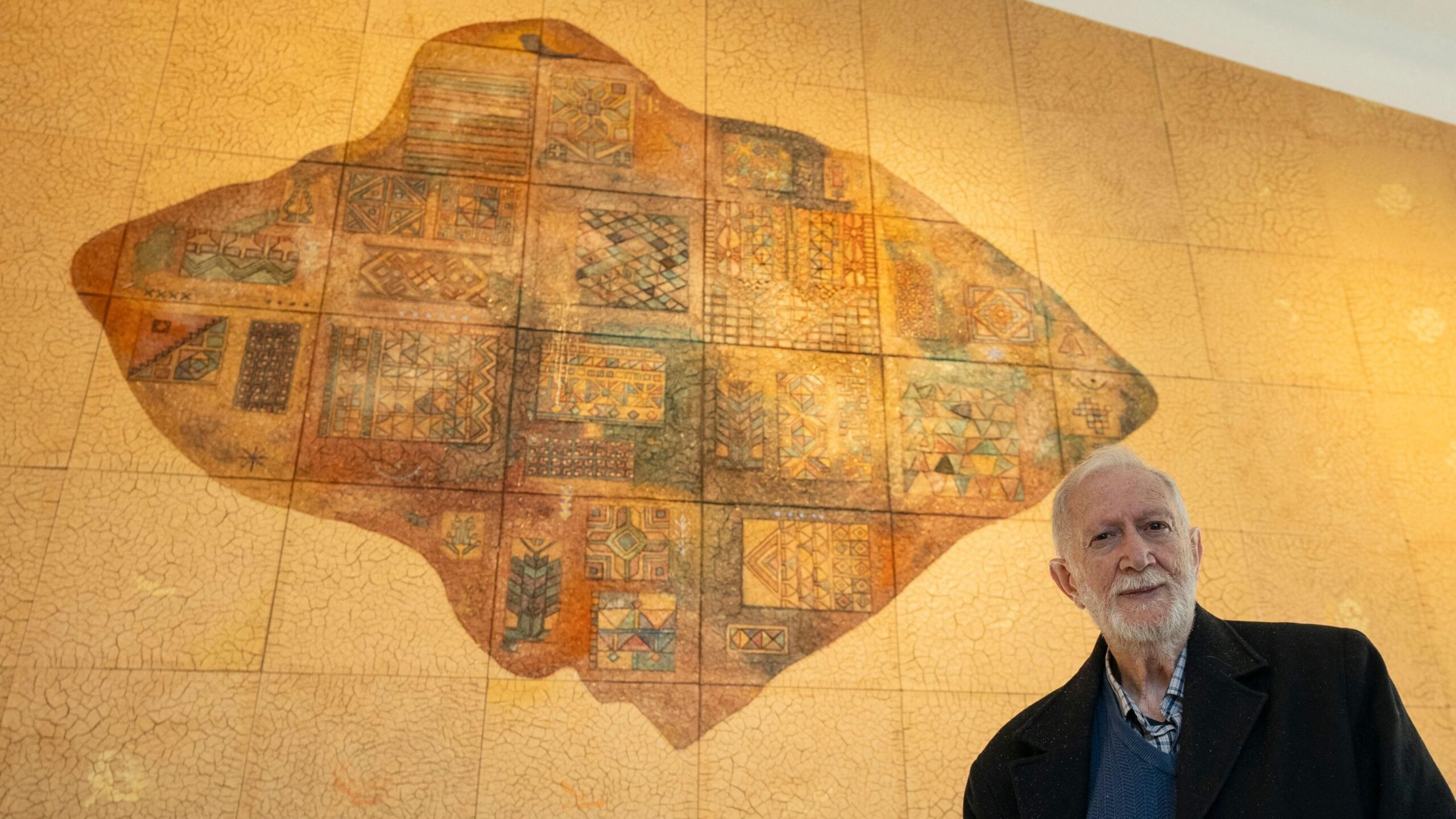 Image source, Palestinian Museum
-
Published
The funeral has taken place at a packed church in Birzeit, near Ramallah in the occupied West Bank, for the celebrated Palestinian artist Sliman Mansour, who died this week at the age of 79.
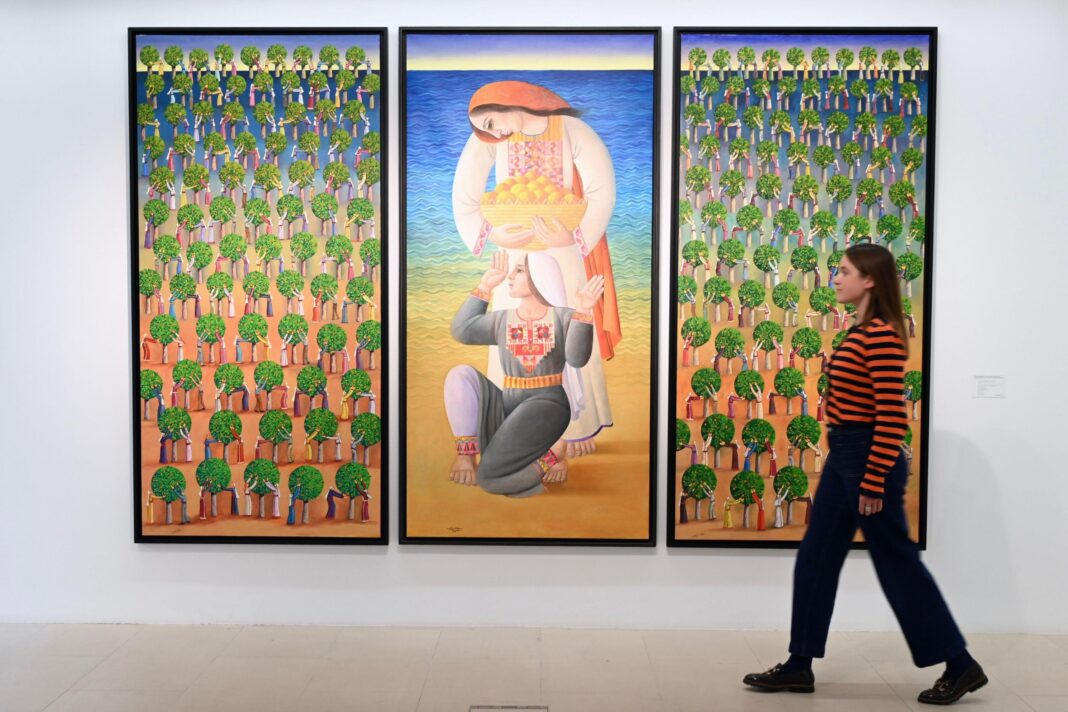
He was best known for his bright and powerful paintings depicting the Palestinian landscape, with its olive groves and citrus trees, as well as cultural scenes featuring symbols of identity amid the nationalist struggle – the Palestinians’ pursuit of self-determination, independence and statehood.
One of his most famous works is Camel of Hardship, painted in 1973. It shows an elderly porter carrying the burden of Jerusalem and the golden Dome of the Rock on his back.
“He was actually the main Palestinian artist, the best known locally and internationally,” recalled his friend and fellow artist Vera Tamari.
Tamari said Mansour’s work showed “Palestine in all its beauty and hope”.
“He portrayed the Palestinian woman in her thobe – her traditional embroidered costume – and he portrayed people very much attached to the land,” she went on. “He wanted people to know that we are rooted here.”
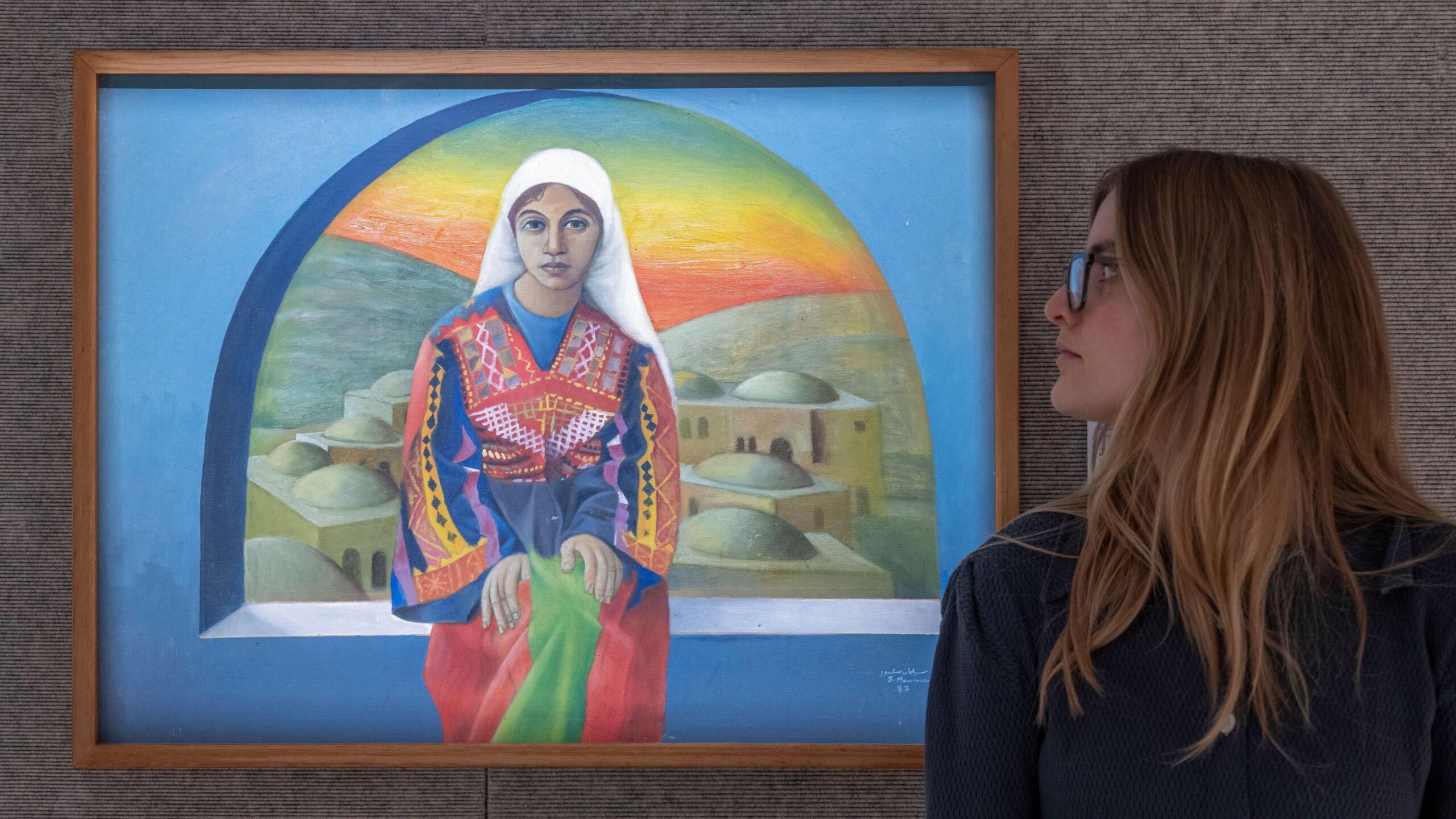 Image source, Alamy
Mansour was born in the village of Birzeit in British Mandate Palestine in 1947 – a year before the State of Israel was established, and the advent of the first Arab-Israeli war. During the conflict, more than 700,000 Palestinians were expelled from their homes or fled in what is known as the Nakba, “the Catastrophe”.
As a young man, Mansour studied fine art in Jerusalem but went on to develop his own distinctive style. He has spoken of how Palestinian artists lived in a “cultural ghetto” and how he was influenced by a book showing works of the Mexican painter Diego Rivera.
Over time, Mansour contributed to creating a local artistic movement, as co-founder of the League of Palestinian Artists and the International Academy of Art and helping to set up local art galleries.
As well as his paintings on canvas, Mansour created cartoons, children’s illustrations and wrote books. Many remember him as an inspiring art teacher.
His works are held in private collections and at major international institutions including the Guggenheim Museum in Abu Dhabi, the Mathaf: Arab Museum of Modern Art in Doha, the Institut du Monde Arabe in Paris, and the British Museum in London.
However, unlike many artists, Mansour was also strongly in favour of his paintings being reproduced as prints, making them more accessible and adding to their wide appreciation.
To play this video you need to enable JavaScript in your browser.
This video can not be played
“He was the mastermind of creating a Palestine that unifies us all as Palestinians, something that we long for and we work to live in,” said Amer Shomali, a visual artist and director general of the Palestinian Museum.
“I grew up in a refugee camp in Syria,” he continued. “As a child, I had two of his posters on my wall. He was everywhere. He was focusing and capitalising on reaching the masses.
“He liked the idea that [his work] was being displayed by people who could afford it all around the world.”
The political nature of Palestinian art often drew the attention of Israeli security forces in the occupied West Bank. In a podcast, Mansour spoke about how in the 1970s and 1980s soldiers would confiscate posters and postcards, arresting the sellers.
When a new space for solo exhibitions, Gallery 79, was founded in Ramallah, he said: “The soldiers started coming to the opening of every new exhibition and sometimes taking whatever they didn’t like.”
“We developed a kind of art that is symbolic so that people will understand what we mean and the soldiers will not understand,” he commented.
During the first intifada or uprising, which began in 1987, Mansour helped found the New Vision collective with other artists, including Tamari. Boycotting Israeli-made supplies including oil and acrylic paints, they turned increasingly to natural materials from clay to henna.
“Sliman specialised in working in mud and straw in very effective cracked surfaces, which reminded people of history and time and the rootedness of Palestine in the earth itself,” Tamari said.
Friends remember a soft-spoken, humble man with a gift for explaining complex ideas in a simple way and who loved to share his work.
Although his canvases typically sell for hundreds of thousands of dollars, when he completed a large mural for the Palestinian Museum, his requested fee was only a fig tree to be planted in the garden.