

This post was originally published on this site.

Sometimes founders search high and low for the right startup idea, while other times it comes to them. Federico Felici and Jonas Buchli are two of the lucky ones.
Over and over again, they heard the same thing from fusion companies: “We would ideally buy many of the components to make our our control system, but there isn’t really anybody providing them — and especially there isn’t anybody who speaks the language of fusion,” Felici told TechCrunch.
For years, the two founders have worked to develop new ways to control experimental fusion devices. “We spent quite a lot of our time solving exactly the problems that our customers need to solve,” he said. “It felt like the right time.”
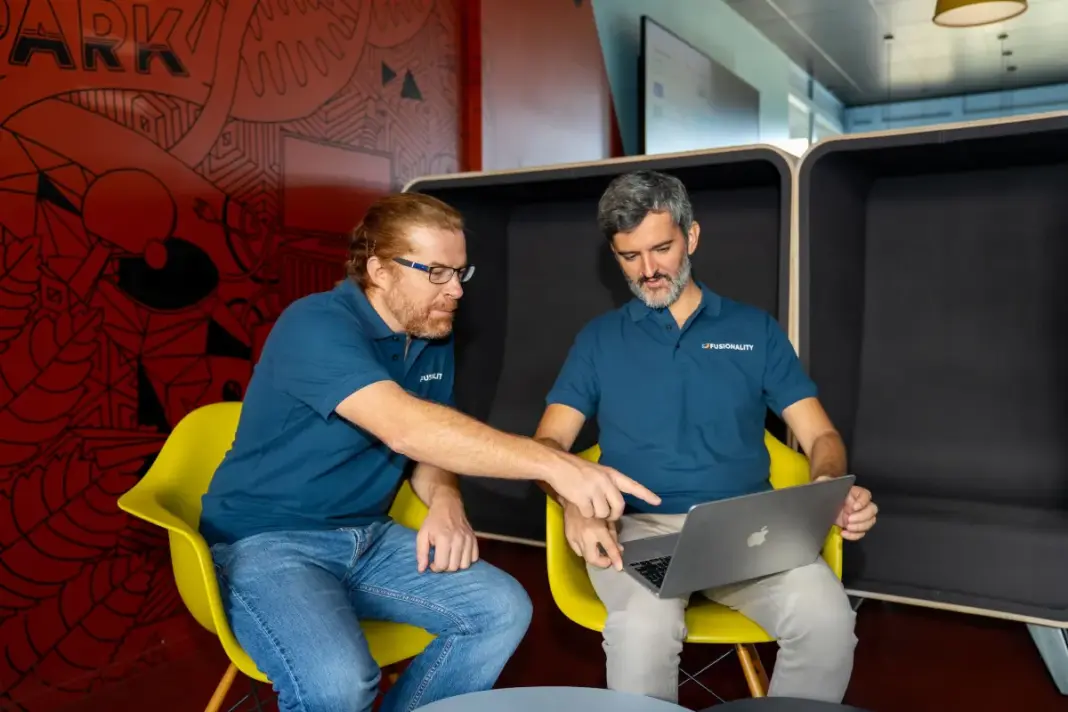
To capitalize on the opportunity, Felici and Buchli founded Lausanne-based Fusionality this year and quickly raised a $3.7 million (CHF 3 million) pre-seed round from Founderful and Playfair. Felici serves as the company’s CEO, Buchli its CTO.
Fusionality is part of an emerging supply chain that has popped up to serve the burgeoning fusion power industry. Some startups, like Kyoto Fusioneering, are developing components that will help fusion startups turn their engineering breakthroughs into electricity for the grid, while others are existing manufacturers with the skills required to turn out high-precision parts.
Yet few companies specialize in the hardware and software required to control the fusion reactors themselves. “Across the industry, many companies make their own control systems from scratch,” Felici said. “But actually, 80% of each company’s control system is really exactly the same.”
Fusion power plants generate electricity by harnessing the energy released when two atoms fuse, which is more likely to occur in a superheated plasma. But plasmas are fickle, and maintaining the proper temperature, shape, and fuel level requires split-second decision-making.
The control systems used to maintain those conditions are complex to develop and deploy, but much of the fundamental physics is consistent across reactor designs. Fusionality plans to build off that commonality to develop a suite of control systems and simulation environments which startups can then fine-tune to work with their specific design.
Felici and Buchli met while teaching AI to control an experimental tokamak — a donut-shaped device researchers use to study fusion power. Felici was working at EPFL in Switzerland, which houses one such tokamak, while Buchli was working at Google DeepMind. Later, Felici moved to Google DeepMind, where he developed simulations and machine learning interfaces for fusion devices.
Felici said AI will “play an important role in future control systems,” but that it’s not quite ready to tackle the entire challenge. “I wouldn’t be somebody who advocates for AI to take the role of controlling the entire fusion reactor,” he said. Today, AI is more likely to “complement or enhance or optimize” parts of the system, he added.
For now, Fusionality is focusing on a branch of fusion power known as magnetic confinement, an approach that uses powerful electromagnets to keep fusion fuel dense enough and hot enough to feed a power plant. Commonwealth Fusion Systems, Realta Fusion, Proxima Fusion, and Type One Energy are examples of startups developing magnetic confinement devices. Eventually, the company will develop systems for other approaches, Felici said.
Fusionality’s pre-seed funding will help the team, currently seven strong, develop a “tightly selected number of technologies,” Felici said, though he declined to specify which. He likened them to Lego blocks. “We start with a few of these blocks and then we build out more,” he said. “We have the ambition to serve the really wide range of technology that you need to operate a fusion reactor.”
When you purchase through links in our articles, we may earn a small commission. This doesn’t affect our editorial independence.


