
This post was originally published on this site.
To play this video you need to enable JavaScript in your browser.
This video can not be played
When Modestas Bukauskas was 19, he was staring at wires coming out of his body and trying not to look as doctors operated on his heart.
The fledging athlete would be awake throughout surgery that lasted almost five hours. He had been experiencing heart palpitations since childhood, and they were only worsening as his athletic career blossomed.
Many could have lived with the condition, but Bukauskas was not just anyone.
He was a kid who wanted to make his Lithuanian father proud and become a UFC fighter.
And here he was having the operation he hoped would make that possible.
“It was pretty brutal,” Bukauskas tells BBC Sport.
“I was awake the whole time. They literally had wires going up my groin into my heart and they were trying to induce palpitations.
“Then they had to basically burn off an external circuit in my heart to basically fix my heart.”
The experience fortified Bukauskas. He would push himself to the limit in training, and a two-year spell playing basketball in Louisiana resulted in him being on the verge of fainting during sessions in 40-degree Celsius heat.
He was already a British kickboxing champion by the time he had the heart operation, with the palpitations having had him worried.
“It was very dangerous. I was lucky it never happened in any of my kickboxing fights,” says Bukauskas.
“But I think that was a little starting point as to all the hardships I’d have to go through.
“That was the first steps to being able to overcome anything else that came later on in life.”
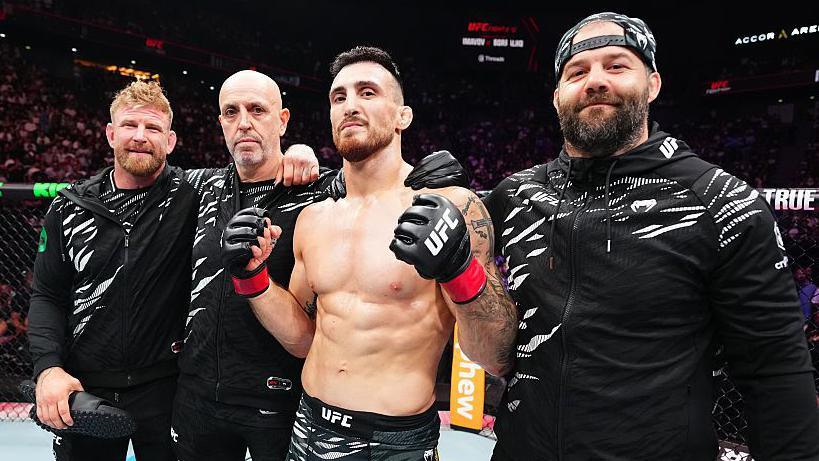
Now aged 31, Bukauskas faces the most important fight of his sporting life when he takes on Nikita Krylov on Saturday evening at UFC 324.
Lithuanian beginnings & ‘no-holds-barred’ father
As Bukauskas puts it, his “whole life has all been about mental resilience”.
He was born in Lithuania in 1994, four years after the country declared independence from the Soviet Union.
The last Soviet troops only withdrew from Lithuania in 1993.
Bukauskas’ father Gintas relocated his family to the UK, hoping for a “better life”.
Gintas had competed in No Holds Barred competitions in the Soviet Union. They were chaotic events of fights and performing physical feats like breaking bricks with bare hands.
It signalled a love of combat sports but was a world away from what his son experiences in the UFC today.
But it meant that the young Bukauskas was soon marked by the fighting spirit. His “battle-tested” father started training him aged five.
While other children were playing outside, Bukauskas was laying into pads and practising kicks with his father in their living room.
“Essentially we’re living out this dream together,” Bukauskas says, acknowledging his father’s influence.
“I always describe him as the angel on my shoulders.
“In all my fights where I get the finish, he’s always the person that screams what the finish will be.
“[It’s like] he’s got a little remote control in the corner and [is] telling me what to do. I’m so thankful and grateful to have my dad.”
‘I drank myself to sleep each night’
 Getty Images
In his youth, Bukauskas played tennis and basketball, even moving across the world to pursue the latter, but every road led him back to fighting.
Once his heart issue was resolved, Bukauskas focused entirely on mixed martial arts – bar a short side quest aged 24 when he appeared on ITV dating show Take Me Out – and was signed by the UFC with a 10-2 record.
He won his first fight but slipped to three defeats in a row. He blew his knee out in a defeat by Khalil Rountree in 2021.
The UFC cut him afterwards and so began another difficult chapter in the life of the young Bukauskas.
“There was a lot of times just in my room, like within my four walls with my knee in a cast… a lot of times where it was very painful, drinking myself to sleep,” he explains.
Deep down, he knew this was not a sustainable path to sporting success.
“Obviously I’m not proud of that,” Bukauskas says.
“I guess you could say I’ve always been taught in the household to be mentally tough, so I never really looked at it like [I was depressed].
“It was my way of escaping the real world.”
Bukauskas hid the drinking from his father. He spent weeks in a dark place in his mind he had never been to before.
But his father and those closest around him were a constant source of reassurance, and Bukauskas re-emerged stronger.
“You just ride that wave,” he says.
“When you’re looking up at the mountain, you’re standing there at the bottom; obviously it looks quite daunting, but you make gradual steps.”
The next chapter of the Baltic Gladiator
Remarkably, it took Bukauskas only 14 months to recover from his knee woes and earn a spot back in the UFC. He returned in 2023 and has a 6-1 record from seven fights since, including four wins in a row.
“It probably would have broken many people,” Bukauskas says of the injury ordeal.
“Because my whole life people have kind of been shoving me off to the side.
“So I just kept using that as fuel. I’m like, OK, I’m going to show you what’s up.”
Fighting gave Bukauskas the identity he craved.
Russian Krylov, 33, his opponent this weekend, has taken on several of the division’s top fighters.
Facing him is Bukauskas’ chance to fire himself into the UFC’s top 15 rankings for the first time.
“If a top-15 match had come a bit earlier, it might’ve been too soon. So I think everything is playing out exactly how it should,” Bukauskas says.
“I expect this to be the best showing of me in a flow state, me showing exactly what I’m capable of.
“Showing all of my attributes and just let people know who the Baltic Gladiator is.”
If you have been affected by issues raised in this article, there is information and support available on BBC Action Line.
Related topics
-
-
14 January
-
-
-
28 April 2024
-
More MMA from the BBC
-
-
16 August 2025
-