

This post was originally published on this site.
Tom McArthur

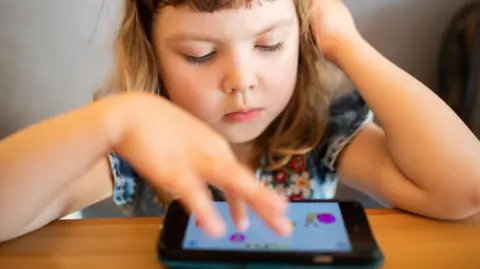
Parents of under-fives in England are to be offered official advice on how long their children should spend watching TV or looking at computer screens.
The government says it will publish its first guidance on screen time for the age group in April.
It comes as government research was published showing that about 98% of children under two were watching screens on a daily basis – with parents, teachers and nursery staff saying youngsters were finding it harder to hold conversations or concentrate on learning.
Children with the highest screen time – around five hours a day – reportedly could say significantly fewer words than those at the other end of the scale who watched for around 44 minutes.
A national working group led by Children’s Commissioner for England Dame Rachel de Souza and Department for Education scientific adviser Professor Russell Viner will formulate the guidance after speaking to parents, children and early years practitioners.
The terms of reference for their work will be published on Monday.
The guidance will also help parents come up with alternatives to screen time for their children.
The government research showed that at age two, 77% of children in the highest-income families are read to daily, compared with 32% in the lowest-income families.
In a statement, Education Secretary Bridget Phillipson said: “Screens are part of family life now. The question parents are asking isn’t whether to use them, but how to use them well.”
Writing earlier in the Sunday Times, Phillipson said: “Like so many parents, I’ve had evenings where you give in when your little one wants ‘just one more’ episode of their favourite show. But we’re beginning to see the risks when ‘just one more’ starts to add up.”
She suggested parents could share a story on a tablet computer or use it for educational games.
Felicity Gillespie, director of charitable foundation Kindred Squared, said “evidence-based” screentime guidance for parents was “overdue and very welcome”.
Kindred polling suggests that 40% of parents think reducing screen time would help ensure their child is ready for Reception. It says this underlines the demand for practical, trusted guidance in the early years.
“We must increase public understanding of how screens and devices can interfere with the way babies and toddlers learn best, which is by looking at facial expressions, chatting, singing and play,” Gillespie said.
Neil Leitch, from the Early Years Alliance, said he broadly welcomed plans to develop guidance on screen time for under-fives, but added: “It’s important that any such support on this topic sits within a much wider framework of guidance for families and educators on digital literacy and online safety.”
The announcement comes after the Conservatives said they would ban under-16s from accessing social media platforms if they win power, promising to follow the example of Australia, which became the first country to introduce the policy last month.
Shadow Education Secretary Laura Trott told the Today programme that “we need to shift the social norm to say children are not safe on social media sites, it is really bad for them”.
She called for MPs to back an amendment to the schools bill, which is currently progressing through Parliament, banning smartphones in the classroom.
Former prime minister Rishi Sunak, who appeared on BBC Breakfast on Monday to promote his new numeracy charity with his wife Akshata Murty, said the issue was a “complex” one, where “there probably isn’t one thing that will make everything better”.
“We need to make sure when kids are at school they are focused on learning and being at school, and not having the distractions of phones and social media in the classroom,” he added.


