
This post was originally published on this site.
How Aldi is taking on US supermarkets with its $4 almond butter
 Image source, Francisco Velasquez/BBC
-
Published
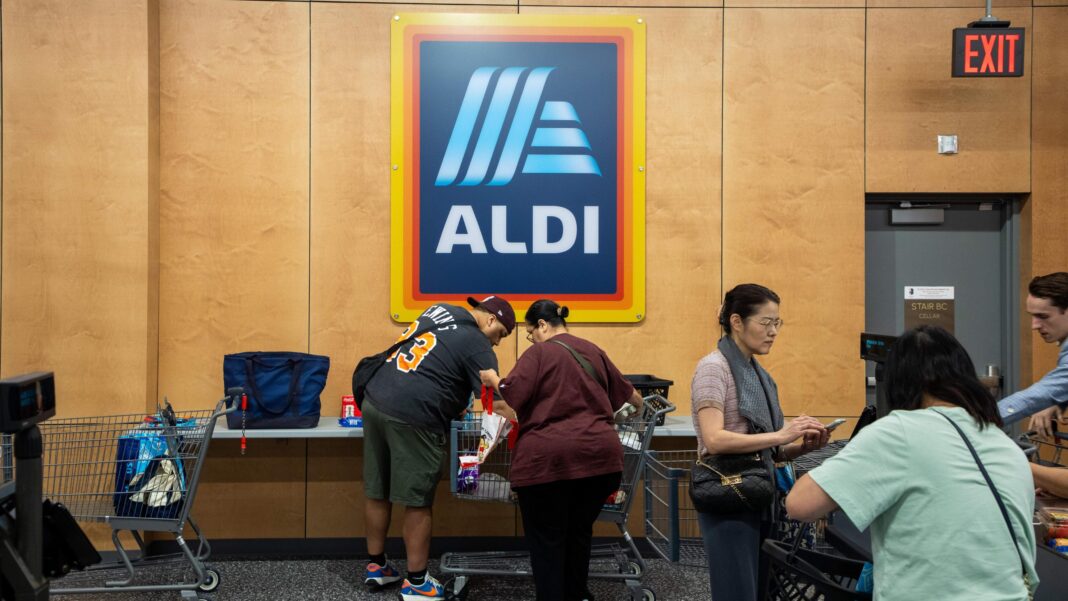
When Mary Porter walked into Manhattan’s newest Aldi store hunting for bargains, the long-time resident found what she considered a retail miracle in plain sight: a $4 jar of almond butter that costs $22 in her own neighbourhood.
“Aldi has the reputation for being inexpensive, so I thought I would come and check it out, and by golly, it is amazing,” Porter, 79, told the BBC, marvelling at the savings alongside the fresh spinach and organic raspberries filling her basket.
To the unassuming passer-by, the storefront is completely hidden, tucked away in an underground parking lot beneath The Ellery, a luxury apartment complex where the cheapest rent starts at nearly $5,000 (£3,725) a month.
In fact, the building’s own website completely omits the discount grocer from its curated online neighbourhood guide, choosing instead to highlight pricier nearby options like Whole Foods and Brooklyn Fare.
But step past the luxury façade into the basement, and the quiet disappears. Even on an early Tuesday afternoon in July, the brightly lit, bustling space hums with high energy as a lunchtime crowd of New Yorkers tightly navigates the narrow aisles with oversized canvas bags.
Porter’s discovery is part of Aldi’s $9bn US expansion plan to add 800 new stores over five years, specifically targeting dense urban hubs like Manhattan. It marks a massive scale-up for the German discounter, which first entered the US in 1976 and has steadily grown its footprint to nearly 2,800 storefronts.
The aggressive real estate blitz signals a bold shift for a brand traditionally associated with suburban strip malls and lower-end consumers.
Incumbent US grocers may look with some concern at the insurgency Aldi pulled off since it entered the UK market in the 1990s.
Alongside fellow German discounter Lidl, Aldi picked up huge swathes of the market by offering discount prices for high-quality goods. The traditional “big four” grocers at the time – Tesco, Sainsbury’s, Asda and Morrisons – were slow to respond to the new competition, leaving the challengers to gradually pick off their shoppers.
Today, Aldi is the UK’s fourth biggest grocer, commanding 10.8% of the market.
Its rapid growth is being mirrored across Europe, its rise aided by easing perceptions of it as a strictly discount grocer as shoppers became increasingly impressed by the quality of its products. The cost of living crisis of the 2020s further fuelled its ascent.
However, while Aldi is rapidly ascending the ranks of American grocery consciousness, it is not, and may never aim to be, Walmart.
Aldi currently holds just 2.9% of the US grocery pie, while Walmart controls about 20%.
Yet analysts say that staying smaller is precisely how Aldi wins.
Data from location analytics firm Placer.ai reveals Aldi is capturing middle- and higher-income shoppers with household incomes between $75,000 and $125,000.
While hard discounters traditionally rely on lower-income demographics, years of persistent inflation have flipped the script, forcing wealthier households to aggressively trade down.
“Those shoppers have started to trade off a visit to a conventional grocery store or a quick service restaurant and started to go into Aldi more frequently,” RJ Hottovy, Placer.ai’s head of analytical research, told the BBC. “They’re looking for ways to stretch their household budget.”
For some urban commuters, the new city location offers a better experience than older formats. Kelvin Dozier, who usually shops at an Aldi in Brooklyn, recently started visiting the Manhattan location right across from his office for convenience.
“The one here – it’s brighter,” Dozier told the BBC, noting the fresh sweet navel oranges in his basket. “The one in Brooklyn is a little smaller. It almost seems temporary, but here it looks like a permanent location.”
Still, winning over city slickers accustomed to premium brands remains an uphill battle. Ralph Montenegro, visiting Aldi for the first time, remained fiercely loyal to competitors.
“It has more variety than say Target,” Montenegro said, praising the prices on staples like flour and fruit, though he noted he still prefers Trader Joe’s. He added that Aldi’s heavy reliance on packaged, private-label processed foods was a detractor compared to the natural organic options he prefers.
This strict reliance on limited, private labels is exactly what keeps Aldi’s overheads low, according to Dustin York, an associate professor of communication at Maryville University.
He says that Aldi targets a lean, highly efficient model that provides about 80% of what a traditional big-box retailer carries, but at a much lower cost.
Still, York argues it is unlikely that Aldi will take dramatic market share from Walmart, because the retail giant is simply too massive. “I call Walmart the battleship, and I call Aldi a kind of submarine.”
But navigating those crowded waters can bring a distinct financial hazard.
“Their biggest kryptonite is real estate cost,” York warned, pointing to a brutal Manhattan retail landscape where average asking rents are between $350 and $700 per square foot.
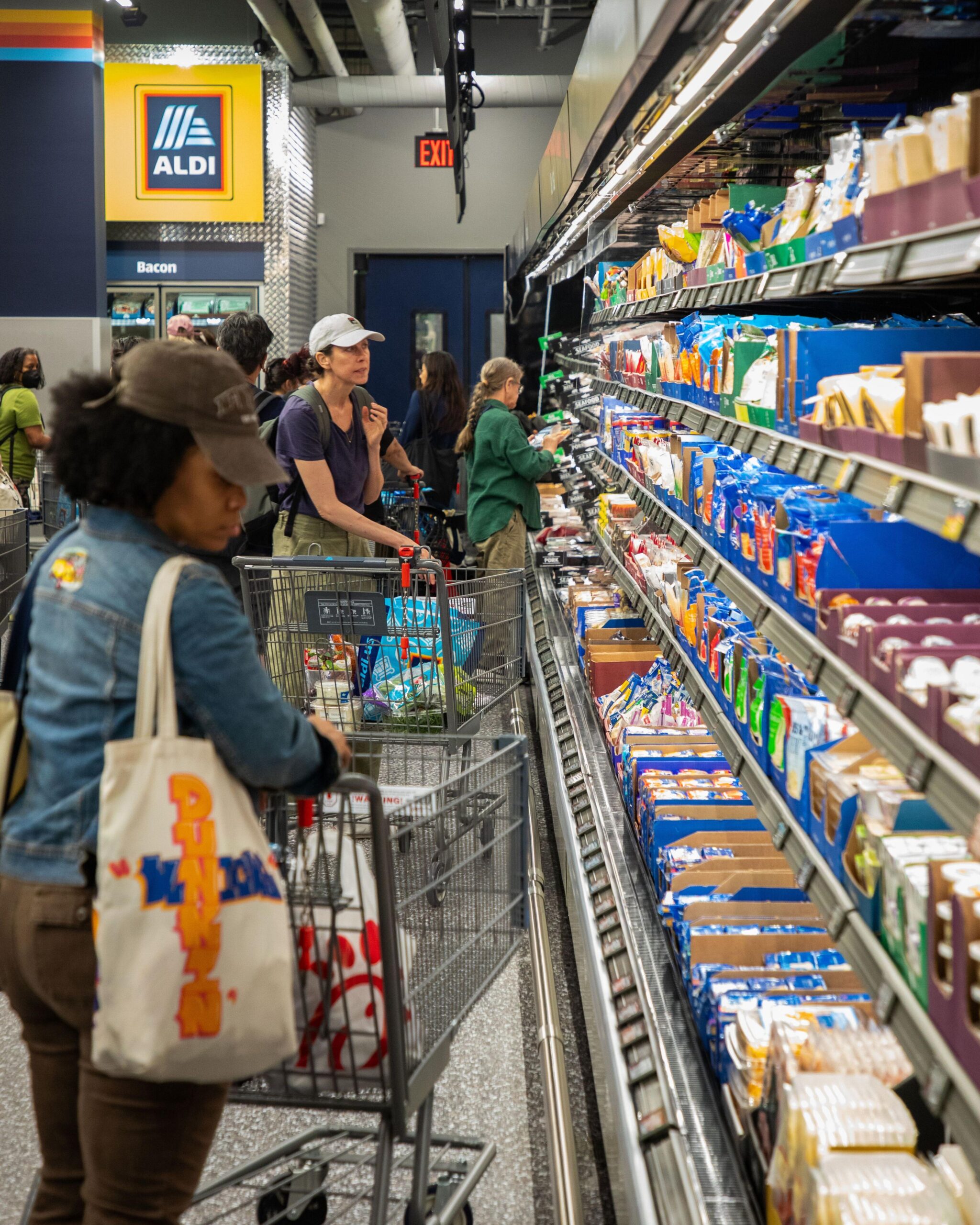 Image source, ALDI
In addition to high rents, Manhattan’s roads provide another challenge.
Speaking on Bloomberg’s Odd Lots podcast, Aldi’s US chief commercial officer Scott Patton detailed that supplying the Manhattan store requires trucking inventory in from South Windsor, Connecticut, using shorter, specialised trucks to navigate tight city streets.
“We come at night because of the congestion,” Patton said, noting that each truck requires a two-driver team to handle the city’s turning radiuses. One driver watches for blind spots while the other unloads the groceries. To keep shelves in the Manhattan location stocked, Aldi runs three to four of these trips every night, calling the operation a “logistical symphony”.
-
Walmart becomes first retailer to hit $1tn market value
-
Published3 February
-
Because of those structural constraints, beating America’s largest retailer is nearly impossible, says Jerry Sheldon, a retail analyst at IHL Group.
“The reason Aldi cannot simply out-discount its way to the throne is that Walmart fights with a war chest and Aldi fights with a scalpel,” Sheldon explained.
Walmart pours more than $20bn a year into its business, the bulk of it into technology, automation, and its supply chain, with robots moving product through its warehouses and AI setting its forecasts on delivery routes.
Furthermore, Sheldon points out that Walmart earns billions from things like advertising and membership, which Aldi does not.
“Aldi is a brilliant single-purpose machine, while Walmart is a money machine that happens to sell groceries cheaply. That gap is the whole ballgame,” Sheldon said.
For shoppers like Mary Porter, the corporate chess match matters less than the immediate relief to her wallet.
“I get on the subway with my big bag and go home with my cheap groceries. I mean, I’m so happy. This is amazing,” Porter said.
Additional reporting by Archie Mitchell