

This post was originally published on this site.
How do you score points in artistic gymnastics?
-
Published
It’s been a strong start for Team Scotland in the 2026 Commonwealth Games artistic gymnastics, with Reuben Ward making history by winning the nation’s first ever gold medal in the men’s all-around.
England also clinched bronze with Wales in fourth place in the women’s all-around team event.
And there could be many more medals to come for the home nations this week, with several individual events taking place.
As one of only two events at this year’s Games where winners are decided solely by judges applying a scoring scale – the other being boxing – how are points allocated to gymnasts to separate the medallists from the rest?
Get in touch
Send us your questions
How do men’s and women’s disciplines differ?
Firstly, it’s important to note that men and women compete in slightly different events across artistic gymnastics.
The men’s events are:
-
Pommel horse
-
Rings
-
Parallel bars
-
Horizontal bar
Women will compete in:
-
Uneven bars
-
Balance beam
And all athletes compete in:
-
Vault
-
Floor exercise
This applies to both individual and all-around disciplines, meaning in the men’s all-around contest athletes are judged on six events, and for the women’s all-around the scores are based on four events.
Women are judged on their top eight highest-scoring skills, and men on 10.
There is further variation when women receive marks for ‘artistry’ on floor and beam, including ‘expression, confidence and personal style’ incorporated into the routine and a varied tempo throughout.
Men are not scored under such criteria, especially as the floor event contains no music, but can still add in elements to show originality and creativity.
The women’s vault event also has the apparatus set to a lower height than the men’s.
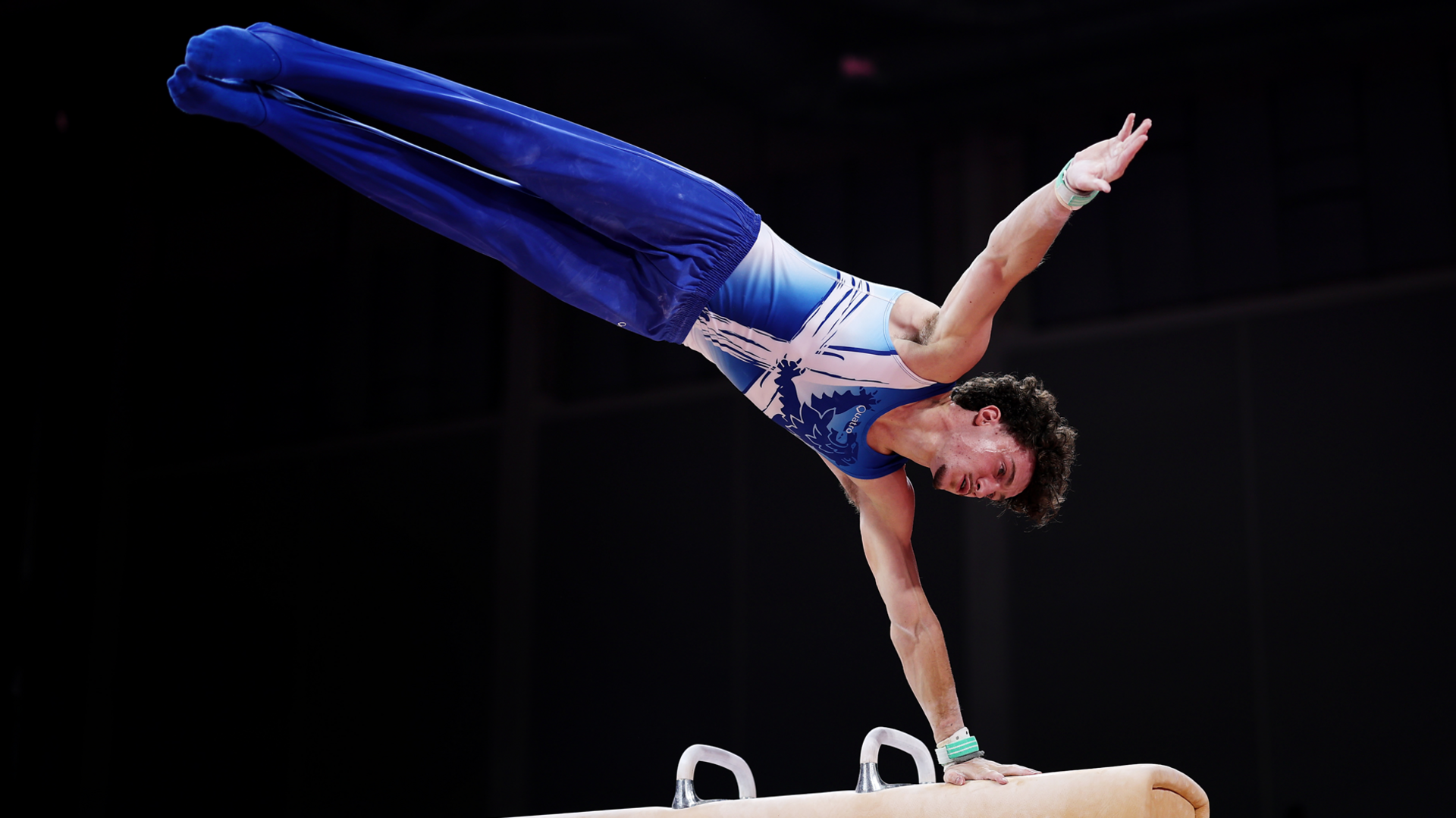 Image source, Getty Images
What is the scoring system?
Like many judged sports, there are two main factors to balance when scoring an artistic gymnastics routine – difficulty and execution.
The two scales being used to allocate points are the ‘D-score’ for difficulty and the ‘E-score’ for execution, each having a dedicated panel of multinational judges who have been approved by the International Gymnastics Federation (FIG).
The scores produced by each of these panels – following any ‘neutral deductions’ – are then combined to give the gymnast a final score, either as a standalone result for the individual events or a combined score across multiple events for the all-around contests.
The biggest difference between how the two scores are decided upon is that the Difficulty Score starts at zero and racks up depending on how challenging the routine is deemed to be – with no upper limit to the scoring.
However, the question with E-Scores should perhaps be ‘how are points lost’ instead of ‘how are points scored’, as each athletes begins their routine with a perfect 10 which decreases as mistakes are made.
Points are deducted in increments of 0.1, 0.3, 0.5:
-
0.1 points deducted for small errors such as a minor loss of balance
-
0.3 points deducted for medium errors like significant loss of balance
-
0.5 points deducted for large errors – deep squats on landing an example
-
1.0 point deducted for major errors such as falls
D-Scores arise from predetermined values set for different elements in the FIG Code of Points, set from difficulty ratings A through to H-J.
For example, the Code of Points allocates 0.1 points for A-grade ‘basic’ skills such as a forward roll or handstand, and up to 0.8-1.0 points for H-J grade ‘exceptional’ named pioneering moves.
There are also difficulty points available for the composition of the routine showing balance of skill types, and connection points for how well the skills are linked together to produce a flowing display.
The only exception to the dual E-Score and D-Score system is the vault event, where each routine has a pre-determined D-Score and so only the E-Score is judged.
Neutral deductions are applied to the combined E and D-Scores, and take into account errors unrelated to the routine itself.
These include stepping out of bounds, going over allocated routine time, or outfit violations.
For a medal-winning result, athletes will be aiming for points in at least the 14s and into the 15s.
A world-class routine may reach into the high 15s or low 16s.
For example, during her dominance of the 2016 Olympics, US gymnast Simone Biles scored 15.866 on vault, 14.966 on uneven bars, 15.433 on balance beam, and 15.933 on floor exercise to produce an overall score of 62.198 for the gold medal, which was more than two points clear of the runner-up.
How does scoring work for team events?
Artistic gymnastic team events are judged on the same basis as individual events, but the scores are spread slightly differently.
At least two athletes from a nation take part in each apparatus event, with individual scores added together for the overall team score.
If three athletes take part in any of the disciplines, the two highest-scoring routines count towards the team’s overall score.
This article is the latest from BBC Sport’s Ask Me Anything team.