
This post was originally published on this site.
Ninety-six.
Across the past five seasons, that is the points haul Scottish Premiership champions – Celtic on four occasions and Rangers once – have averaged on their way to lifting the trophy.
That is projected to change this term and it is a key reason why we are watching one of the most intriguing top-flight campaigns unfold in Scotland.
With a seismic Sunday in the title race upon us – and just 15 rounds of fixtures remaining after this weekend – the BBC Scotland calculator is being dusted off.
Here, we crunch the numbers behind a gripping three-way battle.
So how many points will it take?
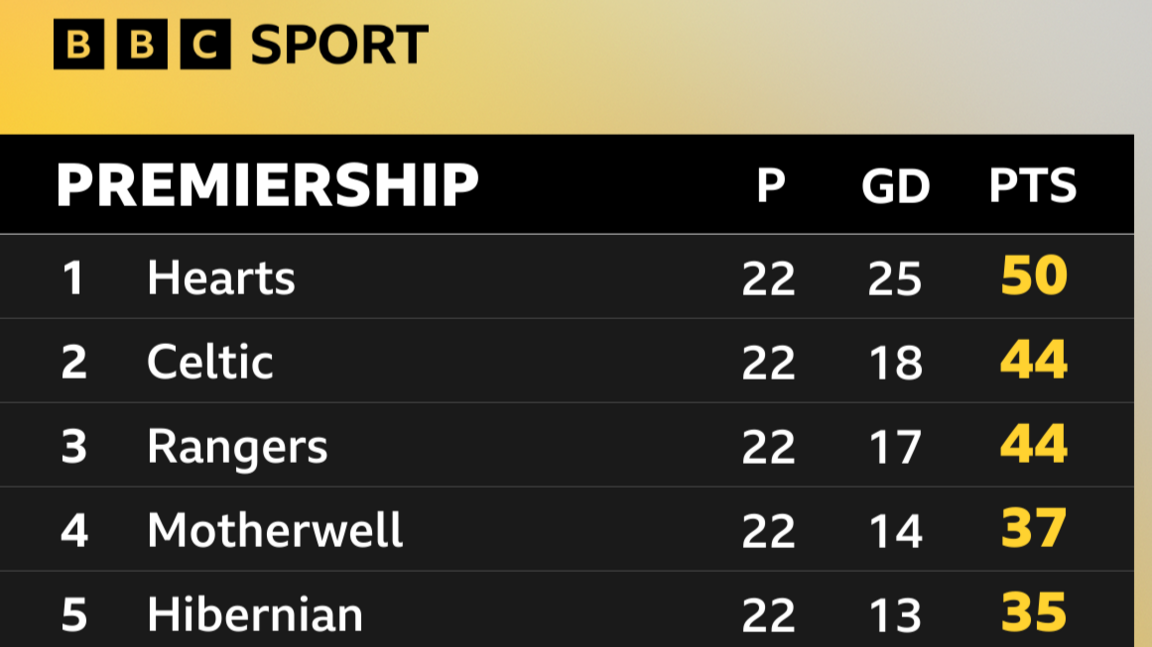
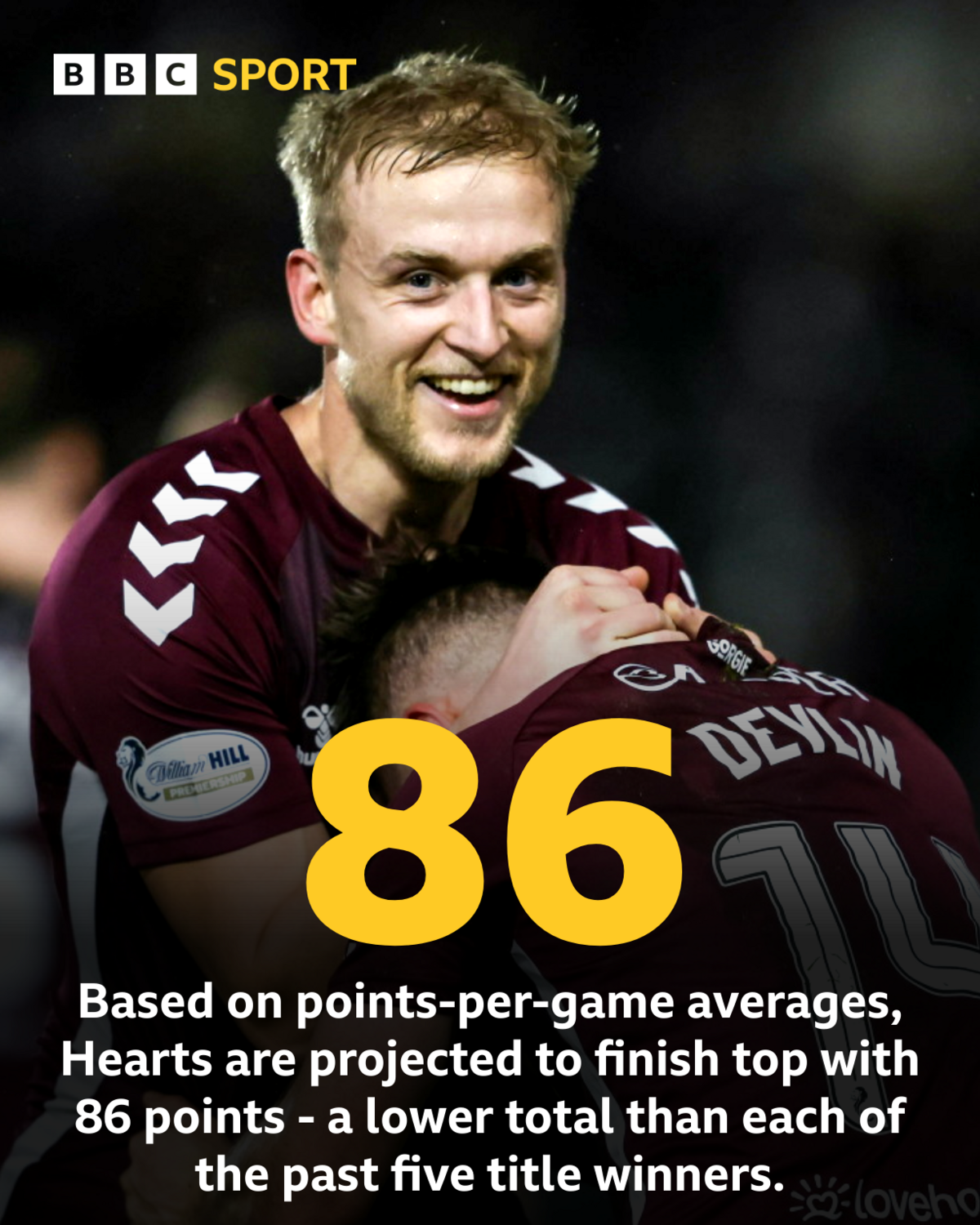
Well, based on points-per-game averages, leaders Heart of Midlothian are currently projected to finish the campaign on a total of 86 points.
That potential haul is lower than each of the five previous champions – and 10 fewer than the title-winning average of 96 across those five seasons.
In fact, the 2.27 points-per-game average that Derek McInnes’ men are posting at present is lower than the last seven winners, including Celtic’s title win in the Covid-curtailed 2019-20 campaign and the triumph that came a year prior.
That is not a criticism. An 86-point total should and would be enough to have you, at the very least, competing for a title in most other European leagues.
However, a relentless standard has been set in the Premiership in recent years.
In 2016-17, Brendan Rodgers’ Celtic achieved an unbeaten season, posting a haul exceeding 100 points. Rangers emulated that feat in 2020-21 under Steven Gerrard.
In the four campaigns since, the Parkhead side have won every title, racking up more than 90 points in each one.
It feels extremely unlikely either of the Glasgow clubs will hit a tally like that this term, given they would need to win each of their 16 remaining games to just edge through the 90-point barrier.
A statement win at Tynecastle on Sunday would be a good place for Martin O’Neill’s Celtic to start if they want to prove that point wrong, while it should also be noted that Rangers are averaging 2.5 points per game under Danny Rohl.
Time will be the only real measure of whether both clubs have given themselves too much to do following the dire reigns of Russell Martin and Wilfried Nancy.
Many have also doubted whether Hearts would be able to maintain their title-challenging form, but after 22 games the sample size feels big enough now to confirm they are going all the way.
What does the underlying data say?
Just as you have finally got your head around expected goals (xG), we are going to throw some expected points data at you.
Yeah, yeah, we know – get the eye rolls out of the way.
These numbers do present us with an interesting insight, but trying to explain them is the issue. Give us a chance.
Basically, our stats provider, Opta, uses the xG values that teams accrue in games, for and against, and then simulates the match 10,000 times, with the expected points based on the proportion of those games they win, draw or lose.
Hopefully that is clear enough.
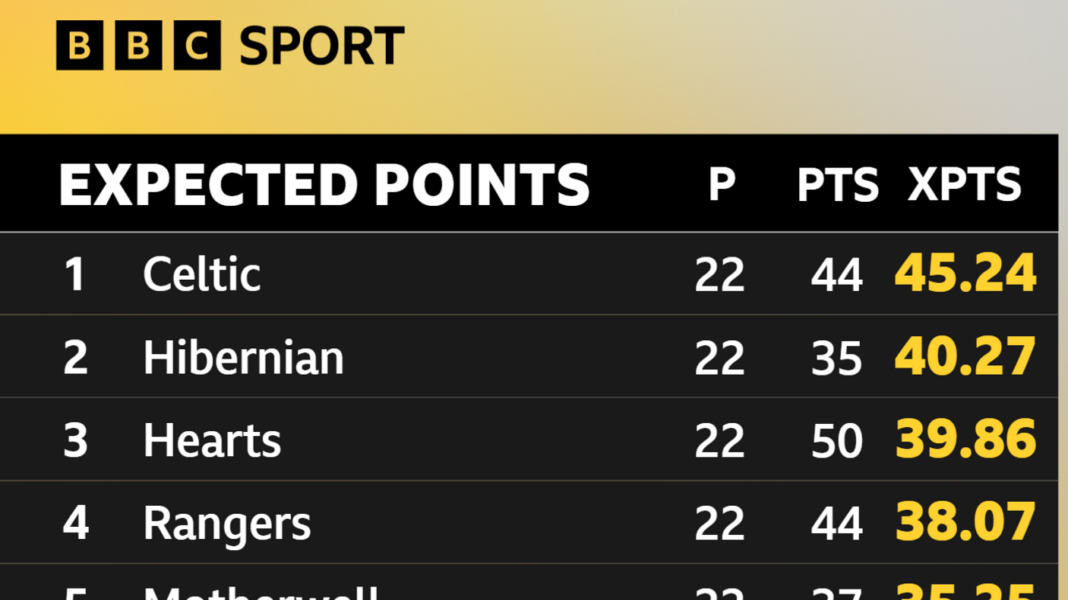
The table they have churned out keeps the same top five after 22 games, but rejigs their positioning: Celtic first, Hibs second, Hearts third, Rangers fourth and Motherwell fifth.
Digging a little deeper reveals perhaps more interesting findings, though.
Opta’s model reckons Hearts are overperforming their expected points by a whopping 10, with Rangers’ overperformance at almost six.
That may fuel the idea for some that both sides could eventually drop off as an underperforming Celtic come strong, but data does not always determine results.
If it did, Nancy would still be in a job given xG stats reflected well on the Frenchman.
It is also difficult to find a metric to gauge how each of these teams will cope mentally as the finish line nears, while injuries and January signings could change the complexion completely.
In the end, it will be the drama on the pitch that will grab attention as an incredible finale to an extraordinary season unfolds over the next four months.
A campaign so unpredictable, even the data could prove to be miles off.