

This post was originally published on this site.
Defining a business entity is essential for determining how your organization will operate, manage liability, and fulfill tax obligations. You need to evaluate various structures, such as sole proprietorships, partnerships, LLCs, and corporations, each with unique benefits and drawbacks. Comprehending these options can help you make informed decisions about asset protection and management flexibility. The right choice can greatly affect your business’s long-term success and compliance. So, what factors should you consider next?
Key Takeaways
- A business entity is a legal structure that defines how an organization operates and its liabilities.
- Common types of business entities include sole proprietorships, partnerships, LLCs, and corporations.
- Each entity type has distinct implications for liability, taxation, and operational governance.
- Choosing the right structure affects personal asset protection and the ability to raise capital.
- Registration involves selecting a business name, filing formation documents, and obtaining necessary licenses.
Understanding Business Entities

Grasping business entities is crucial for anyone looking to start or manage a business. A business entity, by definition, is a legal structure that enables an organization to operate, outlining its liability, tax obligations, and operational framework.
To explain business entity options, consider the common types: sole proprietorships, partnerships, limited liability companies (LLCs), and corporations. Sole proprietorships are the simplest form, with one owner bearing unlimited personal liability.
Partnerships involve multiple owners sharing profits and liabilities. LLCs offer limited liability protection, keeping personal assets separate from business debts, with flexible tax treatment.
Conversely, corporations function as distinct legal entities, providing strong liability protection for shareholders but may incur double taxation unless they elect S Corporation status.
Comprehending these distinctions helps you make informed decisions about which business entity aligns best with your goals and needs.
Importance of Business Structure

Choosing the right business structure is fundamental to your company’s success and sustainability. The structure you choose not merely defines what is a business entity but likewise greatly impacts your tax obligations, personal liability, and ability to raise capital. Sole proprietorships and partnerships expose you to unlimited personal liability for business debts, whereas LLCs and corporations can protect your personal assets.
| Business Structure | Key Features |
|---|---|
| Sole Proprietorship | Simple, few regulations, high liability |
| Limited Liability Company (LLC) | Protects personal assets, flexible taxation |
| Corporation | Complicated, potential double taxation, limited liability |
Understanding the importance of business structure helps you navigate legal intricacies. Consulting with professionals, like attorneys and accountants, is advisable to guarantee you choose the appropriate structure customized to your specific needs. This choice lays the foundation for your company’s future.
Key Considerations When Choosing a Business Entity

When you’re choosing a business entity, comprehending liability protection and tax implications is vital.
Different structures offer varying levels of personal liability; for example, LLCs and corporations limit your risk, whereas sole proprietorships expose you to more.
Furthermore, tax treatment differs considerably among entities, so it’s important to analyze how each option could impact your overall tax burden.
Liability Protection Importance
Comprehending the significance of liability protection is essential for anyone considering a business entity. Choosing a structure like an LLC or corporation can protect your personal assets from business debts and legal claims, minimizing your financial risk.
Conversely, sole proprietorships and general partnerships expose you to unlimited personal liability, making them less favorable, especially in high-risk industries.
LLCs offer liability protection and allow profits to pass through to your personal tax return, avoiding double taxation during the preservation of your assets.
Corporations provide strong liability protection but may face double taxation unless you opt for S Corporation status.
Thus, when selecting a business entity, carefully evaluate the liability protection each option offers, as it impacts your long-term financial security and risk management.
Tax Implications Analysis
How can the choice of a business entity affect your tax obligations? Your selection considerably influences how you’re taxed.
[embedded content]
Sole proprietorships and general partnerships face single taxation, whereas corporations experience double taxation except they opt for S Corporation status.
Limited Liability Companies (LLCs) offer flexibility, allowing you to choose among various tax treatments, potentially optimizing your tax situation.
Be aware that self-employment taxes apply to profits from sole proprietorships and partnerships, and LLC members might incur these taxes too except taxed as an S Corporation.
C corporations face corporate tax rates, whereas S corporations allow profits and losses to pass through to shareholders, avoiding double taxation.
Consulting a tax professional can help you navigate these intricacies effectively.
Types of Business Entities

When you’re starting a business, comprehending the different types of business entities is essential for making informed decisions.
Each structure, whether it’s a sole proprietorship, partnership, LLC, corporation, or nonprofit, comes with its own tax implications and levels of liability.
Common Business Structures
There are several common business structures you can choose from, each with distinct characteristics and implications for liability, taxation, and management.
A Sole Proprietorship is the simplest, where one individual owns the business and faces unlimited personal liability.
Partnerships can be general, where partners share liability and profits, or limited, offering protection to limited partners based on their investments.
A Limited Liability Company (LLC) blends the benefits of a corporation and partnership, providing liability protection as it allows profits to pass through to personal income.
Corporations, classified as C or S Corporations, are separate legal entities that offer limited liability for shareholders.
Nonprofit corporations focus on public benefit and can qualify for tax-exempt status, adhering to specific regulations.
Tax Implications and Liability
Choosing the right business entity is crucial since it greatly affects your tax obligations and liability exposure. Comprehending these implications can help you make informed decisions. Here’s a quick overview:
- Sole Proprietorships & General Partnerships: Simpler tax processes, but owners face unlimited personal liability.
- Limited Liability Companies (LLCs): Offer pass-through taxation, protecting personal assets and potentially reducing tax liabilities.
- C Corporations: Taxed at the corporate rate and may encounter double taxation on profits and dividends.
- S Corporations: Allow pass-through taxation to shareholders, avoiding double taxation.
- Limited Partnerships: Offer limited liability for limited partners, whereas general partners maintain unlimited personal liability.
Your choice greatly impacts both taxation and personal financial risk, so choose wisely.
Sole Proprietorship Defined

A sole proprietorship is the most straightforward business structure, allowing an individual to own and operate a business without the need for formal registration. This form of business organization has no legal distinction between you and your business, meaning you’re personally liable for all debts and obligations incurred.
Here’s a quick comparison of sole proprietorships with other business structures:
| Feature | Sole Proprietorship |
|---|---|
| Ownership | Individual |
| Liability | Personal |
| Registration | Not required |
| Taxation | Personal income |
| Common Users | Freelancers, consultants |
Sole proprietorships are popular among freelancers and small business owners owing to their operational flexibility and minimal regulatory requirements. As they simplify tax processes, you should be aware that profits are taxed as personal income, which could lead to higher self-employment taxes.
General and Limited Partnerships

When considering partnerships, it’s important to understand the key differences between general and limited partnerships.
In a general partnership, all partners share equal management responsibilities and face unlimited personal liability, whereas in a limited partnership, at least one partner has unlimited liability and others enjoy liability protection up to their investment.
Furthermore, both types typically share profits based on their agreements, but the mechanics of these arrangements can vary considerably.
Ownership Structure Differences
Comprehending the differences between general and limited partnerships is crucial for anyone considering these ownership structures. Here’s a breakdown of key distinctions:
- Management: General partners manage the business; limited partners usually don’t participate in daily operations.
- Liability: General partners have unlimited personal liability; limited partners’ liability is confined to their investment.
- Profit Sharing: In general partnerships, profits are shared equally; limited partnerships may have different profit-sharing arrangements.
- Taxation: Profits in both types are taxed only once at individual rates, avoiding corporate double taxation.
- Formation: General partnerships require minimal formalities, whereas limited partnerships need to file a certificate of limited partnership with state authorities to formalize their structure.
Understanding these differences can help you make informed decisions when choosing a partnership type.
Liability Implications
Comprehending liability implications is essential for anyone involved in general or limited partnerships, as these structures have distinct legal protections.
In a general partnership, all partners face unlimited personal liability for the debts and obligations of the business, meaning your personal assets could be at risk. Conversely, in a limited partnership, general partners bear unlimited liability, whereas limited partners enjoy protection, only liable up to their investment amount.
Nevertheless, to maintain this limited liability, limited partners shouldn’t engage in daily management activities.
In Idaho, you can further clarify liability by formalizing your status with a statement of partnership authority or organizational documents. These steps help define the extent of your legal responsibilities and protect your assets effectively.
Profit Sharing Mechanics
Profit-sharing mechanics in both general and limited partnerships play a vital role in defining how earnings and losses are distributed among partners.
In a general partnership, profits and losses are typically shared equally except specified otherwise in a partnership agreement. Conversely, limited partnerships involve general partners who manage the business and limited partners with restricted liability.
Here are key points to reflect on:
- General partners assume unlimited personal liability.
- Limited partners’ liability is confined to their investment.
- Profit-sharing often follows the partnership agreement’s terms.
- General partnerships benefit from pass-through taxation.
- A written agreement is important for clarity and dispute prevention.
Understanding these mechanics helps guarantee fair distribution and protects partners’ interests in the business.
Limited Liability Company (LLC) Overview

If you’re considering starting a business, grasping the structure of a Limited Liability Company (LLC) can be crucial for your success. An LLC combines the liability protection of a corporation with the tax benefits of a partnership, safeguarding your personal assets from business debts. To establish an LLC, you’ll need to file a Certificate of Organization with your state. The profits and losses typically pass through to your personal income, which helps you avoid double taxation, even though you might face self-employment taxes.
[embedded content]
Here’s a quick overview of key characteristics:
| Feature | Description |
|---|---|
| Liability Protection | Shields personal assets from business debts. |
| Tax Structure | Pass-through taxation or elect C/S Corporation tax. |
| Formation Requirement | Requires filing a Certificate of Organization. |
| Management Flexibility | Fewer formalities than corporations. |
Understanding these aspects can help you make informed decisions for your business.
Corporations Explained

When you consider forming a corporation, it’s crucial to understand the different types available and their respective advantages and disadvantages.
Corporations can be categorized mainly into C Corporations and S Corporations, each with unique tax implications and structural requirements.
Types of Corporations
Comprehending the various types of corporations is crucial for anyone looking to establish a business entity, as each type offers distinct advantages and disadvantages.
Here’s a brief overview of the main types:
Advantages and Disadvantages
Comprehending the advantages and disadvantages of corporations is vital for anyone considering this business structure. One major advantage is limited liability protection, which safeguards your personal assets from business debts and legal issues. Furthermore, corporations can raise capital easily by selling stock, attracting more investors compared to other structures.
On the other hand, they face disadvantages, including double taxation on profits and dividends, which can reduce overall earnings. Additionally, corporations require extensive documentation and compliance with regulations, like maintaining a board of directors and formal records, adding complexity to operations.
Finally, although corporations can exist indefinitely, allowing for smooth ownership shifts, this permanence can likewise create challenges in management and decision-making. Balancing these factors is critical in your decision-making process.
Nonprofit Organizations

Nonprofit organizations play an important role in addressing societal needs by operating for public or charitable purposes rather than for profit. If you’re considering starting a nonprofit, it’s important to understand the regulations and requirements involved:
- Nonprofits can obtain tax-exempt status under IRS Section 501(c)(3) if they meet specific criteria.
- Profits generated must be reinvested into the organization’s mission, not distributed to shareholders.
- To keep their tax-exempt status, nonprofits must file annual reports with the IRS and adhere to state regulations.
- Funding can come from donations, grants, and fundraising, but transparency is vital for public trust.
- Many states require a charitable solicitation license before reaching out for donations, ensuring accountability.
Understanding these key points will help you navigate the complex environment of nonprofit organizations effectively, allowing you to focus on fulfilling your mission.
Comparing Business Structures

When you’re considering starting a business, grasp of the various structures available can help you make informed decisions that align with your goals.
The main business structures include Sole Proprietorships, Partnerships, Limited Liability Companies (LLCs), and Corporations.
Sole Proprietorships are the simplest, requiring no formal registration but exposing you to unlimited personal liability.
Partnerships allow shared management and profits; yet, general partners face unlimited liability, whereas limited partners enjoy some protection based on their investment.
LLCs offer limited liability protection, letting profits and losses pass through to your personal income, though self-employment taxes may apply.
Finally, Corporations are distinct legal entities that provide strong liability protection but can be subject to double taxation unless you meet specific IRS criteria for S Corporation status.
Comprehension of these structures is essential in determining how best to protect yourself and manage your business finances.
Advantages and Disadvantages of Each Entity
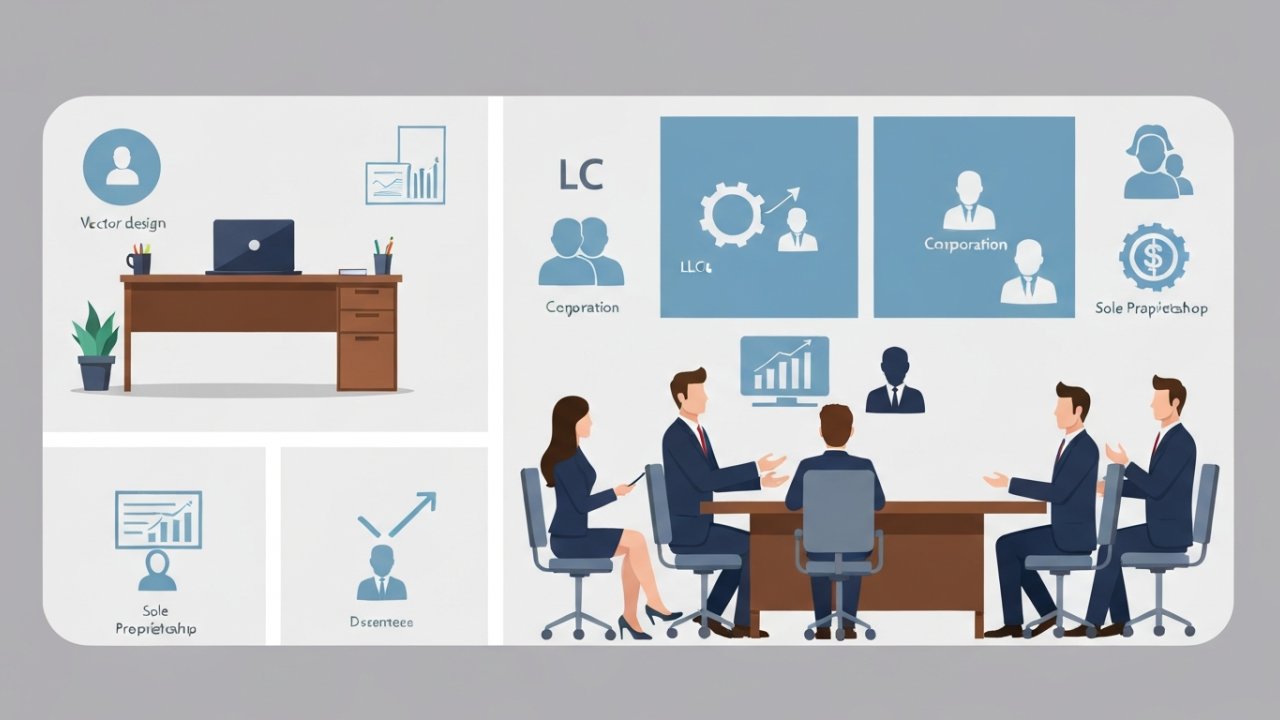
Comprehending the advantages and disadvantages of different business entities is crucial for making the best decision for your venture. Each structure has its unique traits that can impact your business greatly. Here’s a quick overview:
- Sole Proprietorship: Offers simplicity and control, but exposes personal assets to unlimited liability and makes raising capital difficult.
- General Partnership: Facilitates shared decision-making and resources, yet each partner faces unlimited liability, risking personal assets.
- Limited Liability Company (LLC): Provides limited liability protection and flexibility, but involves more paperwork and potential self-employment taxes.
- C Corporation: Delivers strong liability protection and capital-raising through stock, but is subjected to double taxation, increasing overall tax burden.
- S Corporation: Avoids double taxation by passing income to shareholders, though it has strict eligibility requirements and limits on shareholders, which may hinder growth.
Understanding these factors helps you choose the right entity for your needs.
Tax Implications of Different Business Entities
Tax implications play a significant role in determining the right business entity for your venture.
Sole proprietorships are taxed as personal income, meaning all business profits appear on your individual tax return, which could push you into higher tax brackets.
Partnerships likewise face pass-through taxation, with profits reported on partners’ tax returns, potentially leading to increased tax liabilities.
Limited Liability Companies (LLCs) provide flexible taxation options, allowing you to choose how you want to be taxed, optimizing your tax obligations based on your specific situation.
Corporations, conversely, encounter double taxation—profits are taxed at the corporate level and again when dividends are paid to shareholders, unless you elect S Corporation status.
Nonprofit corporations may qualify for tax-exempt status, meaning they don’t pay federal income tax on profits, but they must follow strict regulations regarding profit distribution and transparency in operations.
Comprehending these tax implications is essential for informed decision-making.
The Role of Professional Advice in Entity Selection

Choosing the right business entity isn’t just about comprehending tax implications; it furthermore involves traversing legal requirements and operational goals, which can be complex.
Seeking professional advice is vital in this process. Here’s how professionals can assist you:
- Tailored Advice: Consultants offer insights based on your unique circumstances and objectives.
- Tax Clarity: Tax specialists help you understand the implications of different entities, preventing costly mistakes.
- Streamlined Setup: Early professional engagement can ease compliance with legal requirements, reducing administrative burdens.
- Complex Structures: Experts can clarify non-standard business entities, which often require supplementary documentation.
- Enhanced Decision-Making: Professional guidance improves your choices regarding liability protection and long-term planning, encouraging sustainability.
Incorporating professional advice guarantees you navigate the intricacies of entity selection effectively, setting a solid foundation for your business’s future success.
Steps to Register a Business Entity
Registering a business entity involves several essential steps that lay the groundwork for your new venture.
First, determine the appropriate business structure, such as a sole proprietorship, partnership, LLC, or corporation, considering liability, taxation, and operational needs.
Next, choose a unique business name that complies with state regulations and conduct a name search through the Secretary of State’s office to confirm it’s available.
After that, file the necessary formation documents, like Articles of Incorporation or a Certificate of Organization, with the appropriate state agency.
You’ll additionally need to obtain a federal Employee Identification Number (EIN) from the IRS for tax purposes and hiring, except you’re a sole proprietorship without employees.
Finally, acquire any required licenses or permits specific to your business type and location to operate legally.
Following these steps will help you successfully register your business entity and start your entrepreneurial expedition.
Frequently Asked Questions

What Is a Business Entity Example?
A business entity example is a limited liability company (LLC).
In an LLC, you can operate your business while enjoying personal liability protection. This means your personal assets are typically safe from business debts.
Profits can pass through to your personal income without facing corporate taxes.
An LLC combines the flexibility of a partnership with the liability protections of a corporation, making it a popular choice for small business owners like you.
What Is the IRS Definition of a Business Entity?
The IRS defines a business entity as an organization formed to conduct business activities. This includes various structures like sole proprietorships, partnerships, limited liability companies (LLCs), and corporations.
Each type has its own tax implications; for example, sole proprietorships and partnerships typically allow for pass-through taxation.
To comply with tax regulations, business entities need a Tax Identification Number (TIN) for accurate reporting and classification, influencing how they report profits and losses.
[embedded content]
How Do You Determine Your Business Entity Type?
To determine your business entity type, start by evaluating your need for personal liability protection, as some entities like LLCs shield you from personal risk.
Next, consider tax implications; entities such as S Corporations may offer tax benefits.
Evaluate the complexity of formation and ongoing requirements, with sole proprietorships being simpler.
Finally, think about your fundraising needs, as partnerships and corporations attract investors more easily.
Consulting with a professional can help clarify your options.
What Are the 4 Types of Entities?
The four primary types of business entities are Sole Proprietorship, Partnership, Limited Liability Company (LLC), and Corporation.
A Sole Proprietorship is owned by one person, who’s unlimited liability.
A Partnership involves two or more individuals sharing responsibilities and liabilities.
An LLC offers limited liability protection during allowing profits to pass to members’ personal income.
Finally, a Corporation is a separate legal entity that protects owners from personal liability but may face double taxation on profits.
Conclusion

Choosing the right business entity is essential for your organization’s success. By comprehending the various structures, including sole proprietorships, partnerships, LLCs, and corporations, you can make informed decisions that align with your operational needs and financial goals. Consider factors like liability, taxation, and management flexibility before finalizing your choice. Consulting with a professional can further clarify your options, ensuring compliance with legal requirements and optimizing your business’s growth potential. Take the time to define your entity wisely.
Image via Google Gemini