This post was originally published on this site.
How virtual safety car cost Norris win – and should F1 change rules?
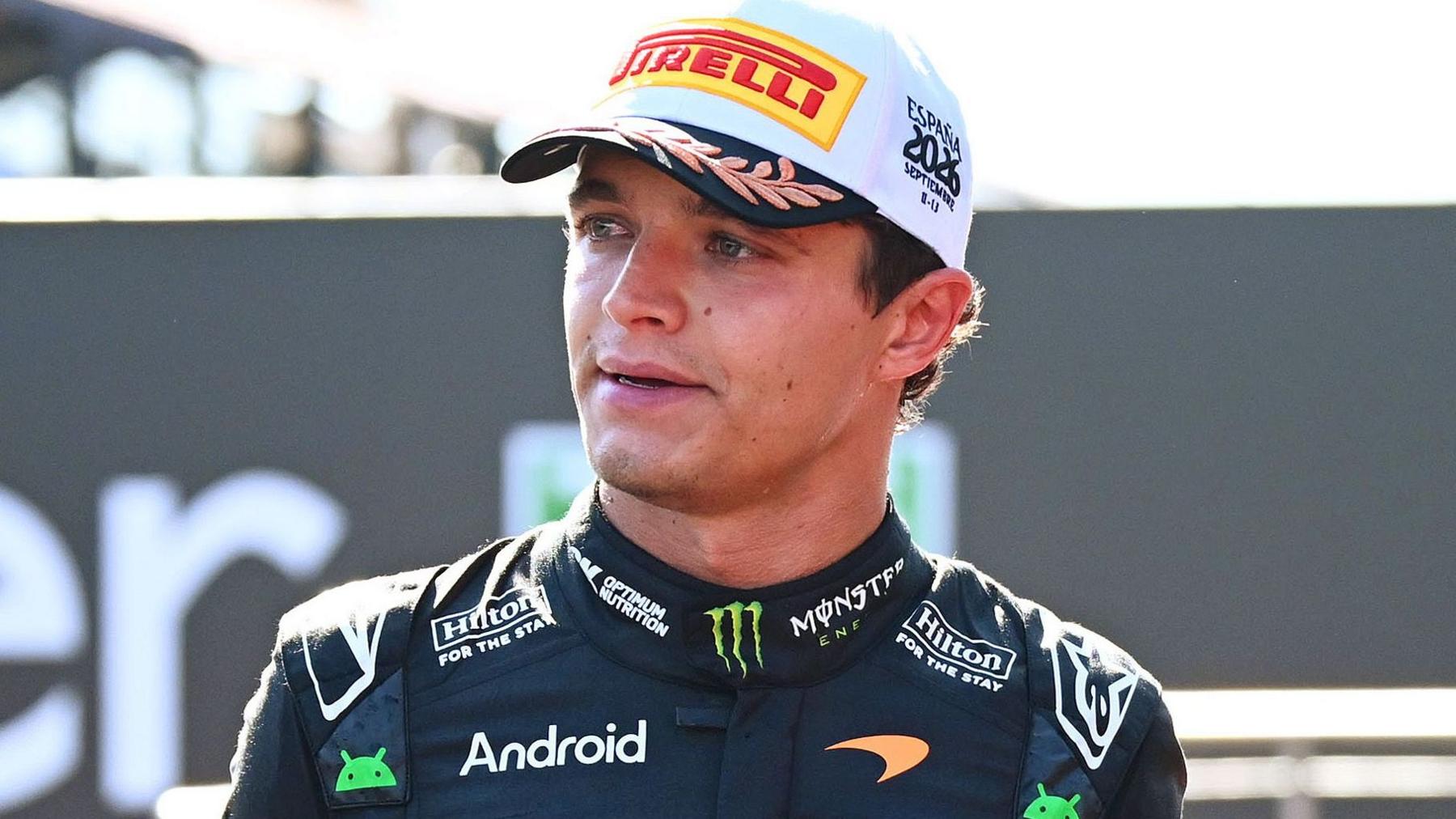 Image source, Getty Images
-
Published
Lando Norris says he was “insanely unlucky” to lose what seemed like a certain win in the Spanish Grand Prix because of the timing of a virtual safety car.
McLaren’s Norris was leading comfortably when the VSC was called, seconds after he had passed the pit lane entry.
That allowed Mercedes’ Kimi Antonelli and Red Bull’s Max Verstappen to pit under the VSC, saving time, while the caution period ended before Norris could make it around to the pits again.
Of the VSC, Norris said: “It is a rule that should not define a whole race.”
“I was the only one on the whole grid that didn’t get the chance to do the pit stop,” he said. “That’s just unfortunate.
“There’s been plenty of times where I’ve gained from it in the past and times where I’ve lost from it, and it’s racing, but never when fighting for a win.
“So, it’s probably one of the first times a win has been lost simply because of it.”
After taking pole position with a lap his team principal Andrea Stella described as “a masterpiece”, Norris was leading Antonelli by more than six seconds after 13 laps in Madrid.
He had just passed the pit entry at the end of lap 14 when a VSC was called because Lance Stroll’s Aston Martin had stopped in the run-off area at Turn 20, while Antonelli and Verstappen were far enough behind to pit.
The VSC, which controls all cars to a specified maximum speed, then ended shortly before Norris completed the next lap, at the end of which he pitted.
Because a stop under the VSC costs 11 seconds less race time than one under green-flag conditions, Norris lost sufficient time that Antonelli and Verstappen were able to pass him.
Norris lost a further five seconds because of problems with his two right-hand side tyres at the stop and emerged from the pits more than 15 seconds behind Antonelli and more than nine adrift of Verstappen.
He caught the Red Bull before the end of the race but as overtaking was virtually impossible on the new Madring street circuit, he was stuck in third place.
Race-winner Antonelli, who extended his championship lead to 81 points, acknowledged Norris’ bad fortune. “If I have to be realistic and honest, today we didn’t deserve to win,” he said. “Lando deserved to win, and so I think our result was probably P2 or even P3.”
-
Antonelli wins as Norris loses out under virtual safety car
-
Published5 hours ago
-
-
Antonelli impressive and one of Colapinto’s best weekends – driver ratings
-
Published2 hours ago
-
What is the VSC?
The VSC is a system by which the cars are forced to drive to a specified lap-time delta while a hazard on track is cleared.
It is used in certain circumstances in favour of deploying the actual safety car, usually when the hazard can be cleared relatively quickly, because it interferes less with the race and minimises the time lost under caution.
A physical safety car involves a modified high-performance road car entering the track and having the field line up behind it.
The various protocols around its operation mean a safety-car period usually goes on for several laps, while in this case the VSC was in operation for less than a single lap.
Why was it a problem for Norris?
The short duration of the VSC in this case was exactly why Norris was railing against the situation.
Every other driver in the field had the opportunity to decide whether to pit or not – the only driver not given that option was Norris.
The pit lane entry is before the final corner at the Madring, and Norris was in the last corner when it was called.
The VSC ended when Norris was in Turn 21, the corner before the pit entry, on lap 15. Antonelli, having stopped, was behind him in Turn 19.
On most circuits, Norris would have had a chance to pass Verstappen and perhaps even do the same to Antonelli before the end, given his pace advantage on the day, but as Antonelli put it: “In the race, you’re just stuck behind.”
Norris was withering in his criticism of the track layout, saying: “I don’t know how someone looks at this design and goes, ‘Mint.'” But he did say there was “a lot of opportunity” to improve it for next year.
Could McLaren have done anything differently?
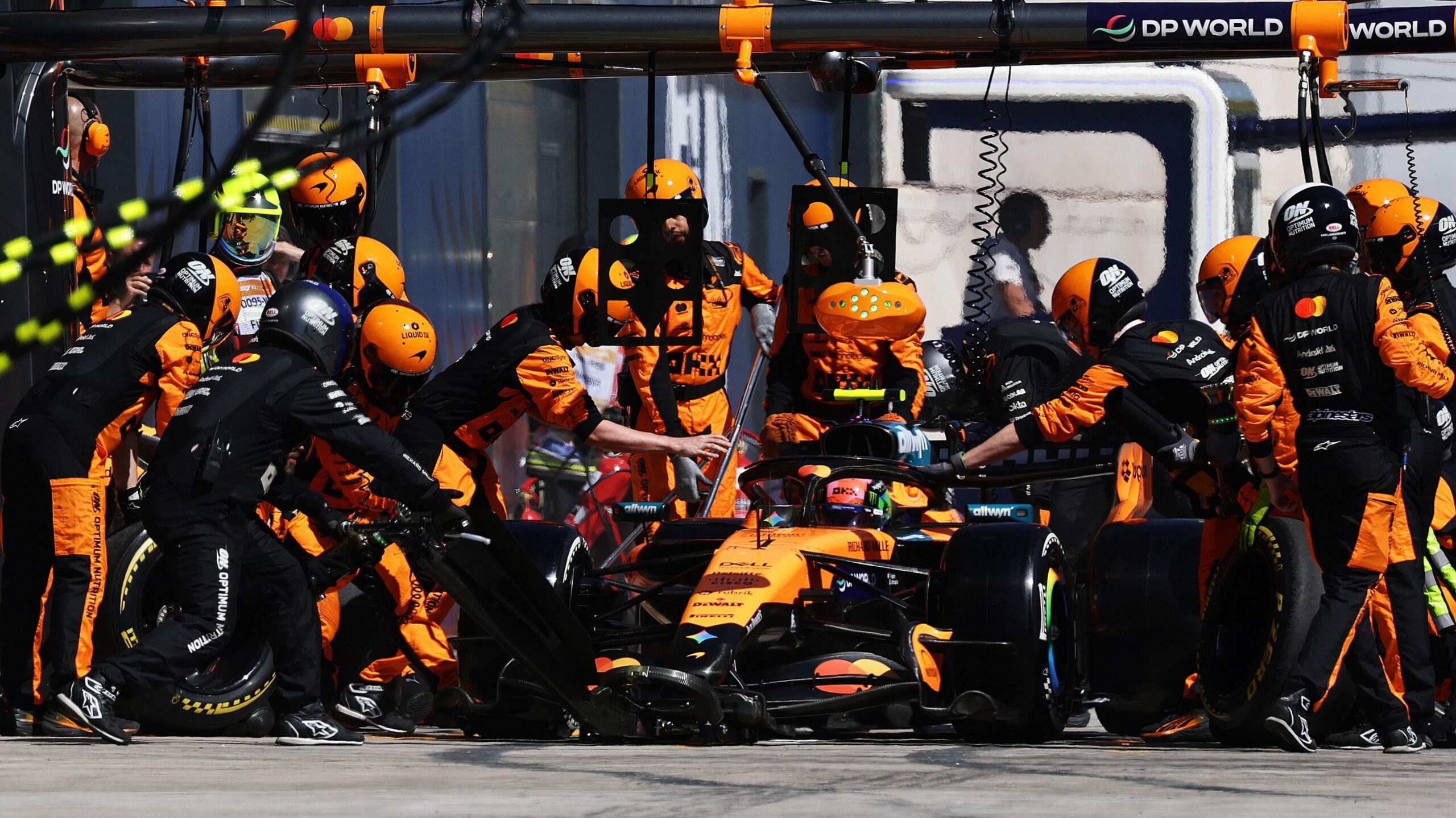 Image source, Getty Images
After the race, one question asked of McLaren was whether pitting on the following lap was the best idea, or should Norris have stayed out?
Norris said: “I had to come in at the end of the lap because it was the only chance.
“It was still effectively some pit loss, (but) the fact that everyone’s kind of on colder tyres and you’re still minimising the pit loss.
“The medium tyre (on which Norris had started the race) was destroyed and the hard tyre (to which Antonelli and Verstappen switched) was amazing.
“But the pace was very, very strong and on the hard tyre… I know they were stuck (behind Ferrari’s Charles Leclerc, who stayed out under the VSC), we caught up 13, 14 seconds or more, almost. So, plenty of positives. A day full of positives, just one thing let it all down.”
McLaren team principal Andrea Stella said: “We considered staying out, but you have to accept the fact that now you are on relatively used medium tyres. And the people behind you will be on new hard. So you’re never going to open a gap on people on new hard.”
The other question was whether McLaren would have been wise to anticipate that the race director would call the VSC and pit Norris before it was deployed.
McLaren team principal Andrea Stella said: “In hindsight, that would have been a good idea.”
But he pointed out that, in the moment, it would have come with risks. The long pit lane at the Madring – the longest on the calendar – meant a pit stop cost a lot of time.
Stella said: “I would have to review with my engineers, see whether it was kind of obvious that it would end up in a virtual safety car. Therefore, you try to anticipate or not.
“Here, the problem is that you need to be extremely careful, because it’s 27 seconds if you don’t pit under a virtual safety car.
“So if you get it wrong, it would be extremely penalising. From the lead, you pit unnecessarily, and now you have lost the victory.
“So a good rule is to respond to what is a fact, to what is the real condition of the circuit.
“But we will definitely take a look as to whether in these conditions it was just simply, you know, obvious that he would end up in a virtual safety car. I cannot answer at the moment.”
Has this happened before?
VSCs and safety cars are commonplace in F1 and they always afford drivers and teams the chance to gain or lose depending on the decisions they make when they occur.
Norris took his maiden victory in Miami in 2024 with the help of a safety car – he had delayed his stop and was able to make it under caution when race leader Verstappen had already stopped, and jumped into the lead.
And in Barcelona this year, Lewis Hamilton’s maiden Ferrari victory was helped by a VSC that gave him a cheap pit stop on a different tyre strategy from rivals Mercedes.
However, this is the only example many could remember of a race leader losing a race in this fashion by being the only driver not to be able to choose whether to pit under a VSC or safety car.
Should F1 change the rules?
After the race, Norris and Verstappen said this kind of scenario had been discussed by drivers many times with governing body the FIA.
“I think there’s always probably some cons to doing it, but it’s tough,” Norris said.
“I’ve won from it in the past, I’ve lost from it in the past. Over the course of a season, it’s hard to know if it’s a good thing or a bad thing.
“It probably equals out over time. Of course, it just hurts more, the fact that I lose a win. You know, there’s literally nothing I could do as a driver today to do a better job.”
Verstappen said: “We’ll probably talk about it in the next briefing and see if there is anything that can be done.”
Stella added: “Perhaps there’s a wider reflection that the Formula 1 community should apply as to whether you keep things like they are or you introduce ways of maintaining more fairness.
“Offering the personal opinion. I’m puzzled myself as to what’s right.
“Is it correct to give enough duration such that everyone will have been subject to the same track conditions? So, for instance, the virtual safety car lasts at least one full lap? Or you just keep it in the hands of the gods, and sometimes you are lucky, sometimes you are not. I’m not sure myself.
“But in general, there’s the right place to have this sort of conversation, which is the Strategy Advisory Committee (SAC). And this is a topic that may be added to the agenda and discussed over there.
“But if there is to be a change, it will have to be a change that goes through the SAC, then the F1 Commission, and then we’ll have to go at some stage to the sporting regulations.
“But I would envisage that this is a relatively lengthy process, unless there’s a big push from F1, from the institutions, FIA or F1, to say, like, ‘we need to make this different’.”
-
-
Published4 days ago
-
-
-
Published2 days ago
-