
This post was originally published on this site.
I’m sitting on the balcony of my homestay in Buscalan, a remote mountain village in northern Philippines, reviewing a sheet of tribal tattoo designs with English descriptions: intersecting arrows around layered squares (to represent a compass), zigzagging rows of blackened triangles (mountains), a chain of triangular hourglasses (day and night). Below me a narrow path winds through muddy rice paddies like a snake and disappears into a horizon blanketed by dense fog. January is the middle of the dry season, but the clouds insist otherwise; raindrops are plunking out a tune on the corrugated metal roof.
I decide on a circle orbited by dots and waves: the sun. Maybe this tattoo will usher in the light. This is my third trip to the Philippines, the country my parents left five decades ago. Reaching Buscalan was challenging, starting with a stomach-churning 12-hour drive from Manila through the Cordillera mountains, then a one-hour hike into a ravine of fragrant laurel trees, and finally a rickety tram—a narrow wood crate with a pulley system powered by a stationary Jeep, originally meant for transporting supplies. Still, none of this deters the most resolute.
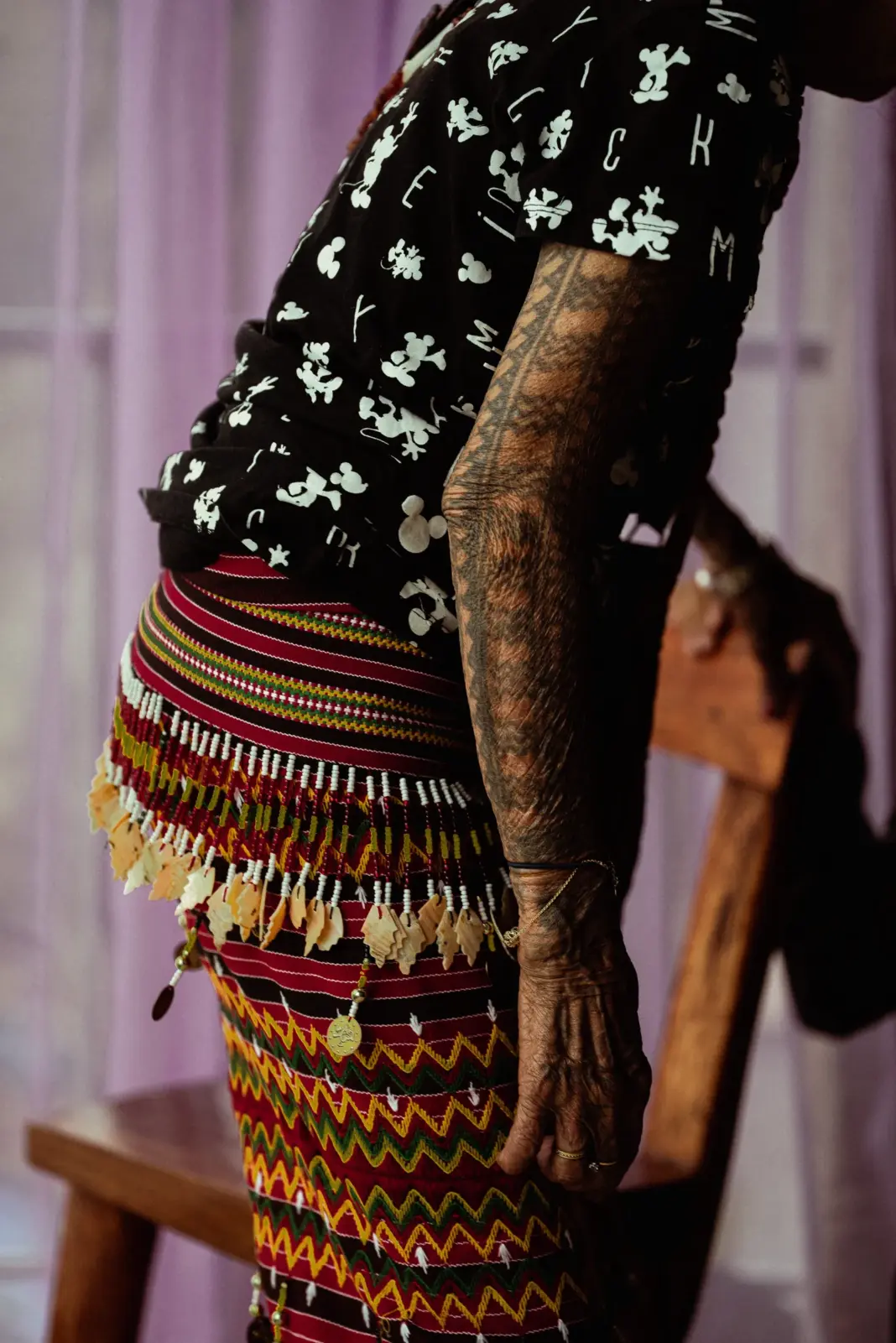
In place of physical souvenirs from my travels, I get body art as intentional scars archiving my journeys. They are always celestial objects: I have another sun, from Melbourne, a magenta star from Budapest, and an emerald constellation grown over multiple trips to Dublin. Now a Kalinga design will be tapped dot by dot into my skin by a mambabatok, a traditional tattooist. Buscalan is famously home to the oldest living artist in the country: 109-year-old Apo Whang-od (whose birth name is Maria Oggay), a woman with arms completely covered in twisted, inky patterns who has been practicing hand-tapped tribal tattoos for over 90 years. Bamboo tattooing was an art initially done by Kalinga men, but Whang-od’s father recognized her artistic talent. So he guided her in making intricately layered designs, like woven fabric, to adorn warriors’ chests as marks of honor. Her signature tattoo now is a cluster of three dots that represent herself and her two grandnieces—the next generation of mambabatoks. If there are holy grails of tattooing, getting inked by Whang-od is certainly one of them.