
This post was originally published on this site.
Jacky Martens and Vikas PandeyDelhi

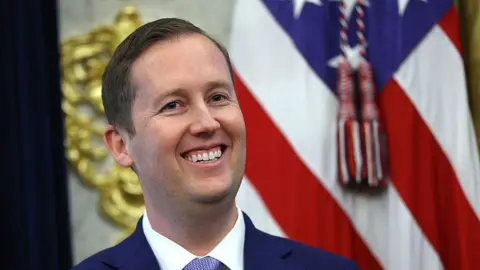
India and the US are continuing to actively engage on trade deal negotiations, Sergio Gor, the new US ambassador to India, has said during a trip to Delhi.
The next call to discuss the deal was scheduled for Tuesday, Gor said, but did not elaborate on who would participate.
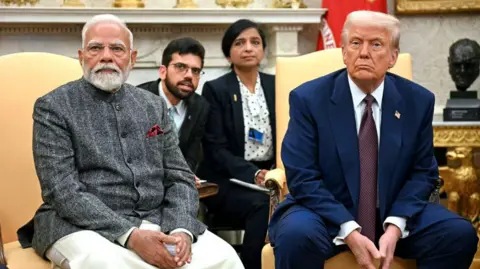
He also said the friendship between US President Donald Trump and Indian PM Narendra Modi was real and that “real friends can disagree but will always resolve their differences at the end”.
Gor’s remarks come just days after some US officials blamed India for the delay in signing the deal, a claim that Delhi has denied.
Trade negotiations between the nations have been strained since the US imposed 50% tariffs on Indian goods – the highest in Asia – in August, including penalties linked to India’s purchase of Russian oil. Washington has pushed for greater access to India’s agricultural sector, a long-standing sticking point which Delhi has strongly resisted.
Sworn in at the White House in November, Gor is yet to formally present his credentials to India’s president.
On Monday, he was formally welcomed as the ambassador at an event in Delhi.
The ceremony had the feel of a mini-inauguration, rich in pomp and careful stage-management. A round of applause greeted him before he addressed reporters. Classic American songs filled the room – a playlist, aides said, personally chosen by the ambassador – with tracks ranging from Hello, It’s Me by Lionel Richie to YMCA by Village People and Ring of Fire by Johnny Cash.
Speaking to reporters, he described India as having “no partner more essential” than the US, adding that the bilateral relationship could become the “most consequential” partnership of the century.
“Remember, India is the world’s largest nation, so it’s not an easy task to get this across the finish line, but we are determined to get there,” Gor said, adding that the two sides were also working closely on ” other very important areas” – such as security, counterterrorism, energy, technology, education and health.
 AFP via Getty Images
Relations between Trump and Modi, once seen as warm, have cooled in recent months, with disagreements ranging from trade to India’s stance on mediation on its conflict with Pakistan, even as the two leaders continue to speak periodically by phone.
On Friday, India’s foreign ministry spokesperson Randhir Jaiswal said that both sides have been “close to a deal” on several occasions but they remain engaged in negotiations.
Delhi’s comments came after US Commerce Secretary Howard Lutnick claimed that the trade deal between the countries stalled because Modi did not call Trump.
“It was all set up. I said [to the Indian side] you got to have Modi call the president. They were uncomfortable doing it, so Modi didn’t call,” Lutnick said in a podcast released last week.
India said the categorisation of the discussions between Delhi and Washington was “not accurate”.
Meanwhile, Trump has also made several comments about India and Modi in recent days, including a warning that he would increase tariffs if Delhi does not stop buying Russian oil.
Separately, US Senator Lindsey Graham last week said that Trump had “greenlit” a punishing Russia sanctions bill that, if passed by Congress, would allow for even higher secondary tariffs and sanctions on countries doing business with Moscow.
Jaiswal said India was “aware of the proposed bill” and was “closely following developments”.
India became one of the biggest markets for Russian oil as Western nations shunned purchases and imposed sanctions on Moscow after Russian troops invaded Ukraine in 2022. Delhi had defended its decision, saying that it needed to think about the energy needs of its vast population.
But since the tariffs kicked in, oil refiners in India have reportedly been cutting their energy purchases from Moscow.
Even though India was among the first countries the US was negotiating a deal with, almost a year later, it is now among the last major economies yet to get a trade pact with the US.
Follow BBC News India on Instagram, YouTube, X and Facebook.