
This post was originally published on this site.
Ethereal Exploration Guild, an Indian space tech better known as EtherealX, has climbed 5.5x in valuation to $80.5 million after its latest funding round. The startup is developing a launch vehicle designed to be fully reusable and is readying engine hot-fire tests ahead of its first technology demonstration flight, planned for 2027.
The Bengaluru-based company confirms that it closed an oversubscribed $20.5 million Series A round led by TDK Ventures and BIG Capital, as TechCrunch reported earlier. Accel, Prosus, YourNest, BlueHill, Campus Fund, and Riceberg Ventures also participated, EtherealX said. The raise follows a $5 million seed round in August 2024 that valued the startup at $14.6 million.
As India pushes to mature its space ecosystem beyond small launchers and component contracts — targeting growth in its space economy to $45 billion from $8 billion over the next decade — EtherealX is among the startups drawing attention.
Satellite operators worldwide are looking for more launch capacity and scheduling flexibility in a market where SpaceX’s Falcon 9 has set the benchmark for pricing and cadence. EtherealX is aiming for that space with its fully reusable vehicle designed to return both the booster and upper stag. That’s an approach that, if proven, could cut per-launch costs and increase flight frequency without relying on a native constellation to keep rockets fully booked.
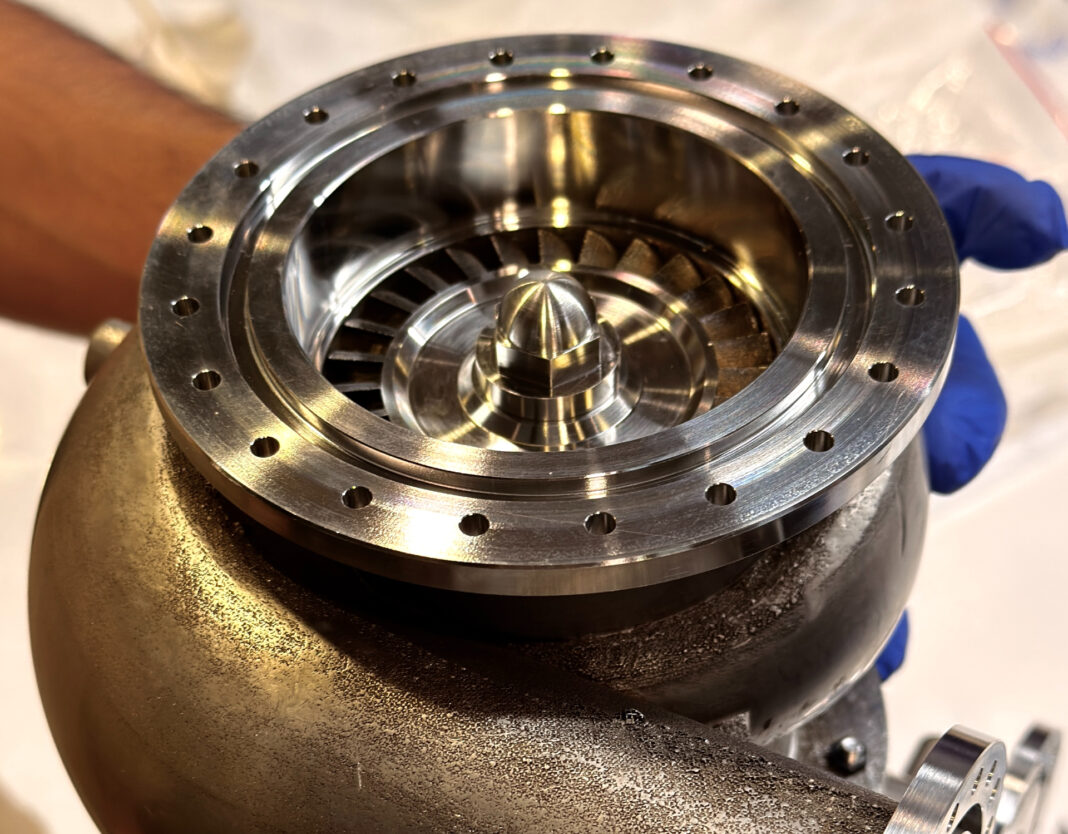
EtherealX is developing two engines in-house: the 80-kilonewton “Pegasus” upper-stage engine and the 1.2-meganewton “Stallion” booster engine, with hot-fire tests targeted for June–July. Thrust, measured in kilonewtons and meganewtons, indicates how much lifting force an engine can generate.
The startup is targeting a November–December 2027 launch window for a technology demonstration vehicle, ahead of commercial missions expected to begin toward the end of 2028, co-founder and CEO Manu J. Nair said in an interview.
Rocket engineers also track specific impulse, a widely used proxy for fuel efficiency, which — along with thrust — helps determine how much payload a vehicle can carry for a given amount of propellant.
Techcrunch event
San Francisco
|
October 13-15, 2026
The Pegasus engine produces 323 seconds of vacuum-specific impulse and uses what the startup describes as a proprietary “full-flow segregated cooling cycle.” The engine integrates an in-house additively manufactured turbopump. Furthermore, the Stallion booster engine uses a gas-generator cycle and delivers 306 seconds of sea-level specific impulse.
Nair told TechCrunch that EtherealX plans to cluster multiple engines per stage for its main medium-lift vehicle, called Razor Crest Mk-1, with nine Stallion engines on the booster and 15 Pegasus engines on the upper stage.
For comparison, SpaceX’s Falcon 9 primarily reuses its first-stage booster while expending the upper stage. EtherealX is targeting deeper reusability by designing its vehicle to return both the booster and the upper stage.
EtherealX’s vehicle aims to carry up to 24.8 tonnes in an expendable configuration, 22.8 tonnes partially reusable, and about 8 tonnes when fully reusable. The startup is targeting pricing of $350 to $2,000 per kilogram over time, Nair said, depending on configuration and cadence.
To support development, EtherealX operates a rocket engine test site in the southern Indian state of Tamil Nadu, known as Base 001, which Nair said is focused on upper-stage engine qualification. The startup has also secured a 150-acre manufacturing and testing campus in Andhra Pradesh’s proposed space city that it expects to become operational from mid-2026 for integrated engine and stage testing.
EtherealX has signed launch memoranda of understanding totaling around $130 million with customers, including Japan’s SpaceBD and Taiwan’s space agency, TASA, Nair said, as it seeks early commercial demand ahead of its first demonstration flight.
The latest funding will be used to complete flight qualification of the Stallion booster engine and to run clustered-firing tests of the Pegasus upper-stage engines, Nair said. To support that ramp-up, the startup currently employs 67 people and expects to grow to about 90 over the next two months as it increases manufacturing capacity and moves to a higher testing cadence ahead of its first demonstration flight.