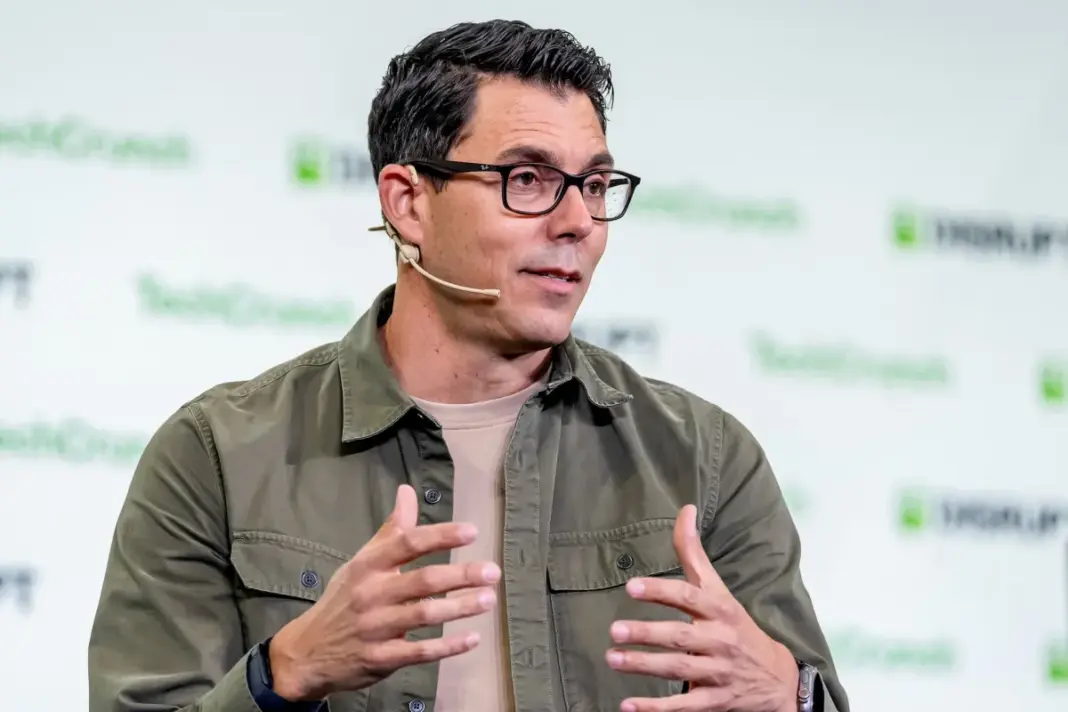

For nearly a century, People’s Choice Beef Jerky has been a family-owned business rooted in Los Angeles, evolving from a neighborhood butcher shop established in 1929 into a nationally recognized beef jerky brand. Now led by fourth-generation owner Brian Bianchetti, the company is demonstrating how a traditional family business can embrace modern technology, expand into e-commerce, and reach new customers without losing the values that made it successful in the first place.
During Amazon Accelerate 2026 in Seattle, I had the opportunity to sit down with Bianchetti to discuss the company’s remarkable history, its transition into online selling, and how Amazon has become an important part of its growth strategy. When Bianchetti joined the family business about a decade ago, he recognized an opportunity to take a company built primarily around manufacturing and wholesale distribution and introduce its products to customers nationwide through digital channels. That decision paid off, with the company’s Amazon sales doubling during its first year on the platform.
Our conversation explored how People’s Choice uses a combination of Fulfillment by Amazon (FBA) and its own fulfillment capabilities, the growing role of artificial intelligence in managing its online business, and why maintaining personal relationships with customers remains essential even as technology transforms the industry.
Bianchetti also shared some exciting news about the company’s future, including a major expansion of its Los Angeles manufacturing operations that involves a new facility, additional equipment, and more local jobs. Throughout our discussion, one theme stood out: successful businesses must be willing to evolve while staying true to what makes them unique.
Here is my conversation with Brian Bianchetti about building on a century of family entrepreneurship, embracing e-commerce, and preparing People’s Choice Beef Jerky for its next generation of growth.
Leland McFarland: All right, for people who may be discovering People’s Choice jerky for the first time, can you tell us a little bit about your company and how a family butcher shop that started in Los Angeles in 1929 eventually became the business it is today?
Brian Bianchetti: It’s a big question to answer, and I’ll do my best, but we have a hundred years of history to go through. But yeah, so for nearly a hundred years, People’s Choice Beef Jerky has been making premium meat products with a focus on quality ingredients, handmade process, and bold flavor. As you can imagine, a lot has changed over the last hundred years, and what my great-grandfather started as a neighborhood butcher shop has evolved and changed. Today, we focus on beef jerky, and we sell omnichannel. So we sell both offline and online, and Amazon’s a really important piece of that ecosystem.
Leland McFarland: Nice.
Brian Bianchetti: Yeah.
Leland McFarland: All right. You’re now the fourth generation of your family involved in the company. Did you always expect that you would eventually join the family business, or did you have a different path in mind? Was there like, “No, Dad, I don’t want to be a butcher. I want to go to art school”?
Brian Bianchetti: Yeah. Yeah, it’s a great question, and you know, time is not kind to family businesses, especially multi-generational family businesses. I mean, I think it’s like 30% of businesses pass from the first to second; that gets cut into half, maybe 12% from second to third; third to fourth, I think is 3% to 5%. So, we’re very lucky to be in this position, and for me to be in this position to take over the family business. And I give my parents a lot of credit because they never put any pressure on me to come back to the family business, which was important, because my personality is, if you tell me to do something, I’m not going to do it. But they allowed me to come to that decision on my own. And I think growing up in the business and seeing my parents model the value of it—not just financially, but also in terms of the purpose that it gives our family to have this amazing legacy and history—allowed me to come to that realization that I wanted to be part of the story.
Leland McFarland: All right. So when you joined the company about a decade ago, one of the things that you helped bring to the business was a much greater focus on digital and e-commerce. What did you see at that time that made you think the internet could become an important part of the next chapter for People’s Choice?
Brian Bianchetti: Yeah, so every generation of my family has impacted the business differently, has evolved it, has changed it, has set a different strategy. And I think that is one of the secrets to staying relevant for a hundred years. And so, as I thought about joining the business and the impact that I could have on it, I looked out to see where the opportunities were. And for me, we have an amazing product, we had a manufacturing capability, we had a positive cash flow business. So it was a matter of how could I build on that? And where I saw the opportunity was within digital and within e-commerce, and being able to sell direct-to-consumer and taking a heritage, legacy business that has been primarily a wholesaler and a manufacturer, to really build a brand and get our product that’s locally made to a nationwide audience. And so we went about kind of transforming and modernizing the company for the 21st century.
Leland McFarland: All right, perfect. So what made Amazon specifically stand out as a place where you wanted to sell your products? Was there a moment where you realized, “We need to be on Amazon”?
Brian Bianchetti: So, I like to joke and say that we’re living in the beef jerky renaissance right now, because there’s so much innovation happening in that space—a lot of new flavors and texture developments—which means it’s a really competitive space as well. And so for a small business like us to be able to compete with much larger competition, we have to find ways to differentiate ourselves. And we do that by storytelling, by being able to talk about what makes our product and our story different. And one of the reasons why we gravitated to Amazon when we did think about expanding the business online were those tools that they made available to be able to tell our story and really connect with potential customers and sort of show the value of who we are and what we do.
Leland McFarland: All right. So your family has been running the business successfully for generations before e-commerce even came along. Was there any resistance to changing the way the company sold its products, or concerns that selling online could change what made the business special?
Brian Bianchetti: Yeah, absolutely. I mean, there was major concerns because when I stepped into the business, my dad had built upon the generations before, but had built a very successful business that was based on the manufacturing and the wholesaling and kind of the local customer base that we had. And so for us to start thinking about what does it mean to be a digital brand, what does it mean to sell e-commerce, there were certain things that we had to change about the business, whether it was our packaging, our operations, or just the fundamental way that we thought about it. There was definitely a shift that needed to happen. But we did it intelligently. I mean, we were strategic in terms of how we invested capital, how we thought about growth, and we were able to kind of prove the concept as we scaled it, and then we reached a point where it was a no-brainer and we went all in on it.
Leland McFarland: Great. So Amazon has previously shared that your sales on the platform doubled during your first year. When you started seeing that kind of response, how did it change the way that you thought about the potential of e-commerce for the business?
Brian Bianchetti: Yeah, again, it kind of validated the early hypotheses that we had about the potential for e-commerce. And I don’t think even in our wildest dreams we expected to see our business double in that first year, but when we did see that, we recognized that this is real, this is the future, and this is where we need to continue to invest. And it’s Amazon 100% as an important piece of that, but it was also our own website and other kind of e-commerce channels. Because for us, as a food brand, we think about our business from an omnichannel perspective and where the opportunities are for us to grow, profitably and strategically, and continue to build that brand. So Amazon was a really important piece of that, but it really proved to us more generally that there was an opportunity online.
Leland McFarland: Great. So you are both fulfilled by Amazon and fulfilled by merchant. How do you decide when FBA makes sense versus fulfilling an order yourselves, and what have you learned from using both approaches?
Brian Bianchetti: Yeah, it’s not a common approach that you hear from a lot of sellers on Amazon to do sort of a hybrid play of fulfilled by merchant and fulfilled by Amazon. But for us, because we’re a manufacturer, we have the warehouse capabilities to do fulfillment. So we kind of toggle depending on demand, depending on what internal resources we have to allocate, and then also what seasonality is going on. So, for example, during the holidays, we really lean heavily on FBA to get our products quicker to customers that are more time-sensitive to make sure that they’re getting their gifts, their jerky boxes in time for the holidays, where our internal fulfillment capabilities can’t deliver with that same speed and reliability. So it gives us as a small business a lot of flexibility to very easily and seamlessly toggle back and forth and really make it work for us.
Leland McFarland: Great. So you described FBA as helping take some of the logistics burdens off of a company—I think that was a quote somewhere.
Brian Bianchetti: Yeah.
Leland McFarland: What does that actually mean inside of a small business? What are you and your team able to spend more time doing because you aren’t personally shipping thousands of individual Amazon orders?
Brian Bianchetti: I’m in the beef jerky business, I’m not in the logistics business. And so by finding a partner like Amazon that allows us to have world-class fulfillment and logistics capabilities, allows us to focus on what we do best, which is making beef jerky. So whether that’s innovating new flavors or building deeper relationships with our customers or just thinking more strategically and big-picture about the business, is really important because we’re very much a small business, we’re very much a lean team. So again, relying on a partner like Amazon to get our product to our customer is a critical piece of our entire business model.
Leland McFarland: Okay. So you’re also using tools such as Seller Assistant to help manage the Amazon side of business. As Amazon adds more automation and AI-powered capabilities for sellers, where do you think technology can make the biggest difference for a company your sized?
Brian Bianchetti: Yeah. I mean, we again are a small family business, but we think about technology as a way to level up our entire game, and for us to be able to exponentially do more work, and that includes our experience on Amazon. So whether it’s being able to optimize our listings more frequently through the use of AI technology, whether it’s the ability to more rapidly A/B test our imagery to drive more conversions, or even on the back end for us to be able to audit our logistics to make sure that any sort of issues that we’re seeing we’re able to clean up, is very powerful. Again, because I’m in the business of beef jerky, and I’m going to let Amazon and the tools that Amazon offers help me grow my business on the platform.
Leland McFarland: Okay. So at the same time, are there parts of running People’s Choice that you deliberately don’t want to automate? With a product that emphasizes being handmade and a business built around the family story, where do you draw the line?
Brian Bianchetti: An excellent question, and it’s definitely been a theme of the conference so far is that relationship between human touch and AI. And in a world that’s getting more transactional, more AI-driven, I actually think that’s one of the ways that we’re going to differentiate ourselves is that attention to detail, that human touch, and whether it’s customer service, whether it’s marketing, whether it’s even our product development, but bringing our customers into that experience and giving them a uniquely human experience as they relate to our brand. I mean, I was on the phone with a customer today that was complaining about some sort of shipping-related thing, and she was so appreciative that like I called her and touched base with her, that she was like, “You know what, it’s all good. Like I’m going to keep my subscription. I’m going to maintain my relationship with you.” And big companies that are maybe relying so heavily on AI and technology don’t have that ability. And obviously there’s limits to how that can scale—you still need technology to power that—but as we think about our future, it’s like how can we continue to keep the human element in every single thing that we do.
Leland McFarland: Okay. One of the things that stands out about People’s Choice is that despite selling products across the country, you’re still manufacturing in Los Angeles. Why has maintaining that connection to Los Angeles remained important to the family?
Brian Bianchetti: We’re very proud to be an LA-based company, and an LA-based company for nearly the last hundred years, and we’re very committed to staying. There’s a very compelling business case for us to move the business elsewhere. There’s places that are cheaper and easier and more business-friendly. But because of that history, because of the relationship that we have with our employees and our customers and our community, we are committed to making it work there. And I won’t sit here and tell you that it’s easy, but you know, we’re going to do all the hard work to continue to thrive there and continue to invest in what has been our home for nearly a century.
Leland McFarland: All right. So as the fourth-generation owner, how do you balance protecting tradition that has worked for almost a hundred years with recognizing when the business has to change?
Brian Bianchetti: A really deep understanding of who we are and what makes us special. I think doing the work to figure out that piece gives us a North Star that informs every decision that we make. So the business might look different 5, 10, 15 years from now, but having that core identity of understanding what makes us special and the why behind what we do allows us to evolve and change without losing our soul.
Leland McFarland: All right. Turning to Amazon Accelerate, what made you want to attend this year, and what are you hoping to get out of this event as an established Amazon seller?
Brian Bianchetti: Yeah, any small business owner-operator would tell you, the day-to-day you’re so caught up in the work that you do, and it’s hard to zoom out and see the big picture and think about your business more broadly. And the opportunity to come to Accelerate and connect with other sellers and other merchants, to like learn about their business and the challenges that they face and share resources and ideas, is incredibly powerful. So that’s one piece for sure. Also learning about what Amazon’s doing to better support our business, and proving to us that they are committed to helping their sellers, and by helping their sellers helping their customers, makes us feel that it’s a true partnership, and they’re here to support our business. And also visiting Seattle is awesome, so I’m happy to be here.
Leland McFarland: Yeah, it’s a perk from going to the conferences.
Brian Bianchetti: Yeah, yeah, exactly.
Leland McFarland: Are there any particular parts of your Amazon business that you are hoping to learn more about while you are here, whether that’s logistics, advertising, AI, product discovery, inventory management, anything?
Brian Bianchetti: Yeah, you know, what I would say is you don’t know what you don’t know, and so a big piece of it is just understanding where other people are focused and what they’re spending time on and thinking about ways that that can impact our business. But I think more generally, one of the areas that we’re really looking towards is our growth mechanisms. So whether that is on the advertising side, or whether it is on the listing optimization side, or even fulfillment, being able to deliver our products quicker, it’s all about how can we find areas of growth on the platform and ways that Amazon can support us.
Leland McFarland: Great. If you meet someone at Accelerate who has a great product and has just started selling on Amazon, what advice would you give them based on what you’ve learned over the past decade?
Brian Bianchetti: Yeah. My advice would be that good things take time, and that it’s about putting in the reps, it’s about investing in your product, in your brand, and belief in what you’re doing, and letting it happen over time. One of the lessons that if I could give some insight to my younger self, it would be that things take time and be patient and just put in the reps and do the work, and good things will come.
Leland McFarland: All right, final question: Looking beyond the event, what’s next for People’s Choice Jerky? As you approach a century in business, what would you like the fifth generation or customers 10 to 20 years from now to say about your generation contributing to the company?
Brian Bianchetti: Yeah. So I’m really proud to share that we actually just launched an expansion project that has been in the works for the last year. It includes the acquisition of another facility, a full buildout, an investment in automation, new machinery, and the creation of more jobs locally in Los Angeles. And it’s been a long road to get there, but it’s something that I’m really proud of. Like, we literally just installed ovens last week. So it marks, I think, an important point in the company’s history and gives us a nice growth trajectory over the next few years. And so as I think about that moment in the context of like the next generation, what I really hope to do is basically create a platform of opportunity for not only the next generation and my kids and all of that, but also our employees and our community, and thinking about the business more broadly about what good can we do.
Leland McFarland: Great. That’s all I got for you.
Brian Bianchetti: Amazing. Cool.
My conversation with Brian Bianchetti at Amazon Accelerate 2026 highlighted an important lesson for small business owners: embracing new technologies and business opportunities doesn’t mean abandoning the traditions and values that built your company.
People’s Choice Beef Jerky is a compelling example of how an established family business can successfully adapt to a changing marketplace. By expanding into e-commerce, taking advantage of Amazon’s fulfillment infrastructure, and using AI-powered tools to improve efficiency, Bianchetti has helped position the nearly century-old company for continued growth. At the same time, his commitment to personal customer service, product quality, and local manufacturing demonstrates that technology is most valuable when it supports rather than replaces the human elements of a business.
One of the most interesting takeaways from our discussion was Bianchetti’s approach to balancing innovation with the company’s identity. While he recognizes the advantages of automation and digital tools, he also understands that a small business can differentiate itself through genuine customer relationships and a compelling brand story.
His announcement of a significant manufacturing expansion in Los Angeles reinforces that commitment. Rather than simply looking for ways to cut costs or move operations elsewhere, People’s Choice is investing in its hometown, its employees, and the infrastructure needed to support future growth.
For entrepreneurs looking to build businesses that last, Bianchetti’s advice offers a valuable reminder: **”Good things take time.”** Success comes from consistently investing in your products, building your brand, staying open to new opportunities, and having the patience to see those efforts pay off.
As People’s Choice Beef Jerky approaches its 100th anniversary, its story illustrates how a small business can honor its past while continuing to innovate for the future.