
This post was originally published on this site.
Shayan Sardarizadeh,
Richard Irvine-Brown,BBC Verify,
Ghoncheh Habibiazadand
Sarah Namjoo,BBC Persian
Iran has warned it will retaliate if attacked by the US, as BBC sources and activists report hundreds of protesters have now been killed in an escalating government crackdown.
“Things here are very, very bad,” a source in Tehran said on Sunday. “A lot of our friends have been killed. They were firing live rounds. It’s like a war zone, the streets are full of blood. They’re taking away bodies in trucks.”
The BBC counted about 180 body bags in footage from near Tehran. The US-based Human Rights Activist News Agency (HRANA) says it has verified the deaths of 495 protesters and 48 security personnel nationwide.
Another 10,600 people have been detained over the fortnight of unrest, the agency says.
The US has threatened to strike Iran over the killing of protesters, and President Donald Trump said on Saturday that the US “stands ready to help” as Iran “is looking at FREEDOM”.
Trump did not elaborate on what the US was considering. He has been briefed on options for military strikes on Iran, an official told the BBC’s US news partner CBS.
Other approaches could include boosting anti-government sources online, using cyber-weapons against Iran’s military, or imposing more sanctions, officials told the Wall Street Journal.
Iran’s parliament speaker warned that if the US attacked, both Israel and US military and shipping centres in the region would become legitimate targets.
The protests which began over soaring inflation are now calling for an end to the clerical rule of Iran’s Supreme Leader, Ayatollah Ali Khamenei.
Iran’s attorney general said anyone protesting would be considered an “enemy of God” – an offence that carries the death penalty – while Khamenei has dismissed demonstrators as a “bunch of vandals” seeking to “please” Trump.
On Sunday the country announced three days of mourning for what it called “martyrs killed in Iranian national battle against the US and Israel”.
Staff at several hospitals have told the BBC they have been overwhelmed with dead or injured protesters in recent days.
BBC Persian has verified that 70 bodies were brought to one hospital in the city of Rasht on Friday night, while a health worker at a Tehran hospital told the BBC: “Around 38 people died. Many as soon as they reached the emergency beds… direct shots to the heads of the young people, to their hearts as well. Many of them didn’t even make it to the hospital.”
The BBC and most other international news organisations are unable to report from inside Iran, and the Iranian government has imposed an internet shutdown since Thursday, making obtaining and verifying information difficult.
Some footage has emerged, including video showing rows of body bags at the Forensic Diagnostic and Laboratory Center of Tehran Province, in Kahrizak.
In one video from the site, about 180 shrouded or wrapped figures can be seen, the majority lying out in the open. Shouts and cries of distress can be heard from people who appear to be looking for their loved ones.
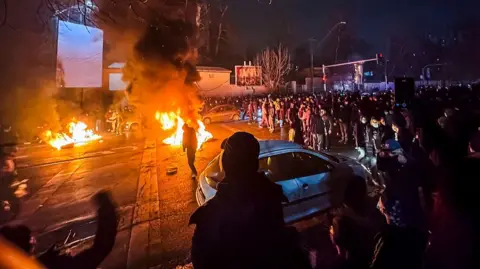
Several videos confirmed as recent by BBC Verify show clashes between protesters and security forces in Mashhad, Iran’s second-largest city.
Masked protesters can be seen taking cover behind bins and bonfires, with a row of security forces in the distance. A vehicle that appears to be a bus is engulfed in flames.
Multiple gunshots can be heard, and what sounds like banging on pots and pans.
A figure standing on a nearby footbridge appears to fire multiple gunshots in several directions as a couple of people take cover behind a fence.
In Tehran, a verified video from Saturday night shows protesters taking over the streets in the Gisha district, the sound of banging on pots in Punak Square, and a crowd marching and calling for the end of clerical rule in the Heravi district.
Iran’s President Masoud Pezeshkian has blamed the US and Israel for the unrest.
“They have trained certain individuals inside the country and abroad, brought terrorists into the country from outside, set mosques on fire, and attacked markets and guilds in Rasht, setting the bazaar ablaze,” he said without providing evidence.
However, footage authenticated by BBC Persian and BBC Verify confirms that Iran’s security officers have been shooting at gatherings of protesters in several areas. They include Tehran, the western Kermanshah province, and the southern Bushehr region.
Multiple verified videos filmed in the centre of the western city of Ilam last weekend also show security forces firing shots towards Imam Khomeini Hospital, where protesters were holding a rally.
Internet access in Iran is largely limited to a domestic intranet, with restricted links to the outside world. But during the current protests, authorities have for the first time severely restricted that too.
An expert told BBC Persian the shutdown is more severe than during the “Women, Life, Freedom” uprising in 2022.
Alireza Manafi, an internet researcher, said the only likely way to connect to the outside world was via Starlink satellite, but warned users to exercise caution as such connections could potentially be traced by the government.
Shah’s son tells protesters: ‘I will soon be by your side’
On Sunday, Reza Pahlavi, the exiled son of Iran’s last shah, who lives in the US and whose return protesters have been calling for, told demonstrators that Trump had “carefully observed your indescribable bravery” in a social media post.
“Your compatriots around the world are proudly shouting your voice,” he wrote, pledging: “I know that I will soon be by your side.”
Pahlavi claimed the Islamic Republic was facing a “severe shortage of mercenaries” and that “many armed and security forces have left their workplaces or disobeyed orders to suppress the people”. The BBC could not verify these claims.
He encouraged people to continue protesting on Sunday evening, but to stay in groups or with crowds and not “endanger your lives”.
In the UK, videos shared on social media appear to show protesters removing Iran’s flag from a balcony on its London embassy on both Saturday and Sunday.
Iran has summoned the UK ambassador in Tehran following the incidents, according to Iranian state media.
The protests have been the most widespread since an uprising in 2022 sparked by the death in custody of Mahsa Amini, a young Kurdish woman who was detained by morality police for allegedly not wearing her hijab properly.
More than 550 people were killed and 20,000 detained by security forces over several months, according to human rights groups.
Additional reporting by Soroush Pakzad and Roja Assadi