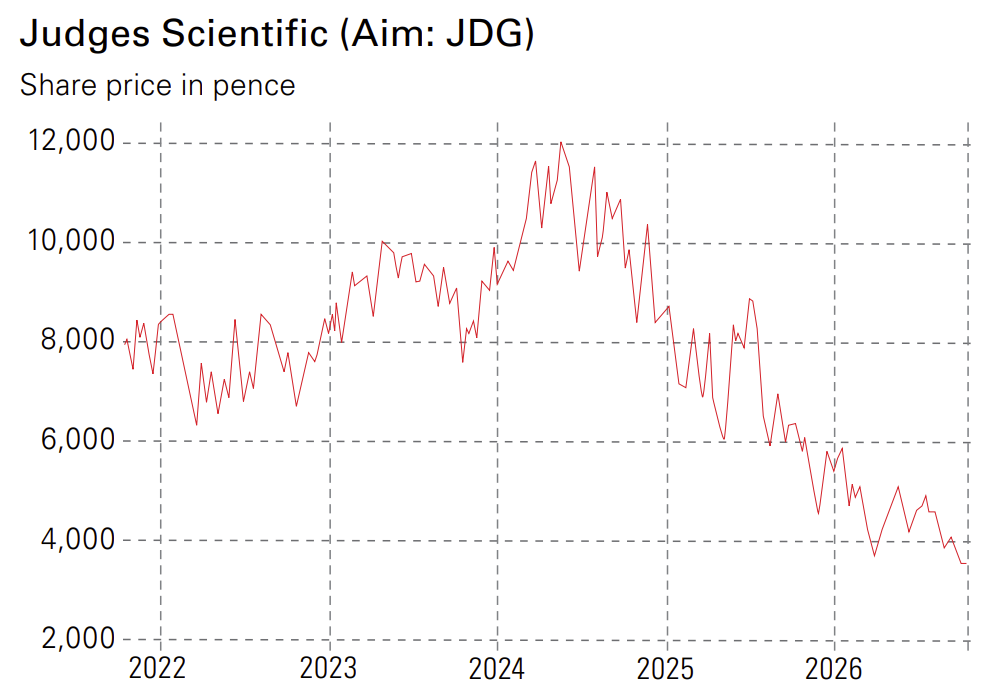
Judges Scientific (Aim: JDG)was once a favourite of the London market. Over the years from March 2004 to March 2024, the shares rose 10,300%, compared with a return of just 160% for the FTSE All-Share excluding dividends. But since reaching an all-time high in 2024, the shares have lost nearly two-thirds of their value. Investors have clearly lost patience with the group, which once commanded a valuation of 40-plus times forward earnings. However, the issues seem to be more cyclical than structural, and the underlying business model is far from broken.
How Judges Scientific profits from niche industries
Judges Scientific isn’t really one single business. The group operates as a collection of businesses acquired over time and owned under one holding company. Former CEO David Cicurel founded and seeded the firm in 2002. It started as an activist investment company, but shifted direction shortly after its initial public offering in 2003 (priced at 95p per share vs the recent peak of 12,000p).
Rather than buying stakes in public equities, Cicurel decided the business would achieve better returns by acquiring whole companies, particularly small firms serving a niche in key scientific and testing end markets. The first entity acquired under this new regime was Fire Testing Technology, which specialises in measuring how different materials react to differing levels of fire and heat. With $3 million in annual sales and an earnings before interest and tax (Ebit) margin of 25%, the deal became the blueprint for further acquisitions.
Start your trial of MoneyWeek today
Get unparalleled financial insight, analysis and expert opinion you can profit from.
Start your trial
Sign up for MoneyWeek’s free twice-daily newsletter.
Join more than 165,000 subscribers and keep yourself informed with latest financial news, insights and expert analysis to help you understand what really matters when it comes to your finances.
Join more than 165,000 subscribers and keep yourself informed with latest financial news, insights and expert analysis to help you understand what really matters when it comes to your finances.
Cicurel and his team continued to build Judges Scientific with similar acquisitions. The template they used and continued to use hasn’t really changed. Judges acquires small, usually owner-operated entities, and leaves them to it. It provides the capital and funding to develop new technology or processes, while the underlying businesses continue to focus on what they do best – serving their customers with small, but vital tools and products.
Latest Videos FromMoneyWeek
A key metric for the group has always been return on tangible invested capital (ROTIC), a measure of profit for every £1 invested in tangible assets. For Cicurel, any business with a ROTIC below 20% was a no-go and, as a group, Judges has tended to earn a ROTIC of 20%+ across the 23 core businesses it owns today.
Why is Judges Scientific struggling?
After nearly two decades of near-continuous growth, Judges Scientific’s growth story stalled in 2024. After its Geotek subsidiary reported delays to a key high-margin project, sales ended the year 2% lower. In November of that year, the firm also issued a profit warning, the only one in its history. Profit fell 21% for the full year. Still, three new businesses were acquired across the holding firm and via subsidiaries as the group continued to execute on its acquisition strategy.
In 2025, clouds continued to gather. These included the hit to global research spending following US budget cuts, higher operating expenses and a slowdown in orders from China. North American revenue fell 25% overall. Net profit declined from £22 million in 2024 to £21 million in 2025. At the end of November 2025, Cicurel also announced he would step down as head of the business in February 2026, to be succeeded by former group business development director Tim Prestidge. The group’s long-standing CFO also said he would step down in September 2027. Investors didn’t hang around to find out how Judges would navigate the transition. Stock sales pushed prices down 50% from their all-time high in 2024 to the end of 2025.
Unfortunately for the new CEO, the outlook doesn’t look set to improve anytime soon. Revenue in the first half of the fiscal year fell 21% year on year to £55.7 million, with adjusted pre-tax profit down 75%. Order intake fell 12% in the first half, driven by lower demand from the US and China and softer sales from renewable energy customers. However, Judges says momentum has picked up since the period ended, with order intake running just 1% behind the levels of the prior year.
Judges Scientific is priced for perfection
(Image credit: Future)
Judges Scientific’s underlying business performance tells one story, but it’s also worth noting that the shares have rerated substantially over the past two years. In 2024, before the recent sell-off began, the shares traded at a forward price-to-earnings ratio (P/E) of around 43, a premium multiple by any yardstick. After the recent decline, the shares are trading at just 19 times forward earnings, a much more realistic multiple, but arguably still a bit high for a zero-growth business.
Still, it’s clear the company is suffering from cyclical, not structural issues. Underlying end markets are robust and demand for scientific equipment hasn’t vanished. Granted, it will take time for funding to return to the sector after budget cuts, but Judges’ underlying businesses are still investing, developing the cutting-edge kit that’ll be required when funding returns.
What’s more, Judges Scientific has the cash to buy peers that might also be struggling and don’t have access to the same capital reserves. The group has also extended its banking facilities to 2030, which will underpin its ability to keep growing through its buy-and-build strategy. Net debt of £41 million is equivalent to roughly 1.9 times earnings before interest, tax, depreciation and amortisation (Ebitda), giving headroom for further borrowing. Most of Judges’ end markets are highly fragmented, served by smaller owner-operated businesses that may not survive alone.
Analysts at Berenberg say the group’s margins will stabilise and sales will improve next year as funding and spending recover. They’ve then pencilled in a small recovery in 2028, before growth really returns in 2029. Based on these forecasts, now could be a good time to start accumulating shares in this one-of-a-kind business, which is going through a rough patch.
This article was first published in MoneyWeek’s magazine. Enjoy exclusive early access to news, opinion and analysis from our team of financial experts with a MoneyWeek subscription.