
This post was originally published on this site.
Kerena Cobbina

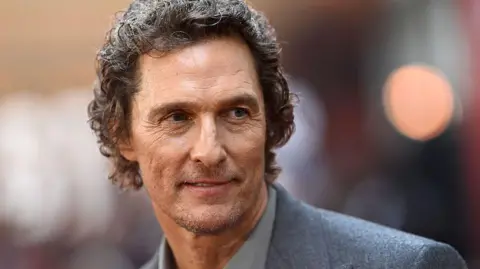
Oscar-winner Matthew McConaughey has trademarked his image and voice to protect them from unauthorised use by artificial intelligence (AI) platforms.
Clips including his famous catchphrase “alright, alright, alright” from the 1993 film, Dazed and Confused, have been registered to the United States Patent and Trademark Office database, the Wall Street Journal (WSJ) reports.
It is the first time an actor has attempted to use trademark law to protect their likeness from AI misuse, his lawyers and an expert said.
Stars across Hollywood and the music industry including Scarlett Johansson and Taylor Swift have endured a wave of fake video, audio and images online, created by AI tools.
Lawyers for the Magic Mike star told the WSJ they had no current examples of McConaughey’s likeness being manipulated by AI, but hoped the trademarks could be used broadly against any unauthorised copies of him.
A secondary aim would be to “capture some of the value that is being created with this new technology”, Kevin Yorn – one of the lawyers representing McConaughey – told the AFP news agency.
“My team and I want to know that when my voice or likeness is ever used, it’s because I approved and signed off on it”, McConaughey said via email to the newspaper.
“We want to create a clear perimeter around ownership with consent and attribution the norm in an AI world”.
Several clips were registered by the commercial arm of the Just Keep Livin Foundation, a non-profit organisation created by the Dallas Buyers Club actor and his wife Camila, according to AFP.
Alina Trapova, an assistant professor in copyright law at University College London, also believes it to be first time an actor has attempted to use trademark law to their benefit against AI.
Trapova has worked on copyright and AI for more than eight years. She told the BBC that AI is a big problem for celebrities, saying that they may object to unauthorised AI “due to reputational reasons”, but for Hollywood stars it “is often a case of missed licensing opportunities”.
She said celebrities are experimenting with different forms of protection as “unauthorised commercialisation” of their likeness in the forms of deepfakes becomes “more and more challenging in the age of AI”.
McConaughey is not a hardline opponent of generative AI.
He has a stake in ElevenLabs, a software company specialising in AI voice modelling “for several years now”, according to the 56-year-old.
The company has created an AI audio version of the ‘Interstellar’ actor, with his permission.
Dr Sandra Wachter, professor of technology and regulation at the University of Oxford, says she would not be surprised if others in the creative industries did the same as McConaughey in the future.
“It is simple for companies to take your work and train a model to do your job. It is comparatively difficult for you to protect your work in the first place,” she told the BBC.
AI images and deepfakes are of growing concern in the entertainment world.
In 2024, Scarlett Johansson said she was left “shocked” and “angered” after OpenAI launched a chatbot with an “eerily similar” voice to her own.
OpenAI removed the voice, but insisted that it was not meant to be an “imitation” of the Avengers star.
In June 2025, Disney and Universal sued AI firm Midjourney over its image generator, which the Hollywood giants alleged was a “bottomless pit of plagiarism”.
Also last year, an AI video generator on Elon Musk’s X social media platform was accused of making “a deliberate choice” to create sexually explicit clips of Taylor Swift without prompting.
Grok Imagine’s “spicy” mode “didn’t hesitate to spit out fully uncensored topless videos” of the pop star without being asked, the Verge reported.